Get Full Government Meeting Transcripts, Videos, & Alerts Forever!
Get email alerts on the Flag Policy IEAA topic
No spam. Unsubscribe anytime.
Parents and residents urge board to reject broad flag-display policy, citing free-speech and privacy concerns
Summary
During public comment Goochland County residents urged the school board to reconsider a proposed IEAA flag-display policy they say would ban pride and other expressive flags, raise First Amendment risks and could conflict with FERPA if board members seek student records.
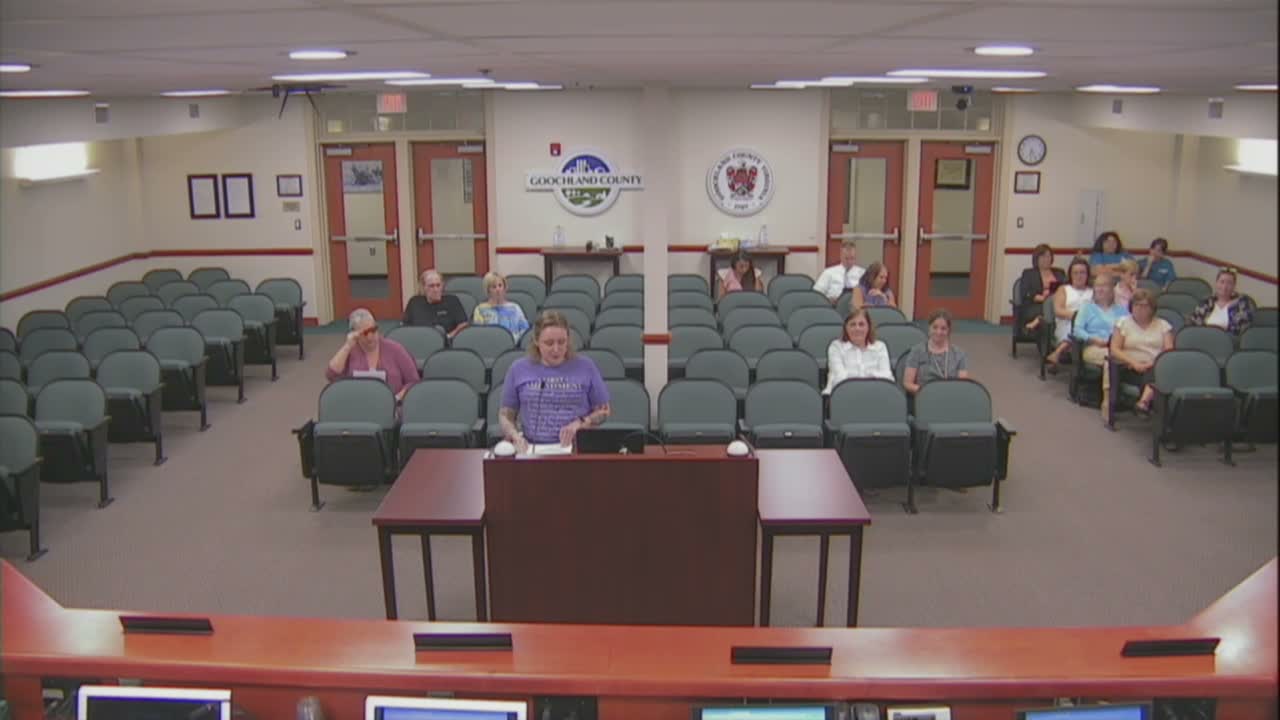
Public commenters at the Goochland County School Board meeting on Monday urged the board to delay or revise a proposed IEAA flag-display policy, saying the draft is overly broad, risks viewpoint discrimination and could expose the division to costly litigation.
Kelly Crockett, a parent at Goochland High School, said the draft policy is "unnecessary, unconstitutional, and it exposes GCPS to civil lawsuits," and warned that any policy narrowly banning particular flags risks violating students' speech rights. "This is a frivolous attempt to suppress constitutional rights and individuality, and it will not succeed," she said.
Dr. Laura Kastner asked the board to explain the problem the policy is intended to solve and questioned whether the measure is meant to target symbols such as the gay pride flag. "Is this about banning the gay pride flag? Is this about Palestine versus Israel?" she asked, urging the board to avoid bringing "culture wars" into classrooms.
Katie Brooking, a District 2 parent, said the draft specifically would bar symbols that many in the community view as protected expression. "Flags that wouldn't be allowed per the new policy include pride flags, Black Lives Matter flags, and the Palestinian flag," she said, and cited Supreme Court precedent including Tinker v. Des Moines and Pickering to argue for caution.
Lauren Comstock accused the board of using policy actions to target particular groups and said she will not permit board access to her children's records if the policy passes. Several speakers also warned that attempts to grant board members broader access to student records could conflict with federal privacy law (FERPA).
Board members responded that the version before them was a first reading and informational: the stated purpose is to "remove distractions from learning" and to promote nonpartisanship. The chair and others said the policy will be discussed further by the policy committee and noted that the administration cited Virginia Code language (subsection 22.1-289.01) when describing student-record access. The board did not vote on the policy at the meeting.
The public comments placed the proposed IEAA policy squarely in the center of a broader debate about how schools balance inclusive signals of safety and free expression with stated goals of minimizing in-classroom disruptions. Next steps: the draft will move to policy committee for further review and the first-reading status means no policy change has been enacted yet.