Get Full Government Meeting Transcripts, Videos, & Alerts Forever!
Get email alerts on the Sb103 Rate Making topic
No spam. Unsubscribe anytime.
Senate committee hears industry proponents for SB103 to shorten rate cases and speed large-customer deals
Summary
The Senate Public Utilities Committee heard proponent testimony on Senate Bill 103, which would reduce regulatory lag by allowing forward (forecasted) test years, requiring rate-case orders within a year, creating an expedited review for special contracts with large customers, and establishing a mandate rider for compliance costs. No committee vote was taken.
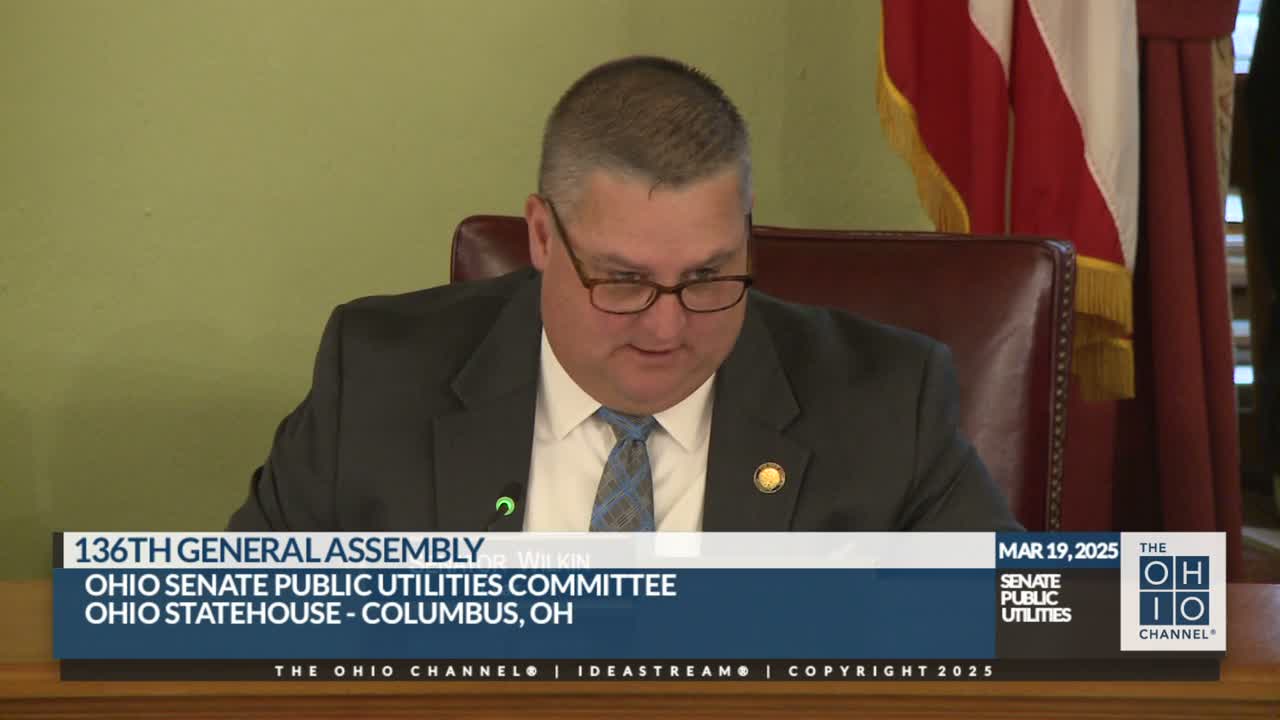
COLUMBUS — The Senate Public Utilities Committee held a second hearing on Senate Bill 103, hearing proponent testimony from gas utilities, industry trade groups and regulatory experts who said the bill would reduce regulatory lag, improve access to capital and support economic development without eliminating consumer safeguards.
“All Senate Bill 103 accomplishes is leveling this playing field,” Bob Heidorn, president and CLO of Columbia Gas of Ohio, told the committee, summarizing four core changes he said would modernize Ohio rate making: adoption of forward test years, rate-case orders within one year, an expedited framework for special contracts with large customers, and a mandate rider to recover compliance costs.
Heidorn and other witnesses warned that lengthy rate cases and “stale” historical test years make Ohio less attractive to investors. Heidorn told senators Columbia annually invests more than $500,000,000 in its pipeline system and that regulatory lag “diminishes cash flow and financial performance,” which can raise borrowing costs for utilities and ultimately customers.
Industry witnesses described guardrails they say are included in SB103. Jimmy Stewart, president of the Ohio Gas Association, outlined three objective criteria for special-contract approval he said the bill requires: no financial risk to existing customers, no subsidy paid by other ratepayers, and a contribution from large-load customers that benefits the system. “With these protections, Ohio’s natural gas utilities take the risks associated with such large investments while also earning a return more appropriate for taking those larger risks,” Stewart said.
Greg White, a former executive director of the National Association of Regulatory Utility Commissioners, said timely orders and modern test years are broadly used by other states and can improve credit metrics for utilities. “The problem is not with the commissioners. It’s with the process that allows for excessive regulatory lag,” White said, adding that legislative direction typically sets policy while commissions implement it.
John Quackenbush, a former state regulator and investment analyst, told senators investors value timely, predictable cost recovery. He said lower regulatory risk generally narrows the spread utilities pay over U.S. Treasuries and cited examples of states where regulatory environments affected credit ratings and capital allocation.
Witnesses argued SB103 is not untested: multiple neighboring states have adopted forward or multi-year frameworks, they said, and SB103 intentionally retains PUCO auditing and due-process protections to ensure only used-and-useful plant is recovered. The bill also would set statutory timelines for PUCO action on both ordinary rate cases and expedited review of large-customer special contracts.
No opponent testimony was offered at the hearing and the committee did not take a vote on SB103. The second hearing concluded after industry witnesses from Columbia Gas, the Ohio Gas Association, the Ohio Oil and Gas Association and the Ohio Chamber of Commerce spoke in favor of the bill and answered senators’ questions. The bill remains under committee consideration.