Get Full Government Meeting Transcripts, Videos, & Alerts Forever!
Get email alerts on the Ev Charging Policy topic
No spam. Unsubscribe anytime.
Senator proposes temporary limit on utility-owned EV chargers to spur private investment
Summary
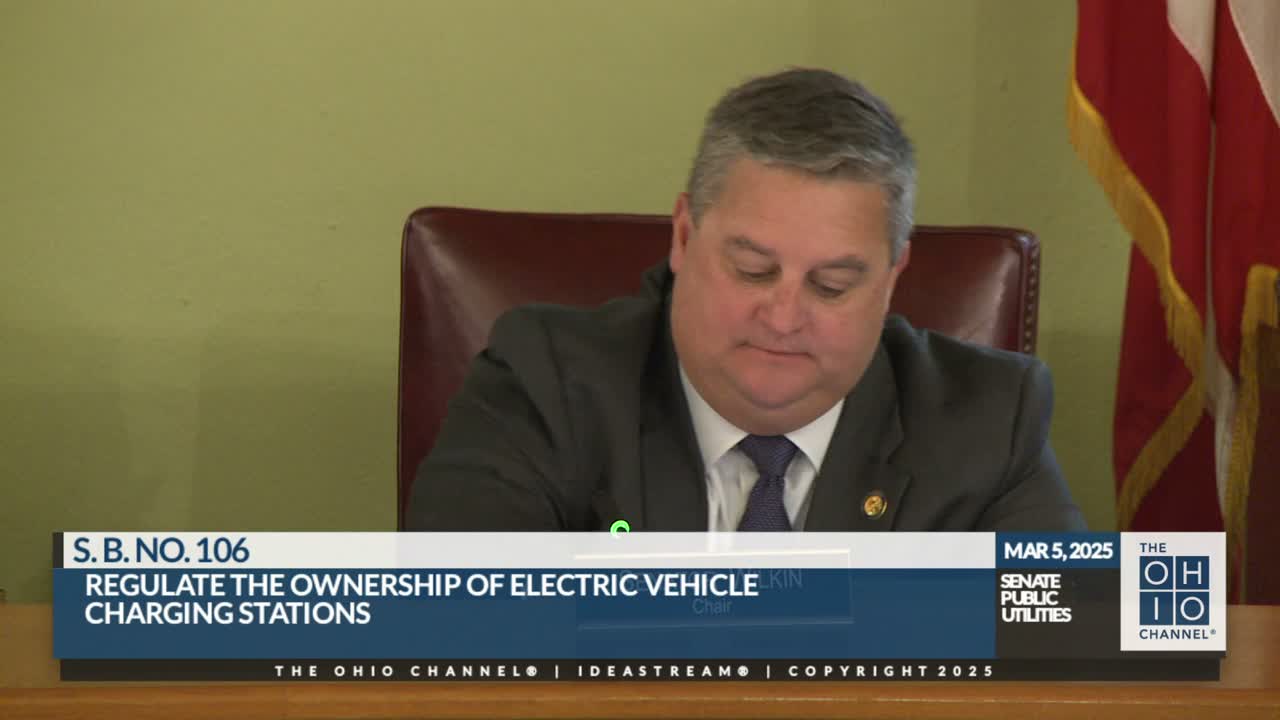
Vice Chair Reineke presented SB 106 to deter electric distribution utilities from entering the EV fast-charging market for five years (unless through a non-ratepayer-funded subsidiary), to give private businesses first opportunity and use NEVI federal funding; committee asked about prior bills and market certainty.
At a Senate Public Utilities Committee hearing, Vice Chair Reineke sponsored Senate Bill 106 to remove regulatory barriers and encourage private investment in Ohio's electric vehicle (EV) charging market.
Reineke told the committee Ohio should create a “sensible policy structure” enabling private businesses to build EV fast-charging infrastructure and said the state can leverage more than $140,000,000 in federal NEVI funds over five years. SB 106 would prohibit electric distribution utilities (EDUs) from owning or operating EV charging stations for five years unless through a separate subsidiary that lacks access to ratepayer funding. After five years, EDUs could petition the Ohio PUCO to own charging stations; the PUCO would retain authority to approve or reject such petitions. The bill would also give private businesses a right of first refusal for service in designated areas of last resort.
Committee members sought context. Senator Smith asked whether a similar bill had been introduced in a prior General Assembly; Reineke said a related measure (SB 266) was introduced previously. Senator Romanchuk pointed to market actors such as Tesla and asked why intervention was needed; Reineke responded that regulatory uncertainty discourages private investment and that the bill provides certainty and a pathway for private entrants including small businesses in rural areas.
The hearing ended with committee questions and no formal vote recorded.