Get Full Government Meeting Transcripts, Videos, & Alerts Forever!
Get email alerts on the Puco Nominating Reform topic
No spam. Unsubscribe anytime.
Senators pitch PUCO nominating-council reforms after HB 6 fallout
Summary
Senators introduced SB 99 to change how Public Utilities Commission of Ohio (PUCO) commissioners are nominated: adding consumer and minority representation on the nominating council, requiring public interviews, limiting terms, and restricting nominees with prior ties to regulated entities. The bill received sponsor testimony and questioning; no vote was taken.
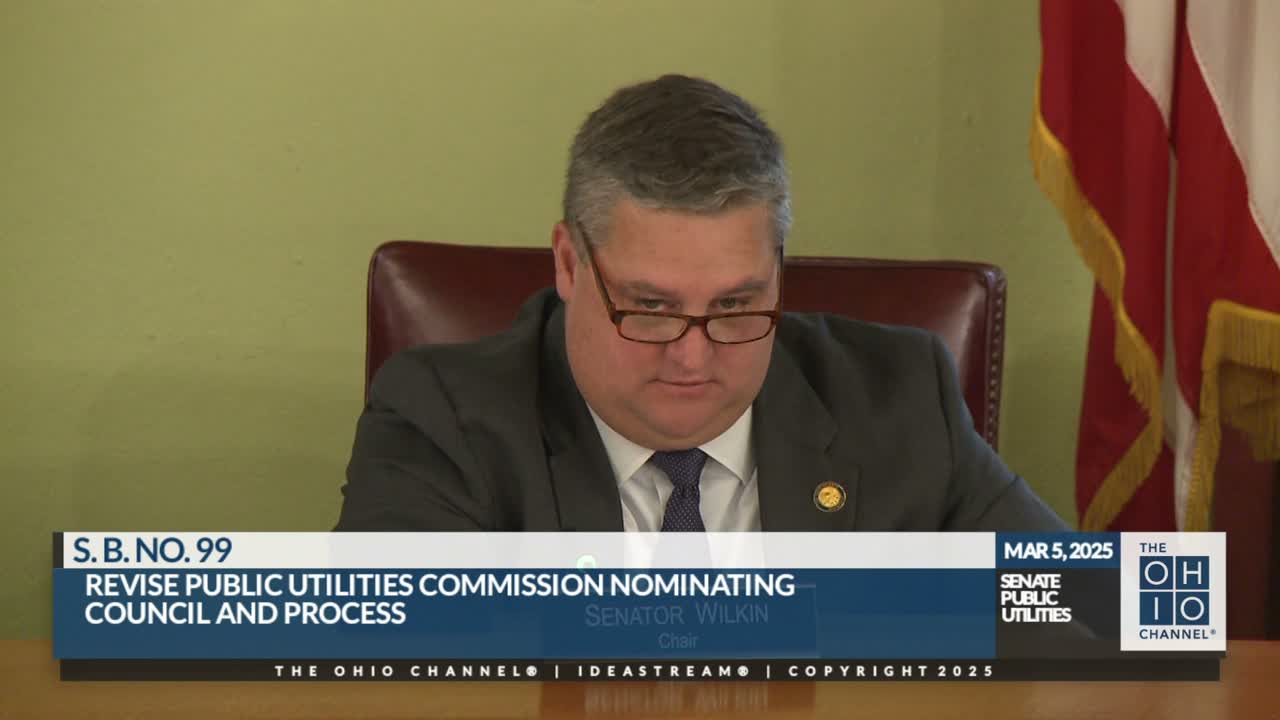
Senators presented Senate Bill 99 at a first hearing in the Senate Public Utilities Committee, saying the measure would revamp the commission nominating council to guard against conflicts of interest that surfaced after the HB 6 scandal.
A sponsor who testified said SB 99 would require the governor to choose at least one consumer representative from a list provided by a Consumers Council, add three members to the nominating council (including a minority communities representative and two public members appointed by minority leaders in each chamber), require public interviews of nominees, and limit council member terms to reduce entrenchment. The sponsor urged the changes to ensure the Public Utilities Commission of Ohio (PUCO) remains a “nonpartisan, unbiased regulator.”
Joint sponsor Senator Edson told the committee the reforms aim to increase transparency and public confidence. “We must ensure that the PUCO remains a nonpartisan, unbiased regulator,” he said, adding that the bill is intended to restore integrity after the HB 6 controversy.
Committee members pressed for specifics about conflicts of interest and disclosure. Senator Smith referenced recent reporting and an editorial alleging that a PUCO commissioner holds ownership interests in matters currently before the commission and asked whether disclosure is sufficient or whether outright prohibitions are needed. The testimony acknowledged the need for disclosure and recusal and said the bill seeks to minimize ties to regulated entities, though speakers noted it can be difficult to eliminate all prior connections given the narrow expertise required for the role.
The hearing record shows committee questioning but no formal vote; the clerk and chair recorded the proceeding as the first hearing on SB 99. The sponsor said he would follow up on implementation details if the committee requested them. The committee took no action to advance the bill during this session.