Get Full Government Meeting Transcripts, Videos, & Alerts Forever!
Get email alerts on the Hb96 Overview topic
No spam. Unsubscribe anytime.
Senate higher education hearing spotlights workforce programs, scholarships and governance changes in HB 96
Summary
Lawmakers heard hours of testimony on House Bill 96 funding and policy provisions, including requests for internship and research funding, a foster-youth scholarship, computer-science teacher training, literacy and autism program pilots, and contested language on online program oversight and curriculum control.
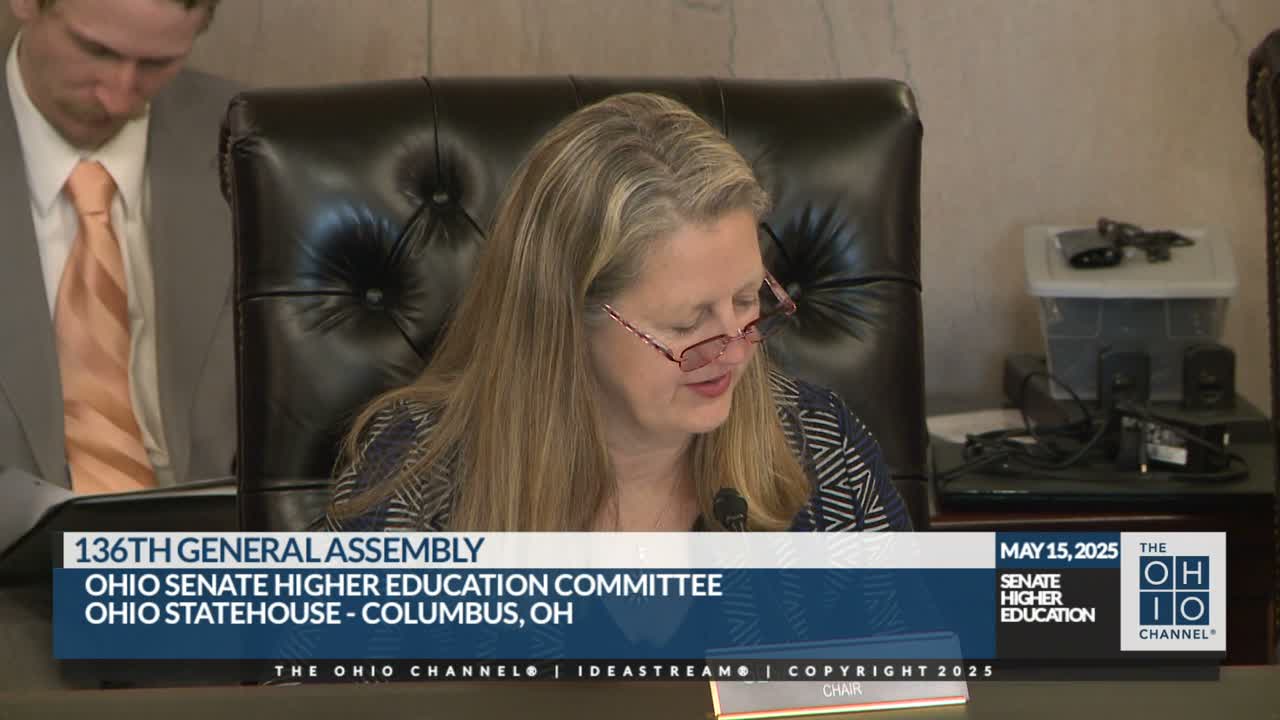
The Senate Higher Education Committee held a final informal hearing on higher-education provisions of amended substitute House Bill 96, hearing from dozens of advocates, college leaders and former service members who urged targeted investments in workforce and student supports.
Witnesses pressed the committee on a broad mix of budget requests and policy changes. Cassie Barlow, a retired Air Force colonel and president of SOTC, asked lawmakers to add a $1 million annual Ohio Intern Academy line to the Ohio Department of Higher Education’s K-16 budget to expand a paid internship model that pairs employers with high-school students and shares wages 50/50 with employers. Mark Baartman, a retired major general, defended continued funding for the Ohio Federal Research Network, citing previous rounds’ returns and student engagement. Several nonprofit leaders sought modest line items: Seeds of Literacy requested $250,000 per year to expand adult literacy services; Success for Autism asked for $300,000 per year to train general-education teachers in a neurodevelopmental model; and the Maltz Museum sought $1.2 million to broaden Holocaust education programming.
Former foster youth and advocates described gaps that stop students from finishing college. Adam Hassan, a Columbus State student and foster-care alumnus, and Gabriela Craft of Foster Action Ohio urged lawmakers to adopt a Foster to College Scholarship Act that would function as a last-dollar program covering cost-of-attendance items such as room and board and include navigators to connect emancipating youth with benefits. Kim Eckhart, a volunteer with lived-experience advocates, said amendment SC1360957 had been drafted to implement the proposal.
K-12 and teacher training proposals drew support. Middle-school STEAM teacher Sarah Bailey and Julia Wynne of co.org urged the committee to retain $8 million proposed for TeachCS to help credential and train teachers to expand computer-science access, especially in small and rural districts.
The hearing also featured two contested policy topics. Jeff Moritz urged approval of an amendment that would permit benefactors limited legal standing to enforce endowment agreements after alleging long-running breaches by a university; he described examples in which promised scholarships were not delivered. And Adam Kissel of the Heritage Foundation warned that HB96 language regulating OPM (online program manager) contracts and requiring state review and disclosure could overreach, stigmatize private partners and trigger fiscal watch consequences for institutions.
Faculty governance and curriculum control drew pointed testimony. Erin Beaton and Richard Finley Fletcher raised concerns that proposed BORCD language would unduly expand boards’ control over curriculum decisions and could bypass traditional faculty shared governance. Several speakers urged the committee to protect faculty roles and practical feasibility when regulating curricula.
No formal votes were taken. The committee recorded dozens of written testimonies and concluded the informal hearing; no immediate committee actions were announced.