Get Full Government Meeting Transcripts, Videos, & Alerts Forever!
Get email alerts on the Higher Education Budget topic
No spam. Unsubscribe anytime.
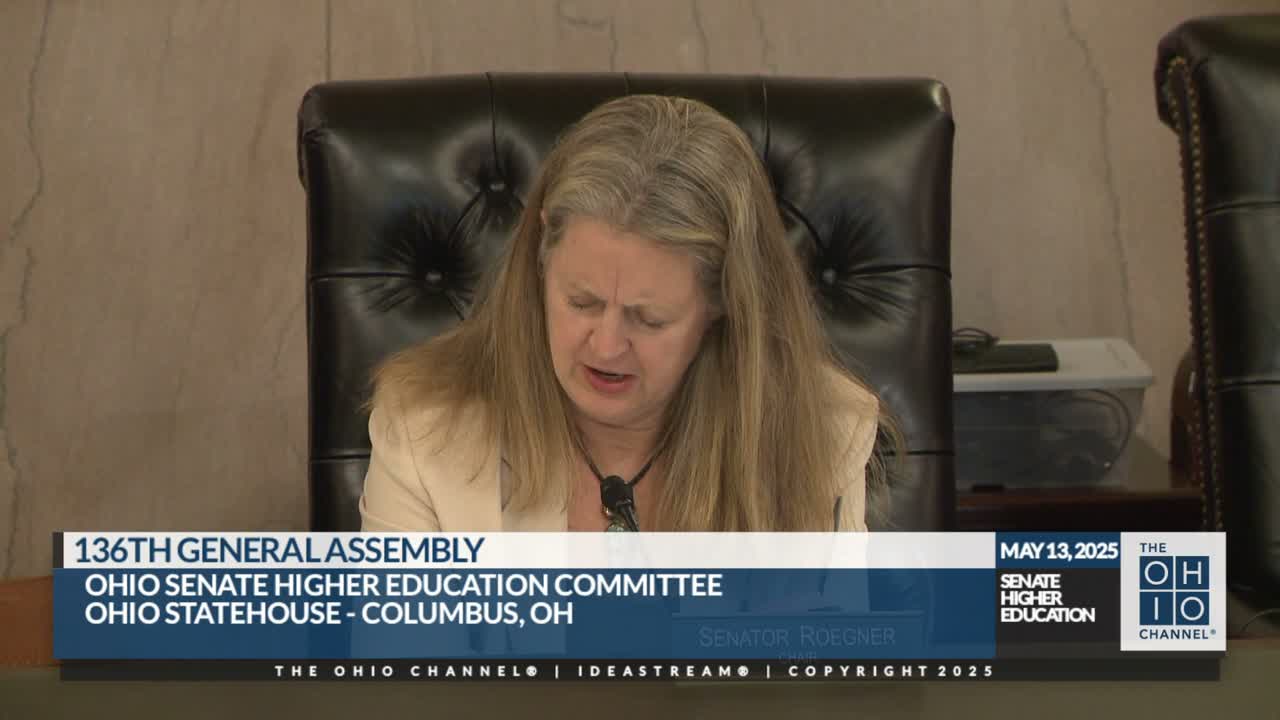
Universities, community and career colleges urge preserving 2% SSI increase and parity for grants during HB 96 hearings
Summary
Representatives from community, career, independent and public universities urged the Senate Higher Education Committee to retain a House-proposed 2% annual increase in State Share of Instruction, seek parity for the Ohio College Opportunity Grant, and avoid policy mandates that would extend Senate Bill 1 requirements to private institutions.
Representatives of Ohio’s higher-education sectors told the Senate Higher Education Committee they want the Senate to preserve the House-proposed 2% annual increase in the State Share of Instruction (SSI) and to avoid extending new operational mandates to private institutions.
Avi Zafini, president and CEO of the Ohio Association of Community Colleges, said the 2% SSI increase is "a direct and efficient way to support our community colleges" and asked the committee to preserve it. Zafini added that, "if you're not able to maintain the full 2 percent increase, we would respectfully ask that the general assembly grant our community college boards of trustees the authority and additional flexibility to increase tuition by up to $10 per credit hour, if absolutely necessary." She also urged the committee to implement outcome-based SSI changes carefully so rural or lower-wage regions are not penalized and recommended streamlining duplicative reporting by allowing data already in the HEI system to autofill required state reports.
Kat Trauthals, executive director of the Ohio Michigan Association of Career Colleges and Schools (OMAXX), urged parity for career-college students in the Ohio College Opportunity Grant (OCOG). Trauthals said career colleges enroll more than 56,581 students annually and reported that "for the 24, 25 academic year, career college students are allocated $2,000 per student in OCOG funding relative to the cost of college tuition — that is not a lot of money." She highlighted job-placement outcomes — "77 percent of our graduates secured employment within 90 days of graduation" — and asked the committee to ensure OCOG awards do not discriminate against students who choose career colleges.
C. Todd Jones, president and general counsel of the Association of Independent Colleges and Universities of Ohio (AICUO), warned that House changes to the governor's merit scholarship program (GMS) tie scholarships to provisions in Senate Bill 1 and require institutions to accept the top 10% of graduates. "The final version inexplicably chose to tie student scholarships to the requirements of certain provisions of Senate Bill 1 and to automatically accept the top 10% of Ohio's graduating class," Jones said, arguing the mandates would impose logistical and financial burdens on small private institutions that receive no operating state dollars.
Laura Linnice, president and CEO of the Inter-University Council, said public universities support the 2% SSI increase to sustain research and workforce capacity. She framed the request as an economic investment, stating that "for every $1 the state invests, it yields 4.6 in tax revenue and public savings," and noted workforce needs including engineers, IT professionals and teachers that rely on public university pipelines.
Katharine Fell, president of the University of Findlay, emphasized the impact of proposed SB1-like mandates on small private campuses, saying such requirements would divert resources from student services and local partnerships; she reported retention and employment figures for her campus, including a reported 90% retention rate from fall 2024 to spring 2025.
Committee members asked for additional data during question-and-answer exchanges. Senator Timken requested debt and repayment data for career-college graduates; Trauthals said she would collect and submit that information. Senators probed the practical effects of tuition authority and reporting requirements; witnesses generally favored preserving SSI and streamlining compliance burdens. The chair closed the informal hearing and scheduled one more budget hearing with public testimony for Thursday, May 15.
The witnesses provided a mix of policy requests (preserve 2% SSI; parity in OCOG; streamline reporting) and cautions about expanding regulatory mandates to private institutions without funding. The committee did not take votes on budget language during this session.