Get Full Government Meeting Transcripts, Videos, & Alerts Forever!
Get email alerts on the Housing Investors Policy topic
No spam. Unsubscribe anytime.
Ohio senator introduces bill to discourage large investors from hoarding single‑family homes
Summary
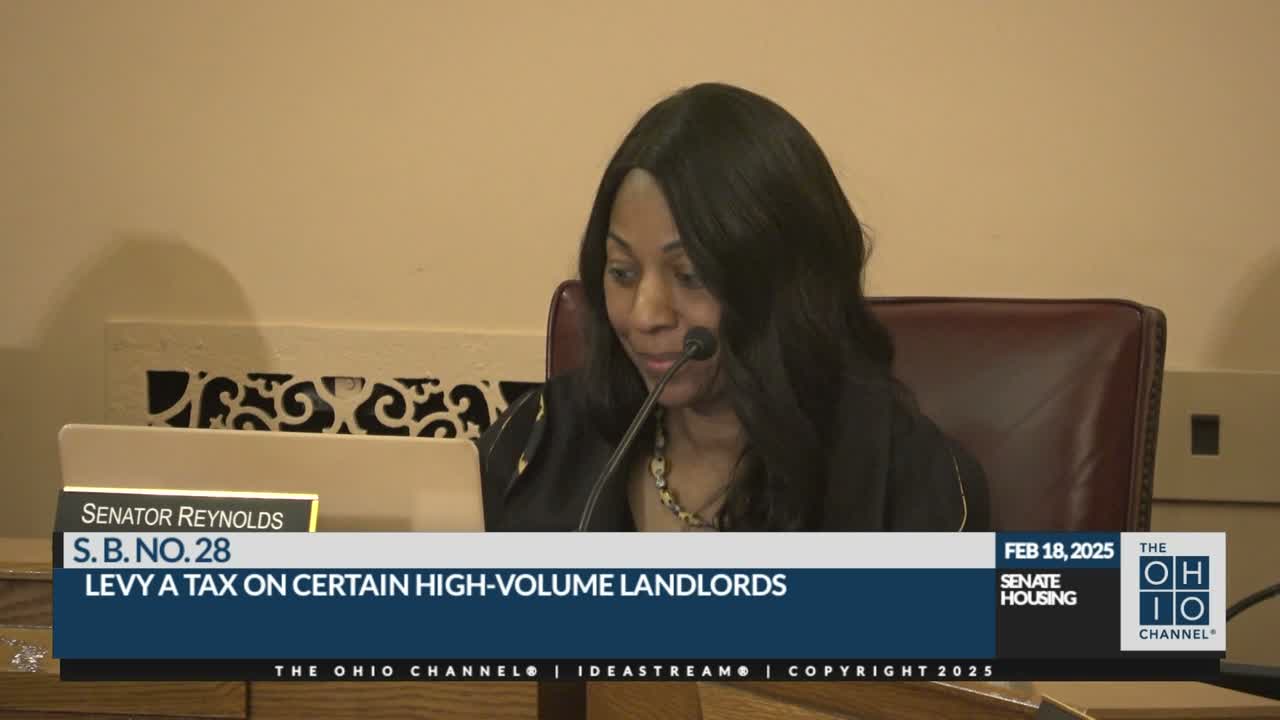
Senator Blessing presented Senate Bill 28 to the Senate Committee on Housing, proposing a monthly charge on large institutional owners of 1‑to‑3‑unit single‑family homes intended to force sell‑offs and restore owner‑occupied opportunities; members probed thresholds, verification and unintended effects.
Senator Blessing on the Senate Committee on Housing said Thursday he introduced Senate Bill 28 to curb large institutional investors who buy single‑family starter homes and convert them to long‑term rentals, arguing the practice reduces pathways to homeownership and drives up rents and prices.
"Simply put, families should not have to compete against edge and pension funds for a basic necessity like housing," Blessing said in sponsor testimony, describing firms that make cash offers, avoid appraisals and minimize capital expenditures to maximize rental returns.
The bill would impose a financial charge intended to eliminate the business case for large portfolios of single‑family homes. Blessing described the measure in testimony as a "charge of $2,000 per month per property" levied on any entity that surpasses a county‑level ownership threshold for certain 1‑to‑3‑unit single‑family homes; he said the proposal excludes apartments, condominiums and public or nonprofit entities such as land banks and port authorities. "That is too much to pass on to tenants, and it destroys the business case for buying up properties in this fashion," he said.
Supporters framed the bill as a targeted response to concentrated ownership that can be modest in statewide share but severe locally. Blessing pointed to neighborhoods where a single investor owns a large share of homes and cited litigation in Cincinnati involving an investor reported to own thousands of single‑family properties in Hamilton County.
Committee members pressed on implementation and consequences. Senator Brenner asked whether the measure could inadvertently affect builders who temporarily hold lots or inventory and challenged how the state could reliably identify ultimate owners behind pass‑through LLCs. "How do you find out or how do you know that there are 3,000 homes owned by 1 institutional investor even though there was a lawsuit?" Brenner asked.
Blessing acknowledged verification is time consuming, saying local officials — county auditors, port authorities and city staff — have pieced ownership records together in prior local analyses. He also said the bill could be adjusted on numeric thresholds and that he is open to alternatives that preserve owner‑occupancy goals while limiting monopolization.
Other senators raised alternatives to the bill, including zoning changes, incentives for owner‑occupied builders and reviewing federal or state tax provisions that may make large‑scale ownership more attractive. Chair Reynolds and others suggested exploring ways to partner with institutional owners on shared‑equity or co‑ownership models; Blessing countered that similar models in the U.K. had unintended outcomes, including fee structures that eroded homeowners' interests.
No vote was taken on Senate Bill 28 at the hearing. The committee did not adopt or amend the measure during the session; members asked staff to consider data‑collection methods, potential threshold levels and possible exemptions to reduce unintended impacts on local builders.
Next steps: The bill remains at the sponsor testimony stage; committee members signaled interest in follow‑up briefings on ownership data and on drafting threshold and exemption language.