Get Full Government Meeting Transcripts, Videos, & Alerts Forever!
Get email alerts on the REDS Housing Accelerator topic
No spam. Unsubscribe anytime.
Sen. Reynolds proposes 20-mile "REDS" zones and $700 million threshold to unlock housing grants
Summary
Senate Bill 184 would create Residential Economic Development Districts (REDS) and a Housing Accelerator Fund that awards grants to counties, townships and municipalities within 20-mile zones around qualifying projects that attract at least $700 million in private investment.
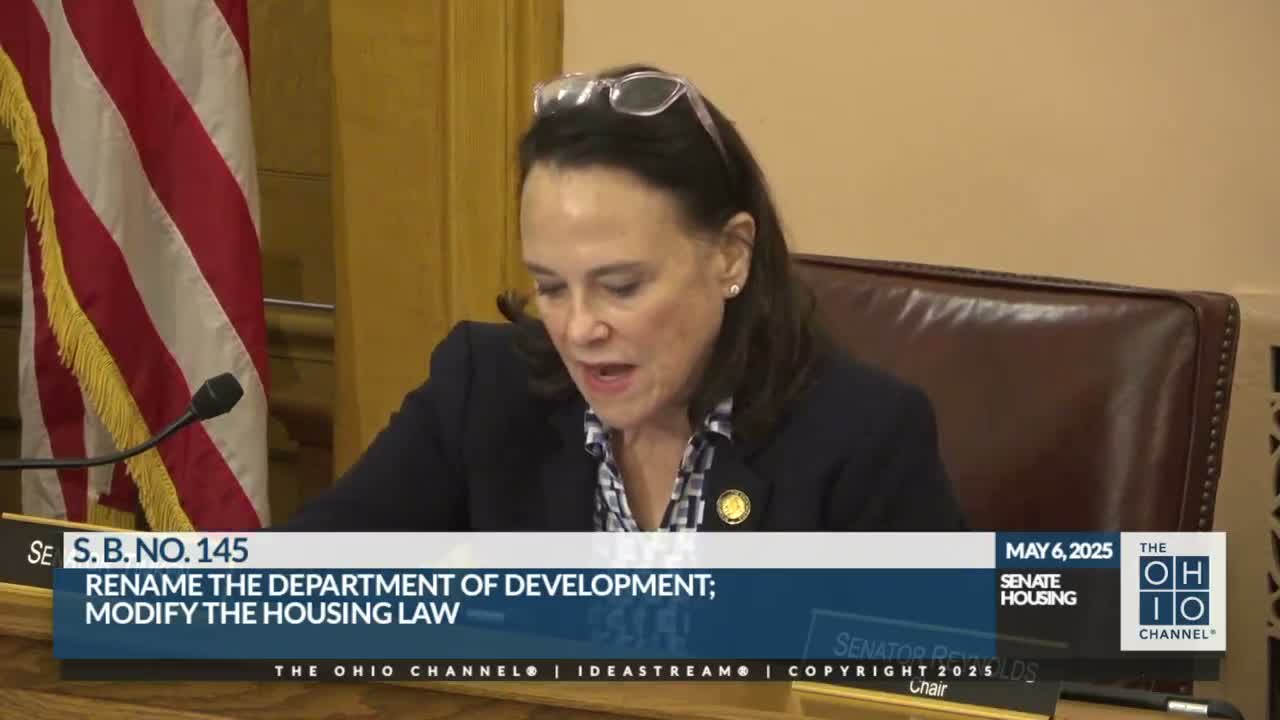
Senator Michelle Reynolds presented Senate Bill 184 to establish Residential Economic Development Districts, or REDS, and a Housing Accelerator Fund intended to spur workforce housing near large private investments. "The program establishes a 20 mile development zone around single project investment sites that have attracted at least $700,000,000 in private investment," Reynolds said, noting JobsOhio estimates roughly 20 to 25 project sites would qualify statewide under those criteria.
Under the bill, the Housing Accelerator Fund (held in the state treasury) would provide grants to eligible counties, townships and municipal corporations inside REDS to address infrastructure barriers to housing: sewer and water tap fee reductions, extension of water and sewer service, traffic studies, roadway improvements, site preparation and other infrastructure costs. Grants could also be used for capital to acquire and ready sites and to provide financial assistance for housing-related infrastructure and public-safety needs arising from population growth.
SB 184 includes eligibility and prioritization criteria: a qualifying major economic project must be reasonably expected to create or retain jobs and commit at least $700 million in private investment, and the Department of Development (as restructured under SB 145) would give preference to jurisdictions that adopt pro-housing zoning, including higher density, smaller lots and reduced setbacks. Reynolds said the bill would not mandate zoning reform but would create financial incentives and model zoning standards to guide communities.
The sponsor described manufactured and modular housing as an explicit option to speed development, noting such units can be built faster and at lower per-square-foot cost while meeting safety standards. Committee members asked whether the $700 million threshold would concentrate benefits in Central Ohio; Reynolds said JobsOhio revised mapping from a 30-mile to a 20-mile radius and that she would share a map with the committee and host an interested-party meeting on May 12 at 3:00 p.m.
No formal action was taken on the bill at this hearing.