Get Full Government Meeting Transcripts, Videos, & Alerts Forever!
Get email alerts on the Housing topic
No spam. Unsubscribe anytime.
Business groups, builders back bill to create 20‑mile housing 'RED' zones around major projects
Summary
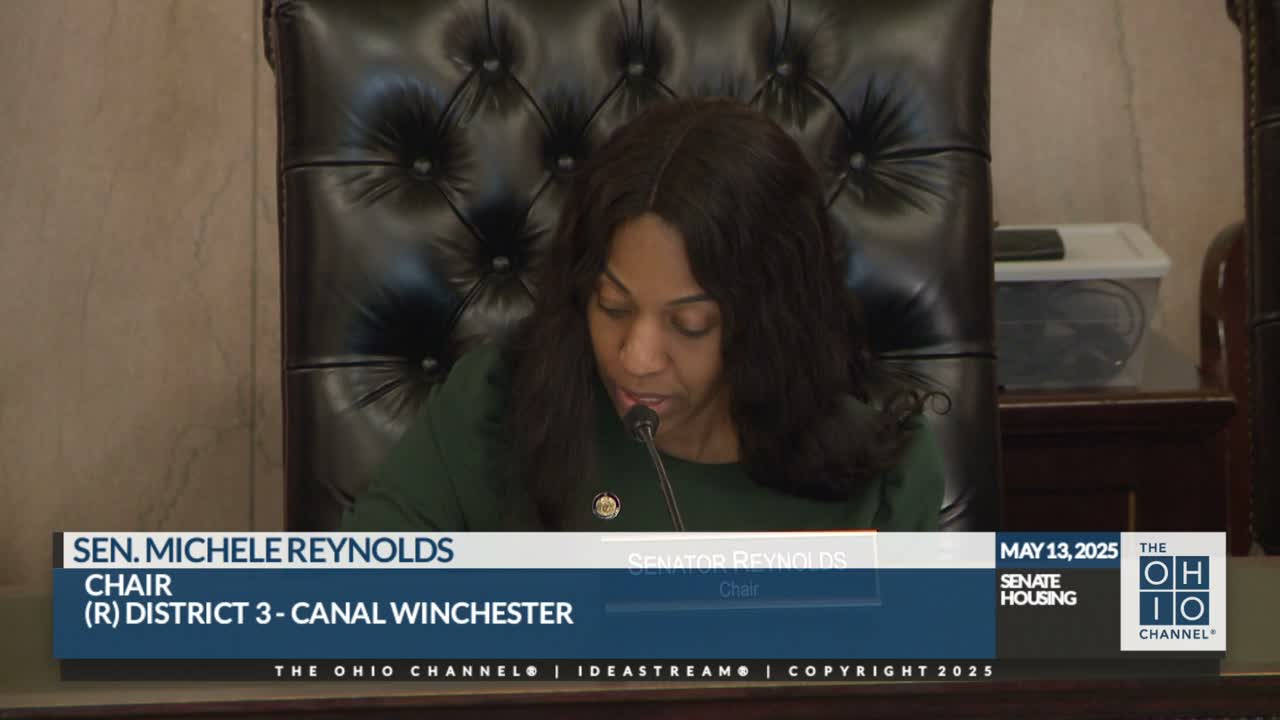
Witnesses supporting Senate Bill 184 told the Senate Housing Committee the bill would create 20‑mile residential economic development districts around major investments (proposed $700 million threshold) and a housing accelerator grant fund to pay for site readiness, infrastructure and permitting incentives tied to pro‑housing local policies.
Supporters of Senate Bill 184 told the Ohio Senate Housing Committee the bill offers a targeted, incentive‑based approach to speed housing development near large economic investments.
“ We are close to a point to where we are going to start losing economic development projects if we do not address the housing supply,” said Nick Rhodes, director of policy and special projects at the Ohio Business Roundtable, in proponent testimony. Rhodes and other witnesses described the bill’s central mechanism: when a qualifying economic development project is announced, a 20‑mile residential economic development district (RED) would be created around the site, opening eligibility for locally administered grants to support housing‑related infrastructure, land acquisition and certain development costs.
The bill would make communities eligible for grants if they demonstrate two steps: adoption of one or more pro‑housing policies (the bill lists examples such as streamlined permitting, fee reductions, zoning changes to permit higher density, expanded utility access and use of innovative housing types) and concrete action toward approving a workforce housing project. Proponents said the grants are intended to be performance‑based and flexible — usable for site preparation, roadway or utility upgrades, capital for housing development, or fee waivers to reduce developer costs.
“ Senate bill 184 incentivizes the exact types of reforms essential to deliver housing quickly and effectively,” said Josh Barkin of MI Homes, who testified that builders frequently face delayed permitting, high hookup and extension fees, and local fiscal constraints that make otherwise viable projects impractical.
Witnesses also discussed how to define a qualifying project. Rhodes cited JobsOhio data during questions: applying the $700 million threshold to JobsOhio’s dataset produced 25 mapped projects; broader modeling could yield roughly 62 projects if the threshold were applied differently, and Barkin said a jobs metric might capture investments that are capital‑intensive but low‑employment (such as some data centers). Tony Long of the Ohio Chamber urged that, if a jobs test is added, the bill should treat investment or jobs as alternative criteria (an “or” rather than an “and”).
Several proponents emphasized that the bill seeks to motivate local change without overriding local control, using incentives rather than mandates. Linda James of the Ohio Community Corrections Association told lawmakers that housing stability underpins reentry and workforce stability and that incentives for smaller setbacks, greater density and modular housing could expand options for people with criminal legal histories and for low‑wage staff.
The committee received written testimony and questions from members; no vote or formal amendment was recorded during this hearing. The bill remains under committee consideration with additional stakeholder input expected as sponsors refine thresholds and scoring rules for the proposed accelerator fund.
The committee moved to the next agenda items after proponent testimony and questions concluded.