Get Full Government Meeting Transcripts, Videos, & Alerts Forever!
Get email alerts on the Student Discipline topic
No spam. Unsubscribe anytime.
Board approves 2025–26 Student Conduct and Safety Handbook after debate over fight‑related discipline
Summary
After extended discussion about fight‑related discipline, the board approved the 2025–26 Student Conduct and Safety Handbook. Board member Ms Taylor urged mandatory suspensions for fighting; Superintendent Doctor Martin said the code uses multiple offense codes and gives administrators latitude guided by an internal discipline matrix.
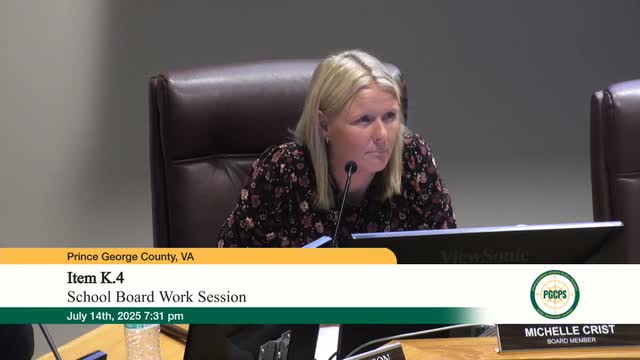
The Prince George County School Board approved the 2025–26 Student Conduct and Safety Handbook on July 14 following extended debate about how the division should discipline students involved in fights.
Doctor Martin presented the handbook and explained it was developed by administrators and coordinators across the division to align with state code and to allow a range of consequences depending on the offense code. He said the handbook must be approved to have printed copies ready for families by August 1.
Board member Ms Taylor argued for a stricter, more uniform approach, saying the schools experienced unacceptable levels of fighting and teacher injuries last year and that a "hard stance" was needed. "I can't support this policy as it is right now," Ms Taylor said, urging a mandatory‑days approach (for example, 10 days for a punch) and citing concerns about repeat offenders and alleged gang activity.
Doctor Martin and other board members responded that the handbook is built around multiple codes for fighting (from relationship behaviors up to assaults with injury) that carry different consequence ranges, and that administrators are trained to assess injury and context. "We have a range of consequences up to and including long term suspension," Doctor Martin said, adding that some more serious codes require recommendations to the board for long‑term suspension or expulsion.
Board members requested additional data and said the administration would provide repeat‑offender counts and continue to refine an administrative discipline matrix and standard operating procedures as a training tool for principals. The board then moved to approve the handbook; the roll‑call vote recorded Mr Johnson yes, Ms Taylor no, Miss Andrews abstain, and Miss Criss yes.
The board directed staff to continue developing the administrative matrix and training and to provide follow‑up data to the board.