Get Full Government Meeting Transcripts, Videos, & Alerts Forever!
Get email alerts on the Child Online Safety topic
No spam. Unsubscribe anytime.
Ohio committee hears competing app-age bills; tech firms, advocates and law-enforcement testify
Summary
Committee hearings on SB167 (app-store parental consent) and SB175 (targeted age-signal and parental controls) drew testimony from Meta, Google, developers, child-safety advocates, law enforcement and legal counsel, with debate focused on enforcement, privacy, constitutionality, and browser or sideloading workarounds.
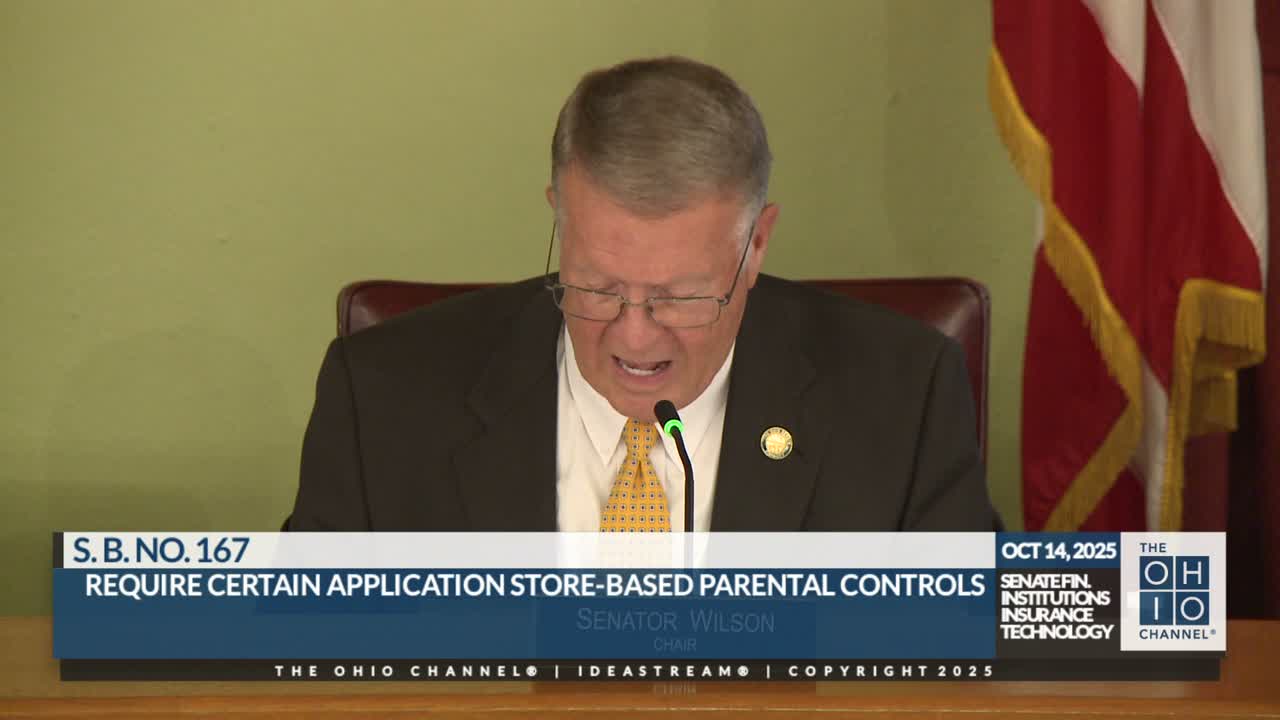
The Senate Financial Institutions, Insurance and Technology Committee heard extended sponsor and proponent testimony on two competing approaches to online age verification and parental controls.
SB167 (described in testimony as the App Store Accountability Act) would require app stores to verify age and obtain parental permission when a teen attempts to download an app, placing a centralized verification and consent flow at the App Store level so parents link their accounts once and do not repeatedly provide sensitive information to dozens of apps. Jennifer Hanley, head of safety policy for North America at Meta, said the approach reduces data exposure and is privacy-protective because app stores would share only a secure age range or a parent-approved signal rather than raw identity documents. Hanley told the panel that partial or selective age verification on some surfaces would fail because teens could migrate to unregulated apps and that app-store level checks are already being implemented in multiple states and by platform vendors.
SB175, supported in testimony by Google and the Developers Alliance, uses a narrower age-signal model: app stores would send a simple "minor" signal (not an exact age or identity) to apps that choose to offer different experiences for minors, and those apps would be required to present parental controls and obtain permission for mature content. Matthew Bai, Google managing director for Android, said SB175 targets apps that offer age-differentiated experiences, limits data sharing and avoids placing unnecessary burdens on small developers.
Witnesses on both sides acknowledged practical challenges. Committee members repeatedly asked how enforcement would work, pointing to language that vests enforcement authority in the attorney general and whether a private cause of action exists; proponents said the attorney general has a record of active enforcement and that limited private actions may be available under the bill text. Senators also pressed witnesses on possible workarounds: web browsers, preinstalled apps and sideloaded software could permit access even if download controls are tightened at app stores. Witnesses said browsers can be included in signaling approaches and conceded there will be technical work to address sideloading and preloaded apps.
Advocates for SB167 emphasized parental-consent and child-safety rationales. Melissa McKay (Digital Childhood Institute) said the bill prioritizes linking children to parent accounts, accurate app age ratings, and a parental-consent step before children can accept app-store contract terms. Law-enforcement and community witnesses including the Fraternal Order of Police and clergy leaders urged action to reduce online harms to youth. Tony Coder (Ohio Suicide Prevention Foundation) said youth suicide and mental-health concerns underscore the stakes, citing that a child dies by suicide in Ohio "every 34 hours" and that a high share of teenagers use social media.
Opponents and industry witnesses pressed legal and constitutional questions. Liam Harrell (American Center for Law and Justice) argued the proposals avoid content-based restrictions by focusing on contract law and parental choices, which he said improves the bills’ odds in legal review; others warned that overly broad mandates have been struck down in prior litigation. Developers and Google stressed a targeted approach to protect small developers and reduce unnecessary data sharing.
The committee did not vote on either measure; the chair closed the hearing and said additional testimony and written submissions have been received and the committee will continue to consider the bills.