Get Full Government Meeting Transcripts, Videos, & Alerts Forever!
Get email alerts on the Education Curriculum topic
No spam. Unsubscribe anytime.
Franklin County board approves Mathspace textbooks and readies accelerated-math pathway under new state law
Summary
The school board approved a purchase of Mathspace-aligned middle-school textbooks and discussed implementation of House Bill 2686, which requires automatic enrollment into accelerated math for students scoring in the top 25% statewide; board members pressed staff on cut-score variability, scheduling and staffing, and parental opt-outs.
The Franklin County Public Schools Board voted to buy Mathspace instructional materials for grades 6–8 (including middle-school algebra and geometry) and heard staff outline how the division will implement state-mandated automatic enrollment in accelerated math.
The board approved the textbook purchase from the district's textbook fund after staff said Mathspace was the only curriculum the division vetted that is 100% aligned to Virginia Standards of Learning (SOLs) and that teachers had selected it after reviewing three options. Staff said they planned to buy classroom sets (35 books per class) so students without home internet would still have materials and that Mathspace would provide in-person professional development if scheduled before school starts.
Why it matters: House Bill 2686 requires school boards to adopt policies for automatic placement of students who score in the top 25% statewide on math SOLs for grades 5–8. Board members raised concerns that the law uses a single SOL score for placement, that cut scores change annually, and that top 25% measured statewide may include students whose absolute scores would not be considered advanced locally.
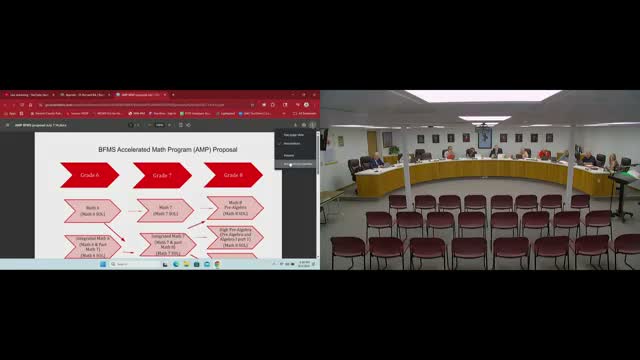
Division staff described a phased approach: begin an accelerated pathway for sixth grade in 2025–26 and move toward fuller implementation in 2026–27, while designing on-ramps and off-ramps so students who struggle can be moved out of accelerated sequences. Staff also noted the statute permits use of multiple data points to place students when administrators feel it is warranted and confirmed a parental opt-out exists.
Board members asked about operational impacts, including course scheduling (because cut scores are released in late June), availability of teachers qualified to teach algebra at the middle-school level, and the need for additional supports. Staff said they would work with middle- and elementary-grade teachers to increase rigor and provide supports so students placed into accelerated courses do not fall behind.
Quotations and attribution: The presenter explained the legislative requirement and implementation timeline; a board member described the statewide top-25% criterion as "absurd" given how cut scores can change year to year. (Direct quotations are attributed to board members and staff who spoke during the meeting.)
Next steps: Staff said they will return to the board with a more finalized policy and implementation plan toward the end of the school year and will schedule professional development if a date can be secured before classes begin.
Ending: The textbook purchase motion passed and staff will proceed with procurement and scheduling for the classroom sets and teacher training.