Get Full Government Meeting Transcripts, Videos, & Alerts Forever!
Get email alerts on the Food Labeling topic
No spam. Unsubscribe anytime.
Sponsors tell committee HB 10 would require clear labels for cell-cultured foods and bar misleading purchases by schools
Summary
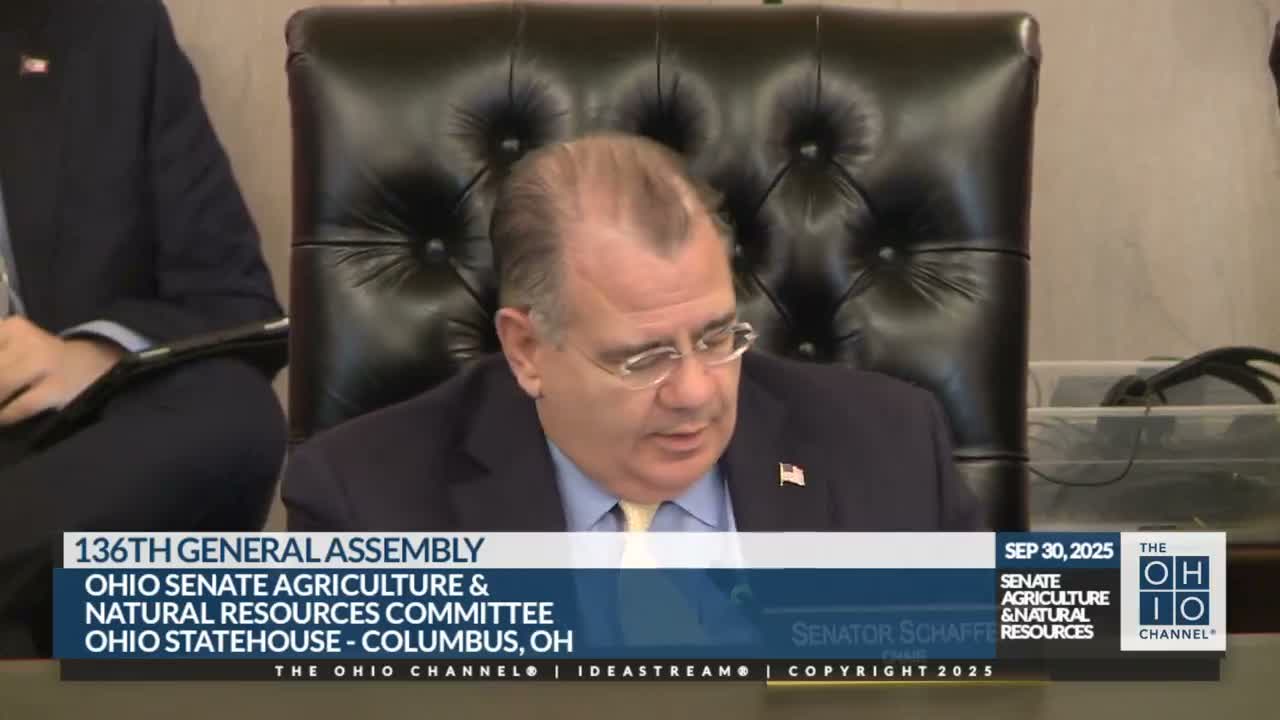
Sponsors of House Bill 10 told the Agriculture and Natural Resources Committee the bill would require labeling that distinguishes traditional meat and egg products from cell-cultured alternatives and would prohibit schools from buying deceptively labeled products; senators pressed sponsors on SNAP/WIC interactions and agency implementation.
Representatives sponsoring House Bill 10 urged the Agriculture and Natural Resources Committee to endorse legislation that would require manufacturers to clearly label cell-cultured and other alternative-protein products so consumers can distinguish them from traditional animal-based foods.
Sponsors told the committee the measure is aimed at consumer transparency and protecting both traditional agricultural producers and school food programs. Testimony noted that "the cost of groceries has surged by 25% in the last 2 years," and sponsors said that clear labeling helps consumers and supports market fairness for Ohio farmers.
One sponsor gave the example of branded products that do not contain traditional eggs or meat and said the bill is not a ban on these products but a requirement that their method of production be clear on labels. "We do not want to ban these products," a sponsor said, "we just want them clearly labeled so when the customer buys it, he knows how it was produced."
Committee members focused on the bill’s interaction with federal nutrition programs. Senator Liston asked about language requiring state directors to submit waiver requests to USDA to exclude cultivated products from SNAP and WIC if the USDA approves them for purchase; Liston sought clarity on whether Ohio could effectively 'unapprove' a USDA-approved product. Sponsors responded that waiver language aims to preserve program purchasing power and noted there are food-allergy exceptions that factor into waiver requests.
Members also asked which state agencies would implement changes. Sponsors identified the Department of Health and the department handling jobs and family services as relevant for SNAP/WIC matters and said the Department of Agriculture would be available to assist. Sponsors repeatedly framed the bill as focusing on labeling and school-purchase rules, not product bans.
The committee did not vote on HB 10 at this hearing. Chair Schafer also noted amendment AM 1360798 had been distributed but would not be considered at this meeting; the amendment was described as addressing pesticide-application compliance and may be considered at a future hearing.