Get Full Government Meeting Transcripts, Videos, & Alerts Forever!
Get email alerts on the Torts topic
No spam. Unsubscribe anytime.
Ohio sponsors present bill to limit public-nuisance claims against manufacturers
Summary
House Bill 126 would bar public-nuisance lawsuits that target lawful design, manufacture or sale of products, sponsors said, while preserving product-liability and environmental remedies; sponsors cited AEP Co. v. Connecticut and an Ohio Supreme Court opiate decision as context.
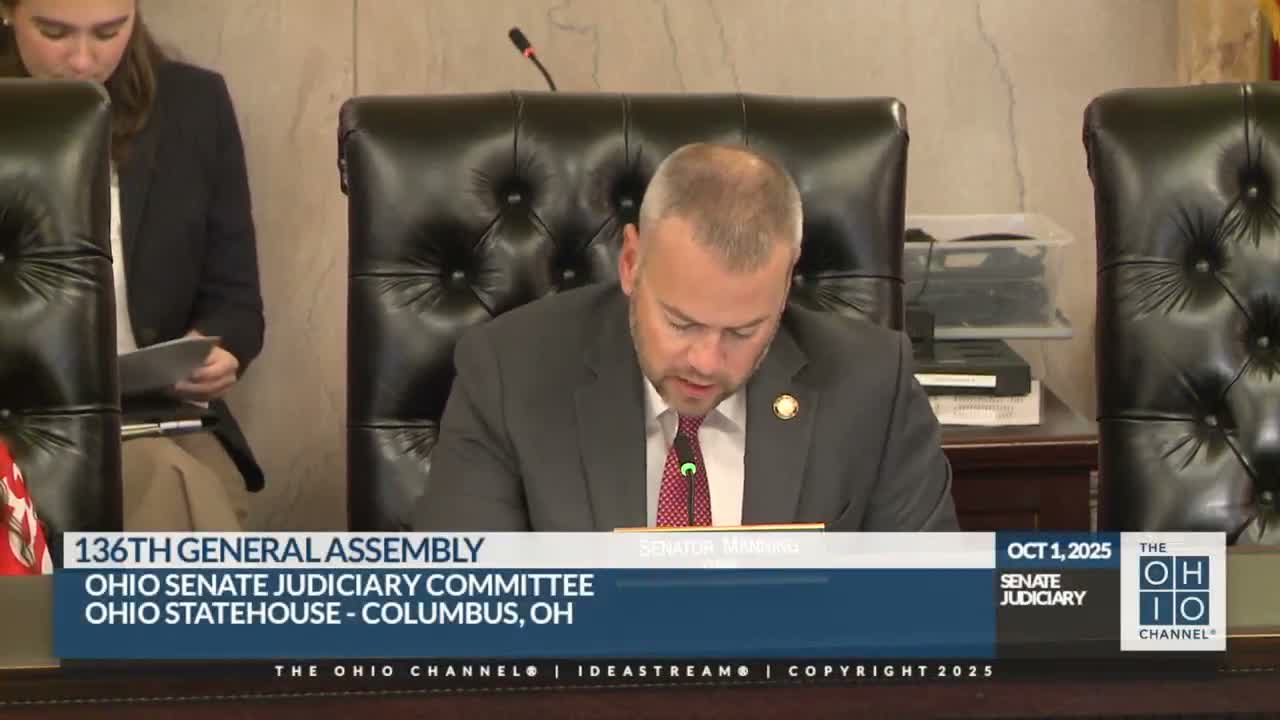
Two sponsors presented House Bill 126 in the Ohio Senate Judiciary Committee, saying the measure would stop courts from treating ordinary product design, manufacture, marketing or sale as a public nuisance when the products are used as intended. The bill, sponsors said, would not block product-liability suits or claims under other statutes that explicitly address environmental contamination.
Sponsors said the bill is intended to restore public-nuisance law to its historical function — abating obstructions to public rights such as blockages of public roadways — and to prevent what they described as an expansion of nuisance litigation into disputes about lawful industries. "Public nuisance claims originated as a legal mechanism to abate impediments to public rights," one sponsor said during testimony.
Sponsoring legislators cited federal and state decisions to explain trends they seek to address. They pointed to AEP Co. v. Connecticut (564 U.S. 410) — a U.S. Supreme Court case that involved climate-change litigation — and to Trumbull County v. Purdue Pharma, a recent Ohio decision arising from prescription-opiate litigation. Sponsors said the bill codifies the Trumbull County ruling in part by directing parties toward existing product-liability procedures when appropriate rather than expanding nuisance doctrine.
The sponsors told the committee the bill includes a carve-out so it would not supersede state or federal laws governing damages arising from environmental contamination, citing the East Palestine derailment as an example of environmental harm that remains actionable under other statutes. They asked the committee for a favorable referral and offered to answer technical questions.
The committee did not take a vote on the measure during the hearing; sponsors answered senators' questions and the matter was recorded as a first hearing.