Get Full Government Meeting Transcripts, Videos, & Alerts Forever!
Get email alerts on the Senate Bill 214 topic
No spam. Unsubscribe anytime.
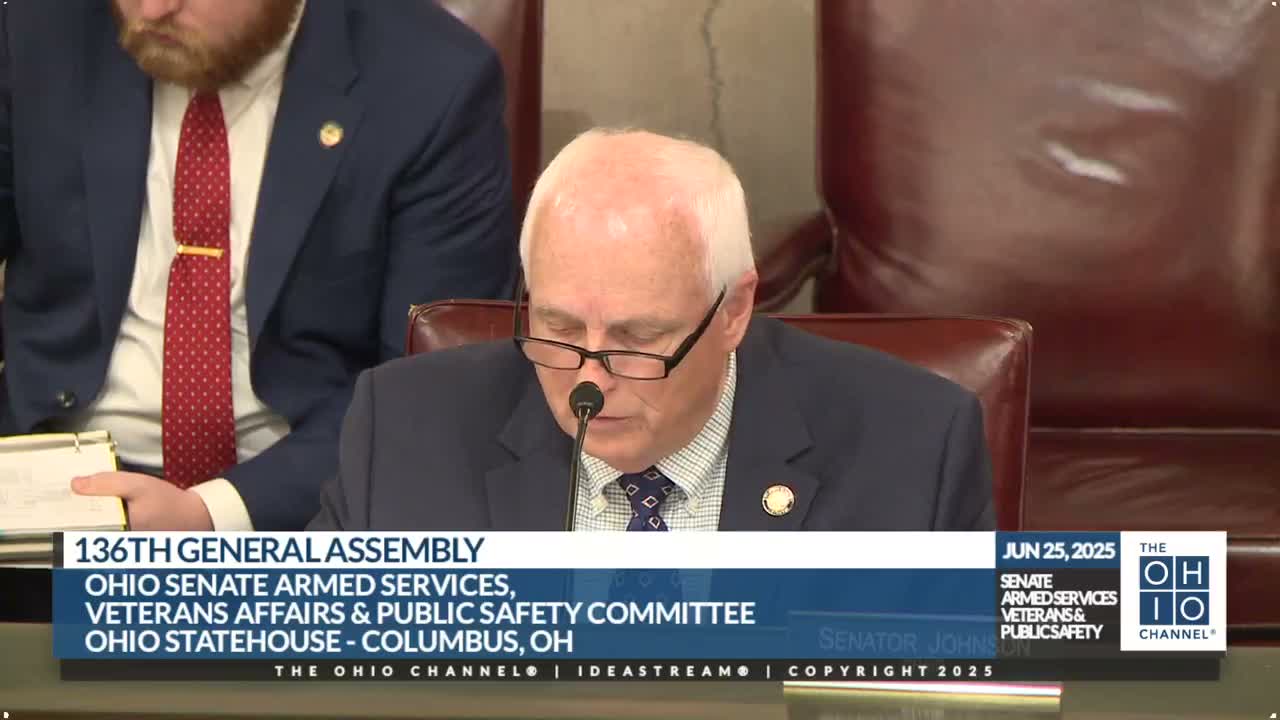
Committee hears proponents on bill to reclassify firearm suppressors; law-enforcement concern noted
Summary
Proponents from the NRA and Ohio Gun Owners Association urged the committee to remove suppressors from Ohio’s 'dangerous ordinance' list, arguing safety and hearing-protection benefits; a senator cited law-enforcement concerns about locating gunshot origins with suppressed firearms.
Supporters of Senate Bill 214 urged the Armed Services, Veterans Affairs and Public Safety Committee to reclassify firearm suppressors so they are no longer treated as a dangerous ordinance under Ohio law.
John Weber, representing the National Rifle Association, testified that suppressors (often called silencers in popular usage) reduce noise and protect hearing for hunters, sport shooters and law-enforcement officers. Weber cited federal agency purchases of suppressors for agent safety and referenced Supreme Court precedent, saying suppressors are in common lawful use and therefore should not be singled out in state statute.
"Suppressors meet this standard and removing them from Ohio's dangerous ordinance list would recognize their widespread responsible use," Weber said.
Senator Weinstein asked whether suppressors could reduce visible muzzle flash or otherwise complicate law enforcement’s ability to locate the origin of gunfire. Weinstein described law-enforcement concerns that suppressed firearms could make it harder to identify gunshots in some locations. Weber responded that suppressors do not make guns more lethal, do not silence a firearm, and that many other firearm accessories already alter flash or sound.
Rob Nisely, political director of the Ohio Gun Owners Association, also testified in support and urged the committee to consider expanding reforms to include short-barreled rifles and shotguns as federal changes proceed.
The committee received written testimony from multiple other parties and concluded the second hearing; no committee vote on SB 214 was recorded in this transcript.