Get Full Government Meeting Transcripts, Videos, & Alerts Forever!
Get email alerts on the Veterans Benefits Mental Health topic
No spam. Unsubscribe anytime.
Senator Schaeffer urges faster VA claims processing and expanded mental-health care for service members and veterans
Summary
Senator Schaeffer told the Senate Armed Services, Veterans Affairs and Public Safety Committee that two companion resolutions urge Congress and federal agencies to expand access to qualified mental-health treatment for active-duty personnel and veterans and to shorten Veterans Affairs disability-claim processing times, citing VA and DoD data on suicide rates and backlog.
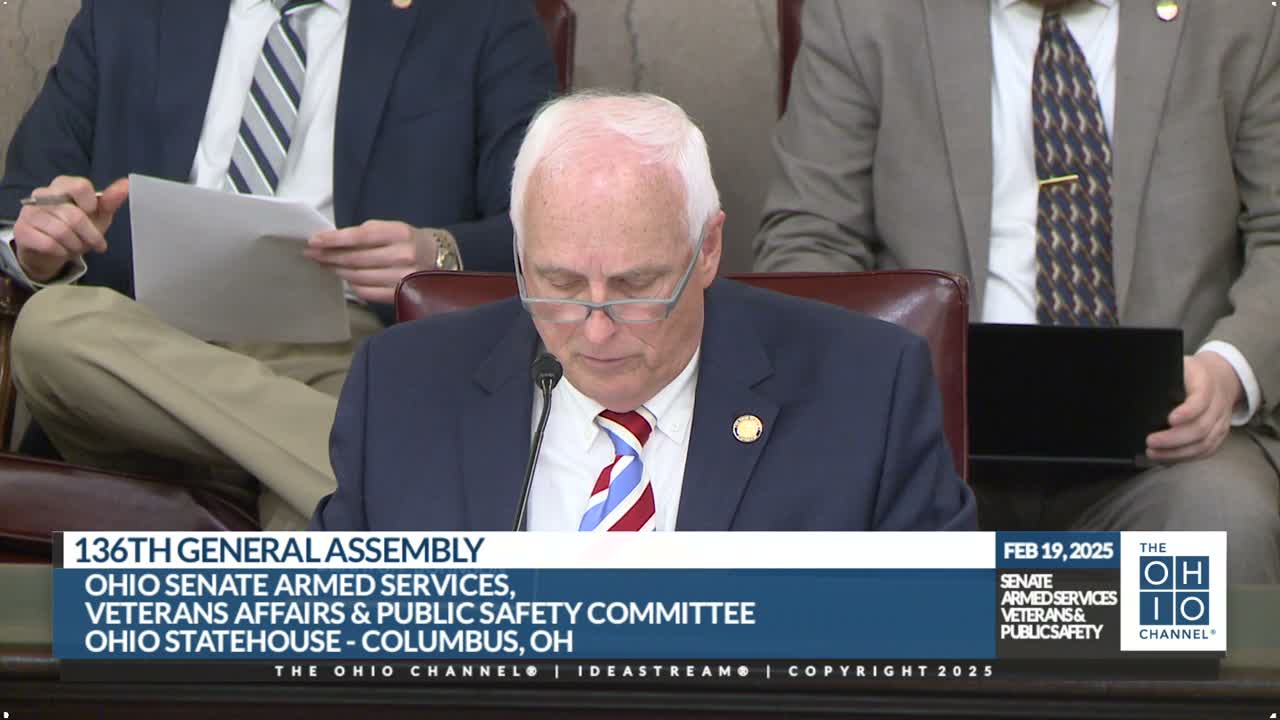
Senator Schaeffer presented sponsor testimony for two companion resolutions before the Senate Armed Services, Veterans Affairs and Public Safety Committee calling for improved mental-health care for active-duty service members and veterans and for faster processing of Veterans Affairs disability claims.
Schaeffer told the committee that Senate Resolution 21 urges Congress to support "prompt and comprehensive mental health treatment" for active-duty military and veterans suffering from post-traumatic stress disorder and other service-related stress disorders. He cited national data and agency reports indicating elevated suicide risk and other mental-health challenges among returning troops. "This is an issue that was brought to my attention by one of my constituents who is a veteran," Schaeffer said.
Schaeffer emphasized several statistics during his remarks, attributing them to federal and research sources: he referenced National Institutes of Health findings on common post-deployment disorders; he cited a United Service Organizations report that 2021 suicide rates among active-duty members were at a high since Sept. 11, 2001; he also cited the Department of Defense quarterly suicide report listing a 2021 Army suicide rate of 36.18 per 100,000 soldiers and referenced analyses by the Journal of the American Medical Association and Brown University’s Watson Institute comparing post‑9/11 deaths by suicide and combat fatalities.
The resolution asks federal entities to prioritize licensed, qualified clinicians with experience treating military personnel rather than relying on less-experienced interns to approve or deny treatment. It also urges the Department of Defense to consider PTSD and traumatic brain injuries when making separation decisions and asks the VA to consider those who served on active duty and were discharged with conditions other than dishonorable for possible eligibility for VA health-care benefits.
On Senate Resolution 22, Schaeffer urged federal leaders to reduce the time it takes the VA to complete disability-related claims. He cited VA figures the committee was given: an average processing time of "just over 139 days" in November 2024 that increased to 146 days as of January, a VA policy threshold that classifies processing over 125 days as a backlog, and a reported backlog of "254,679" claims as of December. "It's simply unacceptable to take four months to process a veteran's disability related claim," Schaeffer said, noting the hardship that delays cause for veterans awaiting benefits.
Committee leadership expressed support for the measures during and after the testimony and did not pose substantive questions during the hearing. There were no committee votes recorded on SR 21 or SR 22 during this meeting; Schaeffer concluded by thanking the chair and members for considering the resolutions.
The committee adjourned after finishing the day’s agenda; no further action on SR 21 and SR 22 was recorded at this meeting.