Get Full Government Meeting Transcripts, Videos, & Alerts Forever!
Get email alerts on the Energy Policy topic
No spam. Unsubscribe anytime.
Senate Energy Committee hears broad support for SB2 to end subsidies, tighten oversight; local tax impacts highlighted
Summary
At a second hearing on Senate Bill 2, business groups, utilities and consumer advocates largely backed ending legacy subsidies and electric security plans to spur new generation, while school officials and local leaders warned the bill’s tangible personal property tax exemptions could cut local revenues and urged mitigation.
The Ohio Senate Energy Committee held a second hearing on Senate Bill 2, an extensive rewrite of state energy rules that would end certain utility subsidies, phase out electric security plans and change permitting and tax rules to encourage new generation.
Proponents from industry groups, independent generators and energy trade associations told the committee SB2 would restore competitive market signals, attract private investment and reduce costs for large power users and small businesses. David Proanno of the Ohio Energy Leadership Council urged the committee to amend the bill so that OVEC coal-subsidy riders end upon enactment and argued the Public Utilities Commission of Ohio should be allowed to finish an audit of previously collected OVEC charges. "Ohio rate payers need relief now and thus OELC requests the amendment set forth in my written testimony," Proanno said.
Consumer advocates and public-interest groups said they supported many SB2 consumer protections — including ending some legacy subsidies and prohibiting utilities from owning generation — but urged safeguards. Maureen Willis, director of the Ohio Consumers' Counsel, called for refunds for consumers where PUCO previously found charges to be unjust and warned that a proposed Consumer Choice Billing Program could shift costs to non-shopping customers. "The subsidies are costing customers $440,000 a day," Willis said, urging prompt refunds and careful drafting of new billing programs.
Industry witnesses emphasized two related policy aims: remove market-distorting subsidies and reduce regulatory delays that slow new projects. Tom Copas of the Ohio Independent Power Producers and Arnie Quinn of Vistra said ending OVEC-era support will not necessarily force plant closures and will give merchant developers confidence to invest. Several witnesses, including the Ohio Manufacturers Association, pushed for reforms to how supplemental transmission projects are approved and urged lowering the Ohio Power Siting Board's review threshold from 100 kilovolts to 69 kilovolts so costly projects receive more scrutiny.
But local-government officials and school-district finance officers cautioned that the bill’s tax provisions — notably an exemption of the tangible personal property (TPP) tax for new generation equipment — could shrink local tax bases. Keijan Keaton, treasurer of Benton Carroll Salem Local Schools, and Louis Gallant, consultant for Perry Local Schools, said reductions in TPP revenue have already hit school budgets; they asked the General Assembly to consider time-limited exemptions, transition payments or one-time mitigation for jurisdictions seeing steep value losses.
Several stakeholders flagged a drafting risk: SB2 abolishes electric security plans (ESPs) and riders, but it also creates a "mini rate case" mechanism to collect certain capital costs outside a standard rate case. Consumer advocates and environmental groups warned that, without limits, mini rate cases could become a backdoor for cost recovery similar to riders. Robert Kelter of the Environmental Law & Policy Center said the Senate should either cap or narrow the mini-rate-case authority or require stronger oversight.
Manufacturers and large energy users urged the committee to retain programs that provide grid reliability and economic-development incentives — interruptible rate programs and transmission-related arrangements — and suggested moving any authorization for those programs from the ESP statute into the rate-case framework so they survive the ESP repeal. "These programs let the customer be shut off essentially by PJM and instead of turning a power plant on, we turn a bunch of big customers off," said an industrial sector witness explaining why interruptible programs are important for reliability.
Consumer groups and some proponents pressed the committee to accelerate the repeal of OVEC subsidies and to return any unspent solar program funds to customers. Tom Bullock of the Citizens Utility Board said repealing the OVEC charge immediately would save about $445,000 daily for consumers and urged publication of hosting‑capacity maps to guide faster, lower‑cost distributed projects.
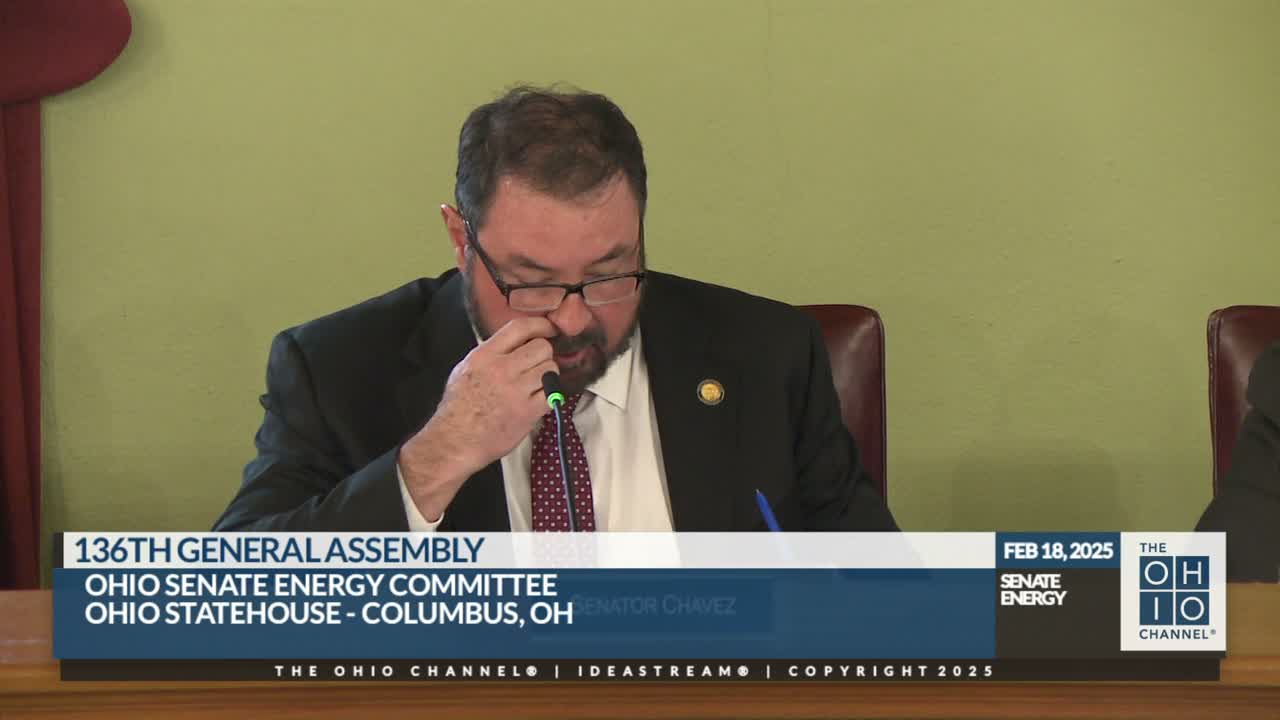
The committee did not take votes at the hearing. Chair Chavez closed the session after dozens of witnesses completed testimony and the sponsors signaled they will review amendments and stakeholder suggestions before further action.
Next steps: the bill’s sponsor and staff will review written and oral testimony and proposed amendments; committee consideration will continue in subsequent hearings.