Get Full Government Meeting Transcripts, Videos, & Alerts Forever!
Get email alerts on the Energy Policy topic
No spam. Unsubscribe anytime.
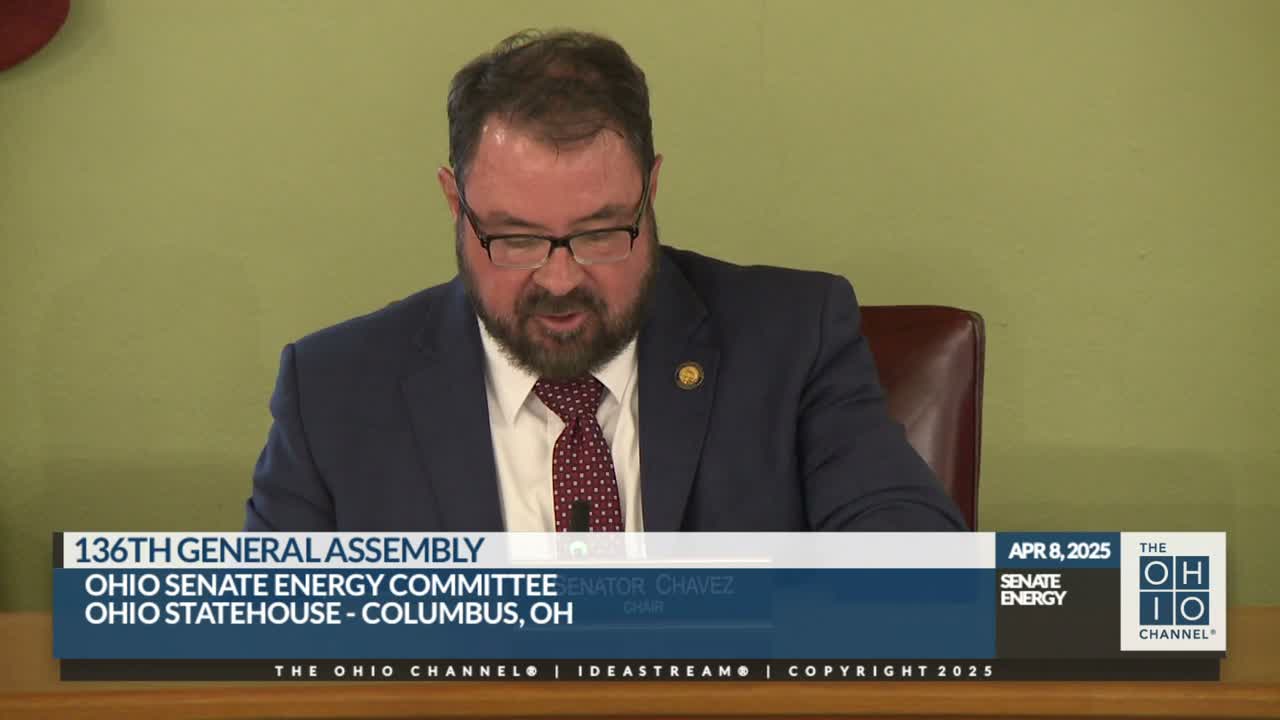
Senate Energy Committee holds first hearing on substitute House Bill 15; witnesses split over refunds, OVEC and transmission changes
Summary
At a first hearing on substitute House Bill 15, sponsors and a slate of industry, consumer‑advocate and environmental witnesses debated changes to Ohio rate‑making, transmission siting, tax treatment for new generation, and consumer refund rules; no vote was taken.
COLUMBUS — The Ohio Senate Energy Committee opened its first hearing on substitute House Bill 15, a wide‑ranging rewrite of the state's energy rules, hearing sponsor remarks followed by proponent and opponent testimony before adjourning without a vote.
Representative Klopfenstein, the bill's sponsor, told the committee HB 15 modernizes a framework he said dates to 1999 and cited growing demand from data centers: "The forecast is 5,000 megawatts of need by 2030," he said, summarizing provisions that would require electric distribution utilities (EDUs) to offer a market‑rate standard service, bar EDUs from bidding distribution‑funded assets into the wholesale market, tighten bonding for competitive retail suppliers, and reduce certain tangible personal property (TPP) taxes on new generation and on transmission, distribution and pipeline infrastructure starting in 2027.
Why it matters: Proponents said the bill would improve oversight, reduce some customer subsidies and attract investment; opponents warned parts of the bill could shift costs to ratepayers, complicate federal‑state jurisdiction or create retroactive obligations. The committee heard repeated concerns about consumer refunds, the immediate repeal of the OVEC rider and the scope of expanded Ohio Power Siting Board (OPSB) review.
Consumer advocates asked for clearer true‑up and refund language. Maureen Willis, director of the Ohio Consumers' Council, said HB 15 “is a good start” but urged stronger protections for consumers in the multi‑year true‑up process and questioned the bill's refund language, saying, "Please don't make it harder than it already is to get refunds for consumers." Willis recommended either deleting the refund limitation or adding language that preserves full refunds when charges are collected subject to refund and reconciliation.
Utilities and transmission stakeholders offered both support and objections. Chris Holland, senior counsel for AES Ohio, said AES supports modernizing rate making in principle but cautioned that transmission siting and rate changes raise jurisdictional and practical concerns: "Transmission rates are regulated by the Federal Energy Regulatory Commission, not the Public Utilities Commission of Ohio and not the Ohio Power Siting Board," he said, warning that OPSB expansion could slow critical projects. AEP Ohio's Steve Nourse urged protections for existing contracts and requested a transition for unrecovered costs, estimating AEP Ohio's potential unrecovered deferrals at roughly $40 million.
Manufacturers and large energy users backed several provisions to limit subsidies and increase oversight. Kim Boiko of the Ohio Manufacturers Association said repealing ESP subsidies and ending the OVEC rider would save customers millions: "Ohioans have already paid over $670,000,000 since 2017," she said, and projected higher costs if the subsidies remained in place.
Proponents also pressed for attention to transmission spending and for rules to prevent unchecked project costs. David Perano of the Ohio Energy Leadership Council argued the bill closes a regulatory gap for supplemental transmission projects and cited an estimate that 292 such projects since 2017 cost about $1.57 billion allocated to Ohio ratepayers. Environmental advocates urged demand‑response measures: Robert Kelter of the Environmental Law & Policy Center supported HB 15 but asked the committee to add the residential and small commercial demand response program from Senate Bill 2, saying such programs could deliver roughly 400 megawatts of peak‑saving capacity and save customers about $40 million under current PJM prices.
Other contested items included provisions on behind‑the‑meter generation and so‑called "self‑build" transmission lines. AEP warned that allowing nonutility parties to build transmission beyond their property rights could conflict with existing law and operational limits. Some witnesses asked the committee to refine expedited review windows at the OPSB (discussing 90‑day and 45‑day timeframes for different case types) to preserve community notice and review.
What happened next: The committee closed the hearing after taking written testimony and in‑person statements from the sponsor and a full slate of stakeholders. No committee action or vote was taken at the hearing; the bill remains under committee consideration and may return for further amendment or markup.