Get Full Government Meeting Transcripts, Videos, & Alerts Forever!
Get email alerts on the Energy Policy topic
No spam. Unsubscribe anytime.
Senate Energy Committee advances Substitute Senate Bill 2 after debate over OVEC recovery, utility ownership and reliability
Summary
The Senate Energy Committee voted to favorably report Substitute Senate Bill 2 after testimony from utilities, trade groups, environmental advocates and reliability experts on contract grandfathering, OVEC cost recovery and utility participation in behind‑the‑meter projects.
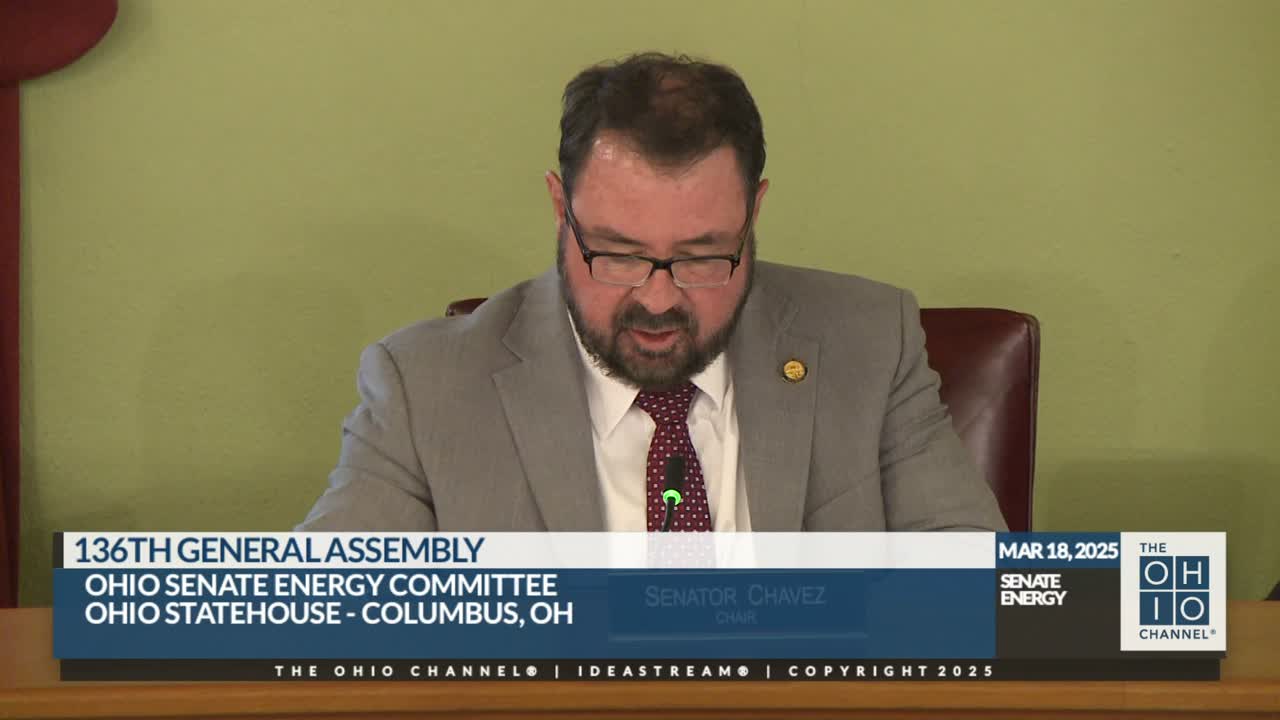
The Senate Energy Committee on Tuesday advanced Substitute Senate Bill 2 after a day of testimony that split utilities and business groups from environmental and reliability advocates over contract protections, rate-making procedures and how the state should handle cost recovery for legacy generation. Vice Chair Landis moved the bill be favorably reported to the committee on rules and reference; the motion passed on a roll call and the bill will be sent forward.
The bill, as explained when Senator Reineke moved to adopt substitute 0333-5, tightens language on three-year forecasted test years, clarifies tangible personal property tax provisions, assigns energy-efficiency school funds to the Facilities Construction Commission and limits continued utility ownership of behind‑the‑meter projects to facilities that are operational before the bill’s effective date. "That substitute bill ... is mostly clarifying language and tightens up wording regarding the 3 year forecasted test years," Reineke said during his explanation.
AEP Ohio, represented by Frank Stregari, opposed the bill’s current version on several grounds. Stregari said the statute cited in his testimony (identified in the hearing as "revised code 49 28.47") has been used to enter contracts with mercantile customers and that the current draft of the bill could "undo agreements like these that were formed in reliance on this current law." He warned that immediate elimination of OVEC cost recovery would force AEP Ohio to write off about $52,000,000 and could raise utilities’ cost of capital, ultimately affecting ratepayers. "No ratepayers will pay a single dime," Stregari said of specific mercantile contracts AEP submitted under the statute, adding that the company sought a reasonable transition to avoid an immediate write-off.
Committee members pressed witnesses on those points. Senator Weinstein noted that Ohioans have borne costs tied to OVEC and questioned whether the bill merely shifts burdens; Stregari responded that AEP was seeking a transition period so the company would not be required to take an immediate large write-off. Senator Timken raised concerns that allowing utilities to participate in behind‑the‑meter projects could let them "bigfoot" competitors; Stregari said the statute had rarely been used and that contracts already signed would need grandfathering because "millions of dollars have already been spent."
Reliability concerns featured in testimony from Randy Imager of the Energy Policy Network. Imager said Ohio has lost baseload resources in recent years — estimating 10 baseload plant closures and 14,000 megawatts of capacity retired over the past seven years — and cited FERC and PJM analyses that place the region at elevated risk during peak demand. He recommended policies to repower or retrofit existing plants, require replacement baseload to be in place before closures, and pursue demand‑reduction programs to lessen the need for new supply.
Proponents at the hearing praised other elements of the bill. Kim Buicko, speaking for the Ohio Manufacturers Association, thanked the committee for language that immediately ends OVEC subsidies, strengthens annual true‑up provisions and limits utility ownership to existing behind‑the‑meter projects. "We thank the committee for ensuring that OVEC subsidies are immediately ceased and that customers no longer have to pay for those subsidies," Buicko said. She also disputed claims that the substitute would repeal the statute AEP cited, saying the statute requires Commission approval and does not guarantee utility ownership.
Environmental Law & Policy Center attorney Robert Kelter expressed support for eliminating ESP cases and riders, argued for clearer annual true‑up procedures to ensure utilities do not over‑recover, and urged stronger incentives for demand response. Kelter recommended adding language that would require an annual filing and a commission hearing so spending is "used and useful" and subject to scrutiny.
Melville Nickerson of NRG, a proponent, said the bill would strengthen competitive retail markets and lower costs for consumers by requiring competitive bidding for the standard service offer and enabling suppliers to directly bill customers and provide on‑bill financing. "Consumers win when they're allowed to choose what works best for their families and their businesses," Nickerson said.
After testimony and brief questioning, Vice Chair Landis moved to favorably report the substitute bill to the committee on rules and reference. The clerk called the roll; the motion carried and the committee directed Legislative Service Commission to harmonize amendments as needed. The bill will proceed to the committee on rules and reference for further consideration.
Votes at a glance: Vice Chair Landis moved that the committee favorably report Substitute Senate Bill 2 to the committee on rules and reference; the clerk called the roll and the committee recorded sufficient affirmative votes to send the bill to rules and reference. No formal tally of nay or abstentions was announced on the floor during the roll call announced in the hearing.
The committee adjourned with no further business.