Get Full Government Meeting Transcripts, Videos, & Alerts Forever!
Get email alerts on the Energy Rate Reform Sb2 topic
No spam. Unsubscribe anytime.
Senate Energy Committee adopts substitute of SB 2 as working document after hours of testimony on refunds, three‑year rate plans and behind‑the‑meter generation
Summary
The Ohio Senate Energy Committee adopted a newly drafted substitute to Senate Bill 2 and heard proponent and opponent testimony on refund timing, utilities’ role in generation and a new three‑year rate-making structure that witnesses said could either improve investment certainty or risk higher costs for consumers.
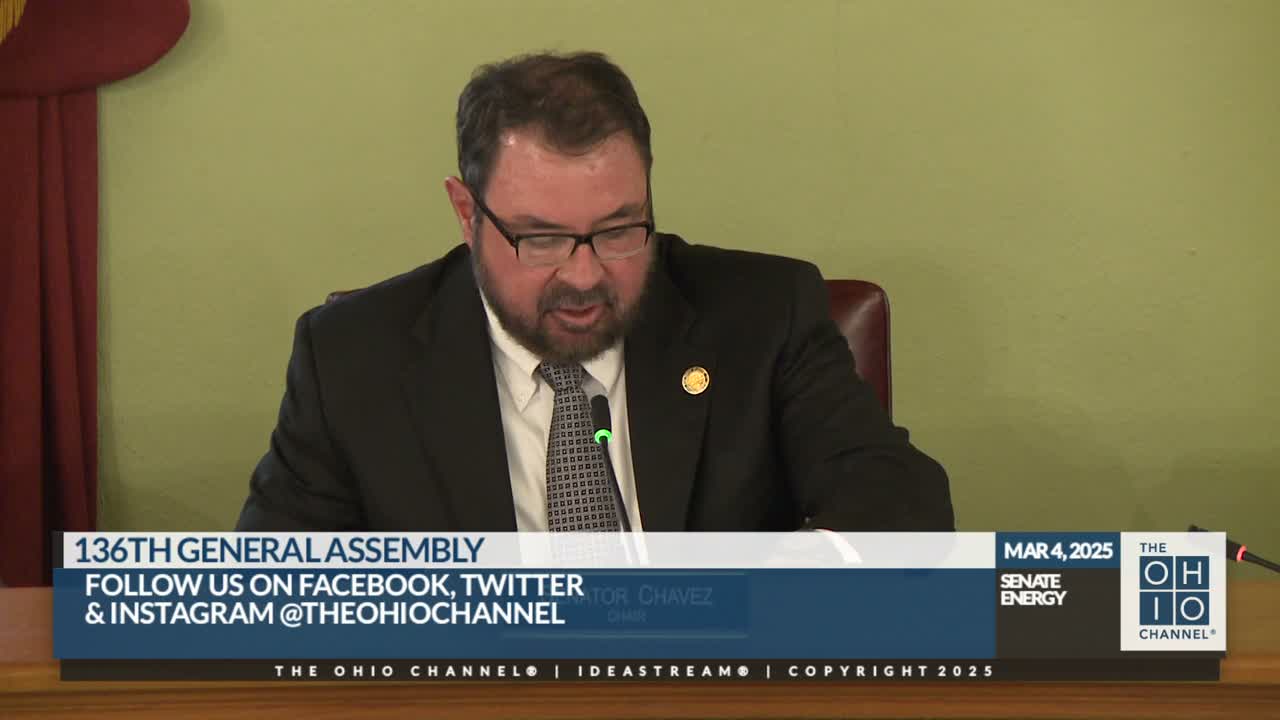
The Ohio Senate Energy Committee on March 11 adopted a new substitute to Senate Bill 2 and labeled it the working document after the committee’s sponsor explained changes that redraw how the Public Utilities Commission of Ohio reviews utility rates and programs.
Senator Kevin Reineke moved to adopt the substitute (verbatim in the record: "I move to adopt substitute bill 0 3 3 3 dash 3"), and the chair declared the substitute agreed to "without objection." Reineke told the committee the sub-bill narrows the timing and scope of refunds (refunds would be issued on the date a court rules rates unlawful rather than back to the original rate-case approval date), reinstates PUCO audit language, prohibits discriminatory interruptible rates, implements staff‑suggested midpoint rates subject to refund during rate cases and establishes shot‑clock timelines for completeness and staff reports. He also described a provision allowing multi‑year (three‑year) rate proposals with annual true‑ups and said the substitute treats certain linear generation as a renewable source and energy storage like generation for tax purposes.
Proponents told the panel the changes would support reliability and competition. Joe Price of the Ohio Energy Group said his members — large, energy‑intensive manufacturers — supported moving statutory authority for programs such as interruptible rates from the electric security plan framework into rate cases, calling those programs important for keeping the lights on during emergencies. "These programs are really big, big reason why manufacturing is successful in Ohio," Price said, and warned market generation costs and a capacity price increase expected on 06/01/2025 would put pressure on manufacturers.
Todd Schnitzler, president and CEO of the Electric Power Supply Association, argued SB 2 would strengthen competitive markets by eliminating the ESP option in favor of a market‑rate standard service offer and limiting non‑bypassable charges that have previously been a vehicle for costs charged to captive customers. "We think repeal of the ESP statute is fundamental to reorder the regulatory framework in the state of Ohio," Schnitzler said.
Reliability experts urged caution about supply and transmission. Timothy R. Gallagher, CEO of Reliability First Corporation, said regional assessments place PJM at an elevated risk for electricity deficiencies and emphasized that replacing dispatchable baseload faster than it can be replaced risks reliability: "We cannot have a system right now that is solely based on renewables because they do not provide these services," Gallagher said, urging an "all of the above" resource mix and faster permitting for generation and transmission.
Consumer and manufacturer witnesses raised concerns that version 3 reduces consumer protections. Maureen Willis, agency director for the Ohio Consumers' Council, said the "-three refunds provision misses the mark" because it limits refunds to riders and would not return the full and complete refunds consumers could receive under prior language. Willis said the sub‑bill's three‑year, asymmetrical rate‑making and the prospect of utility‑owned behind‑the‑meter generation create risks of cost shifting and make policing cross‑subsidization difficult.
Kim Boiko, representing the Ohio Manufacturers Association, said the bill’s wording around "reasonable arrangements" (the testimony cited statute 4905.31) could allow discounts or revenue deltas to be passed to other customers and called the guaranteed returns in a three‑year forecast model "not good for customers." David Proano, representing the Ohio Energy Leadership Council, echoed concerns that forecast‑based multi‑year plans could advantage utilities and that reconciliation processes could take months or years while consumers pay higher interim rates.
Other witnesses diverged: Joseph DeMear of the Wood County Green Party urged removing language (cited as Section 41A in his testimony) he said would permit fossil and nuclear sources to be labeled green; Randy Emminger of the Energy Policy Network cited NERC and FERC findings about plant retirements and supply chain constraints and urged ensuring base‑load resources remain in place before closures.
The committee limited oral testimony to five minutes per witness and accepted written testimony filed on members’ iPads. Chair Chavez said the committee would continue working on the new document and post the sub‑bill on the committee website and senate.gov.
What happens next: the substitute was agreed to as the working document and will be available on the committee website. No roll‑call vote on passage occurred today; rather, the committee adopted the substitute as the working draft and will continue deliberation and amendments as needed.