Get Full Government Meeting Transcripts, Videos, & Alerts Forever!
Get email alerts on the Energy Policy topic
No spam. Unsubscribe anytime.
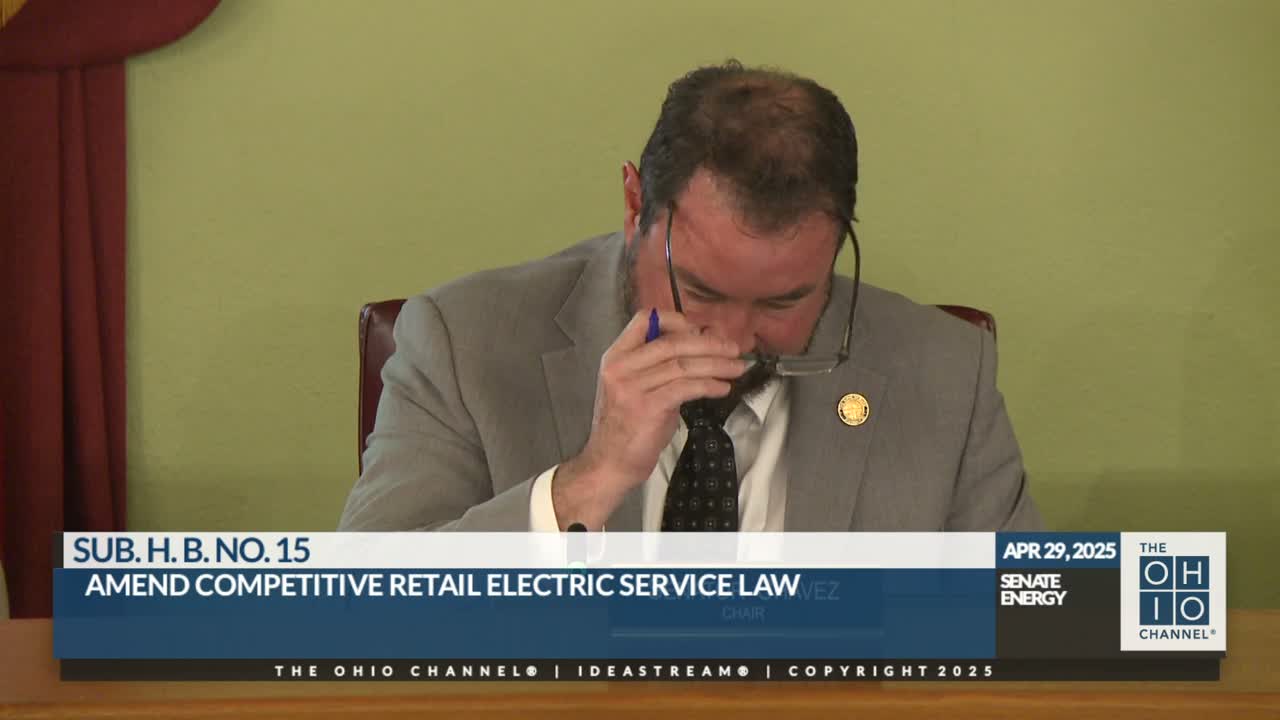
Senate Energy Committee advances substitute House Bill 15 after proponent testimony on consumer refunds and renewable siting
Summary
The committee adopted a substitute that reduces tangible personal property tax on new generation and transmission equipment, defines repowering, and advances HB 15 after proponents urged changes to refund language and supported priority investment areas for renewables.
The Senate Energy Committee considered substitute House Bill 15 (substitute 0688-10), a package combining provisions from Senate Bill 2 and House Bill 15 that the sponsor described as clarifying and cleaning up prior language. Senator Reineke, the sponsor, said the substitute reduces the tangible personal property tax on new generation and energy conversion equipment from 25% to 7%; reduces TPP taxation on new transmission, distribution and pipeline infrastructure from 88% to 25%; and defines ‘‘repower’’ to require that at least 80% of the production equipment’s true value derive from the newly installed production equipment. The substitute preserves multi-year rate-making plans, maintains an immediate repeal of OVEC where previously proposed, and leaves in place an accelerated review process intended to shorten regulatory timelines.
Maureen Willis, testifying for the Ohio Consumers' Counsel, spoke as a proponent of the bill’s consumer and regulatory reforms but urged the committee to delete a provision that would limit refunds to charges collected only after a court ruling (identified in Willis’s remarks as line 619 of the bill). Willis told the committee that limiting refunds in that way could prevent consumers from recovering unlawful charges collected prior to a court decision. She cited past cases in which the Public Utilities Commission of Ohio (PUCO) approved charges without refund protection, saying that, in one example related to FirstEnergy, customers paid roughly $456,000,000 even after a court later found the charges unlawful. "We respectfully propose that you delete the refund provision altogether," Willis said, arguing that the bill should allow refunds when refundability is included in PUCO‑approved tariffs.
Willis also raised what she described as a regulatory gap for supplemental transmission projects built at 69 kV, noting testimony that since 2017 nearly 292 such projects were installed at a cost the testimony estimated at more than $1,570,000,000 and that consumers ultimately bore those costs through transmission riders. She urged restoring PUCO jurisdiction or other oversight for those projects.
Rebecca Molino of The Nature Conservancy in Ohio testified in support of HB 15 and asked the committee to emphasize the bill’s "priority investment areas" language to accelerate renewables on brownfields and former coal mine lands. "Renewable energy is an important piece of the energy landscape in Ohio," Molino said, noting TNC research that identified more than 500,000 acres of former mine lands and brownfields potentially suitable for renewable development.
An opponent, Kathy Becker, submitted written testimony but did not appear in person. After hearing testimony and discussion, Vice Chair Landis moved to favorably report substitute House Bill 15 to the committee on Rules and Reference. The clerk called the roll; the members present recorded affirmative votes and the chair announced the bill would be sent to Rules and Reference. Committee members were asked to sign the vote sheet.
Next steps: the bill was forwarded to the committee on Rules and Reference for further consideration.