Get Full Government Meeting Transcripts, Videos, & Alerts Forever!
Get email alerts on the Energy Policy topic
No spam. Unsubscribe anytime.
Senate Energy Committee adopts substitute Senate Bill 2 after contested testimony on siting timelines, utility ownership and renewables
Summary
The Senate Energy Committee adopted a substitute version of Senate Bill 2 by unanimous consent after testimony from residents, industry and advocacy groups arguing over shortened siting timelines, utility ownership of behind-the-meter generation, rate-making changes, school energy loans and what counts as 'green' energy.
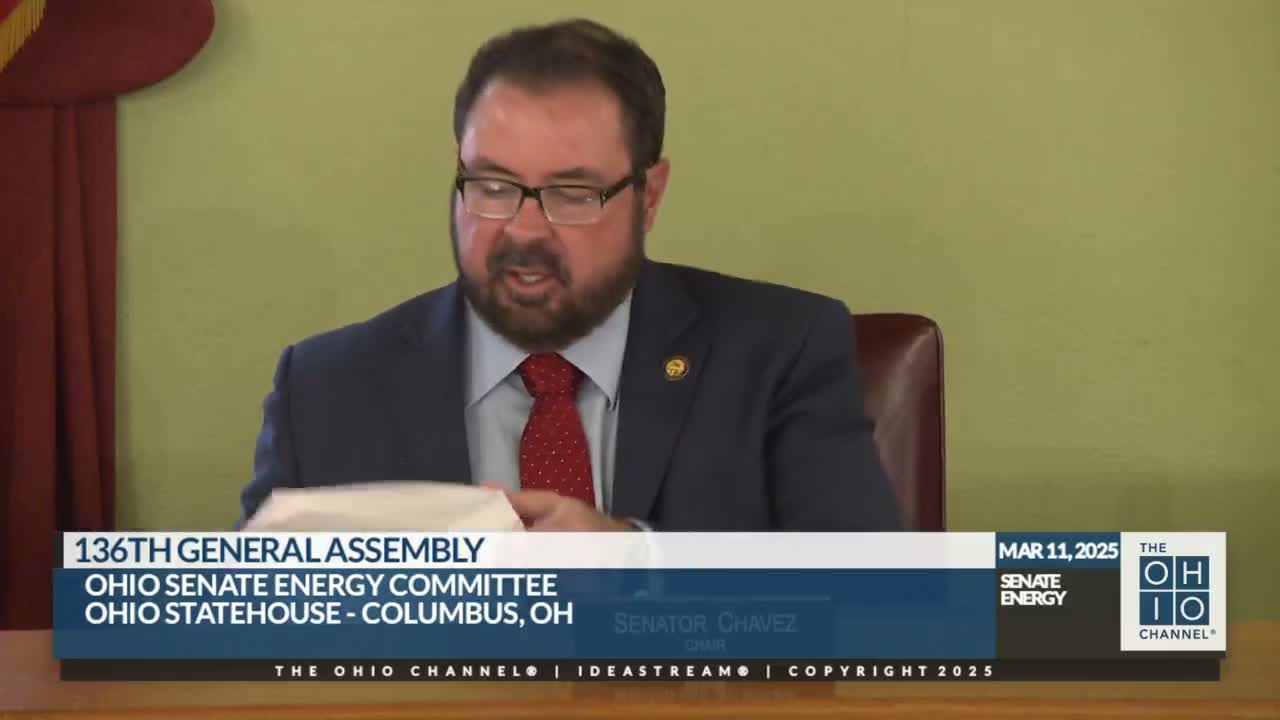
The Senate Energy Committee on the fifth hearing of substitute Senate Bill 2 adopted the substitute version of the bill by unanimous consent and heard competing testimony over how the measure would change siting deadlines, rate-making practices and the market for behind‑the‑meter generation.
Committee members accepted the substitute bill as the working document “without objection,” and the committee chair said the new sub bill will be posted on the committee website and on senate.gov later in the day. Senator Reineke introduced the substitute and summarized its main changes, including restored intervenor rights in rate cases, removal of a mini-rate‑case structure, a prohibition on utilities owning behind‑the‑meter generation except for projects already grandfathered (with a one‑year completion window), a school energy efficiency loan program in place of the prior school solar program, and deadlines for PUCO rate‑case steps.
Why it matters: supporters said the substitute modernizes Ohio’s approach to electricity investment and provides clearer timelines for permitting and multi‑year rate plans; opponents said key provisions would cut local input, shift risks to customers, and broaden the definition of what the state would treat as green energy.
Resident and environmental testimony: Kathy Becker, who said she was testifying for herself and is associated with Save Ohio Parks, praised repeal of the legacy generation surcharge and backed a fund to help schools finance energy measures. She warned that the bill’s shortened Ohio Power Siting Board (OPSB) schedules — in some cases reducing approvals to 45 days — would leave little time for public involvement. “If this passes in its current form, Amazon would be able to … propose to put a 100‑megawatt gas plant there, and the local officials in Hilliard would have no say,” Becker said, urging at least 120 days and stronger local involvement.
Industry perspectives: Tony Long, general counsel for the Ohio Chamber of Commerce, testified as an interested party that he scored the substitute against Ohio Revised Code 49 28 0 2 and found the bill an improvement over the status quo. He said multi‑year rate plans can reduce investment lag and recommended interconnection reforms and a regulatory sandbox for new products. By contrast, Kim Boyko, speaking for the Ohio Manufacturers Association, warned that forecasted test years and the bill’s true‑up and annual increase mechanics could allow utilities to collect projected costs and profit before projects are completed, increasing litigation risk and making rates less stable. “This change eliminates an important customer protection in current law and will increase cost to customers,” Boyko said.
Competition and ownership concerns: Dylan Borchers of the Ohio Independent Power Producers stressed that private developers have recently invested billions and built thousands of megawatts in Ohio. He said allowing electric distribution utilities (EDUs) to own behind‑the‑meter generation would give utilities an asymmetrical information advantage that could be used to favor utility‑owned projects and shut out private competitors. He asked the committee to remove provisions permitting utility ownership of behind‑the‑meter generation.
Renewables definition and nuclear: Patricia Bridal of the Ohio Nuclear Free Network criticized definitions in the substitute that could classify nuclear and fossil generation as “green,” calling that approach misleading and raising lifecycle cost and environmental concerns. She urged prioritizing energy efficiency, wind and solar.
What the committee did: The substitute was adopted as the working document “without objection.” Committee members were told the updated substitute will be made publicly available after the hearing. The hearing concluded with written testimony posted for members’ review.
Next steps: The committee adopted the substitute as the working document; the bill will continue through the standard legislative process and the substitute text will be available online.