Get Full Government Meeting Transcripts, Videos, & Alerts Forever!
Get email alerts on the Water Sewer Bonding topic
No spam. Unsubscribe anytime.
Greene County moves toward public bond sale to finance $65.5 million White Run water project
Summary
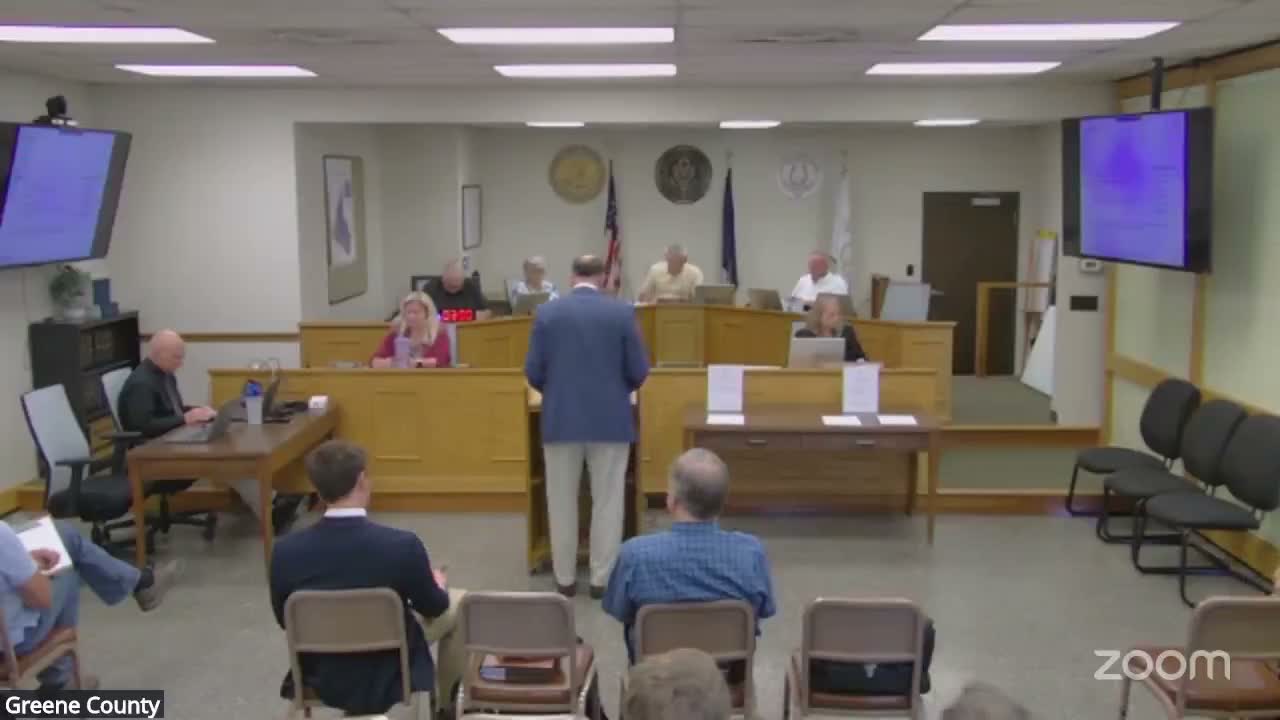
After a workshop presentation on revised cost estimates, county staff recommended a two‑phase bond financing for the White Run reservoir and associated water/sewer work and the Board authorized a Sept. 9 public hearing to consider a bond sale to finance Phase 1.
County officials moved on Thursday to set a public hearing on Sept. 9 to consider selling bonds that would finance the first phase of the White Run reservoir and related water and sewer projects.
The workshop presentation reviewed updated project costs and a financing plan. The presenter said “the total project for Whiterun cost is now $65,500,000” and described an $8,000,000 Department of Environmental Quality loan for a separate Stanislaus sewer project and roughly $14,200,000 in permit financing that has been incorporated into the pro forma. He recommended issuing standalone public market bonds, obtaining a bond rating and using net utility revenues to secure the debt.
The recommendation calls for a two‑phase financing approach: Phase 1 (targeted for 2026) would fund roughly $25 million for the White Run project plus about $1 million for a new well; Phase 2 would follow when additional grant dollars or market conditions make it sensible. The presenter said splitting borrowing gives the county flexibility to reduce later borrowing if state or federal grants materialize.
Board members questioned how revenues would be pledged and whether operational costs would be paid before debt service. Staff answered that bonds would be secured by “net revenues of the system” and that typical utility accounting requires operations to be funded before debt service; staff said connection fees, availability fees and user rates all flow into the utility fund used to meet those obligations.
Staff also recommended several financial policies intended to support a strong rating, including a flat 25% general fund unassigned balance target, limits on tax‑supported debt as a percentage of full value and an 180‑day days‑cash‑on‑hand goal for the utility fund.
The board voted to authorize a public hearing on Sept. 9 to consider an authorizing resolution and related financial policies that would set parameters for a bond sale and allow staff to proceed to market if the parameters are met. If approved after the hearing and final offering documents, staff expects a 60–90 day process to secure ratings and market the bonds.
The next procedural step is the Sept. 9 public hearing when the board may adopt the authorizing resolution, the financial policies and the parameters for sale.