Get Full Government Meeting Transcripts, Videos, & Alerts Forever!
Get email alerts on the Energy Compass Pilot topic
No spam. Unsubscribe anytime.
Fairfax launches Energy Compass pilot to guide homeowners through efficiency and electrification upgrades
Summary
Fairfax County introduced 'Energy Compass,' a concierge-style pilot that pairs residents with energy navigators to provide technical advice, incentive guidance and contractor referrals; the nine-month pilot (soft launch Sept. 2025) targets 1,000 assisted households and 200 completed upgrades at full scale.
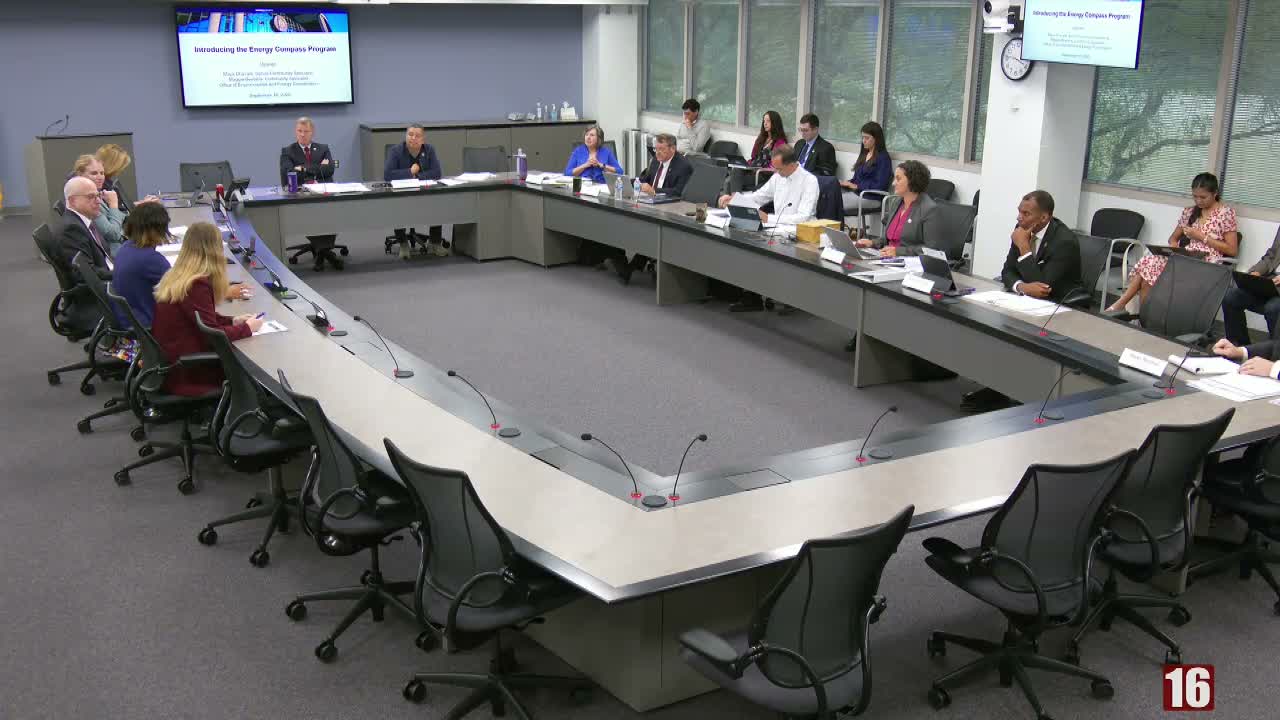
Maya Dvali, senior community specialist in Fairfax County’s Office of Environmental and Energy Coordination, presented the county’s new Energy Compass program to the Board of Supervisors’ Environmental Committee on Sept. 16, describing a concierge-style pilot to help homeowners navigate energy-efficiency and electrification upgrades.
Energy Compass is designed to give single-family homeowners individualized guidance through a five-step process: outreach and intake, navigator review, a scheduled navigator call for technical assistance, a written summary of recommendations, and follow-up. "It's a way for residents to receive individual targeted information and recommendations," Dvali said, adding the program connects residents to energy navigators who provide technical assistance, information on incentives and referrals to qualified contractors.
Pilot structure and targets: staff described three phases — research and design (Jan–Apr 2025), a roughly nine-month pilot that began in May with a soft launch this month, and a later full launch informed by pilot evaluation. Staff said two energy navigators (selected through consulting support from ICF) are being trained for the pilot; the full program goal is to assist 1,000 unique households with 200 choosing to complete upgrades.
Survey and early take-up: Maggie Bietstra (community specialist) summarized survey findings collected via the county’s Engage Fairfax platform. Respondents cited barriers — uncertainty about whether to act when systems still work, trouble finding qualified contractors, high upfront cost, limited home electrical capacity and uncertainty about benefits. Insulation, windows and doors, HVAC, water heating, solar and battery backup storage topped residents’ upgrade interest. Staff reported there were 52 residents who had already indicated interest and would be part of the soft-launch cohort.
How the county will manage contractor referrals and consumer protection: board members asked how the county will provide contractor lists without endorsing firms. Dvali said the program will rely on external certifications and utility-approved contractor lists (for example, lists maintained by Dominion) and will provide neutral guidance and suggested interview questions rather than direct endorsements. "We are going to provide the contractors who specialize in a specific area ... but being as neutral as possible, looking only at external accreditation or professional associations," she said.
Equity and outreach concerns: supervisors asked how the pilot will reach low- and moderate-income households, and whether the current soft-launch cohort is representative across housing types and income groups. Staff said the pilot will test outreach methods, expand partner advertising, pursue demonstration homes and consider neighborhood-targeted outreach (direct mail or community events) and outreach to commercial owners where residents rent. Supervisors recommended exploring "green business" partner lists, 'gold-star' vetting criteria, and AI-enabled templates to scale navigator guidance and extend impact beyond the two navigators.
Next steps: staff will evaluate pilot throughput (appointment length and staff capacity), refine contractor guidance on the website, test neighborhood-level targeting during the pilot, and report findings that will inform a broader launch.