Get Full Government Meeting Transcripts, Videos, & Alerts Forever!
Get email alerts on the Federal Policy Impact topic
No spam. Unsubscribe anytime.
Fairfax officials say federal rollback of IRA-era incentives threatens local climate and human-services gains
Summary
County staff told the Board of Supervisors’ Environmental Committee that HR 1’s rollback of IRA- and IIJA-era tax credits and programs reduces incentives for residential upgrades, disrupts planned state and federal programs, and increases pressure on county services that help vulnerable residents with heating and cooling.
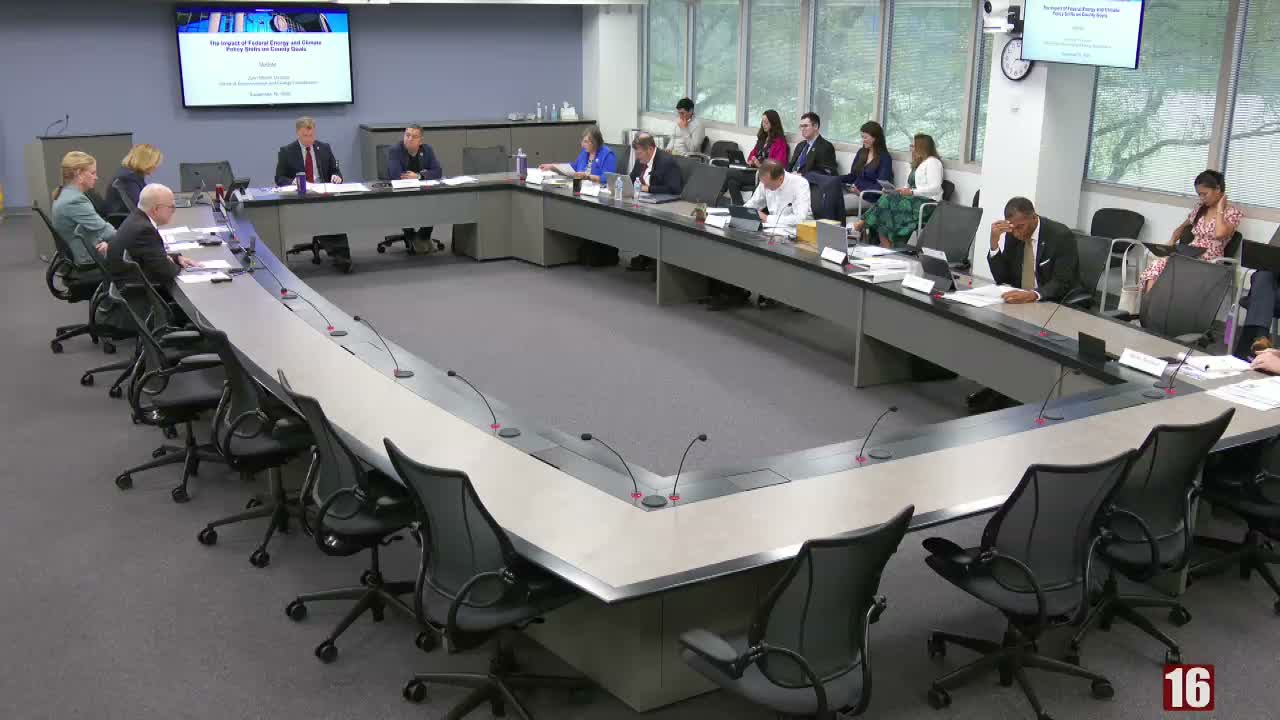
John Morrill, a senior staffer in Fairfax County’s Office of Environmental and Energy Coordination, told the Board of Supervisors’ Environmental Committee on Sept. 16 that recent federal changes have significantly reduced tools the county relied on to meet its carbon-reduction commitments. "This bill reversed many of the tax credits and funding mechanisms put in place for clean energy by the IIJA and IRA," Morrill said, describing a policy shift he called "disruptive" to both energy programming and human services.
The presentation reviewed three federal developments the county had been relying on: the Infrastructure Investment and Jobs Act (IIJA), the Inflation Reduction Act (IRA) and, most recently, HR 1. Morrill said the IRA had extended home-efficiency credits and created state-administered home rebate programs; HR 1 shortened or cancelled many of those supports, including ending the residential 30% clean-energy tax credit at year-end instead of 2032 and curtailing certain state rebate plans. He added that the county’s Energy Efficiency and Conservation Block Grant (EECBG) formula application for $963,000 received conditional approval but remains under Department of Energy review.
Why it matters: Fairfax’s community and operations carbon-reduction plans (adopted 2021) and the 2022 Resilient Fairfax plan rely on a mix of efficiency, on-site renewables and electrification to reduce emissions. Morrill warned that shrinking federal incentives complicates project economics and slows adoption, particularly among residents who need upfront capital or technical guidance.
Morrill also highlighted effects beyond tax credits. He flagged the longstanding Low Income Home Energy Assistance Program (LIHEAP), noting HHS-supported LIHEAP has helped about 1,500 Fairfax households annually with roughly $900,000 in assistance; he said the program’s elimination would leave an unmet need that the county’s AC Rescue program cannot fully cover. "The County AC Rescue program has nearly doubled the number of households receiving room air conditioning," he said, "but even this program cannot come close to satisfying the 1,500 households who receive bill-paying assistance from LIHEAP, if LIHEAP is indeed eliminated."
Board members stressed urgency and equity. The committee chair said the rollback is "very disappointing" and pressed staff to quantify impacts on Fairfax’s CCAP and operational neutrality goals. Morrill said staff is preparing a quantitative assessment to be presented in 2026. Other supervisors urged a two-track response: (1) move quickly to claim remaining federal or state funds the county can still access and (2) pivot locally toward the highest-return strategies (low-cost efficiency measures, streamlined procurement and stronger state and regional partnerships).
What the county will do next: Morrill said Fairfax will complete a quantitative trajectory analysis in 2026, continue updating public-facing energy and climate dashboards, pursue programmatic partnerships, and prioritize short-term actions that deliver the greatest greenhouse-gas reductions per dollar.
The committee’s discussion made a second point: several supervisors framed the federal changes not only as an energy-policy problem but as a human-services risk requiring coordination with Family Services and other county agencies. Morrill noted the county is coordinating across offices and will report back with specific numbers on AC Rescue and other supports.
The committee did not take a formal vote during this presentation; staff were directed to continue analysis and to return with the 2026 quantitative assessment.