Get Full Government Meeting Transcripts, Videos, & Alerts Forever!
Get email alerts on the Instructional Materials Adoption topic
No spam. Unsubscribe anytime.
Miami‑Dade board hears public input on recommended ELA materials; final adoption set for Oct. 8
Summary
Miami‑Dade County Public Schools presented recommended English language arts instructional materials for K–12, received public comment about readings and parental authorization, and voted to accept the hearing record; the board will consider final adoption Oct. 8, 2025.
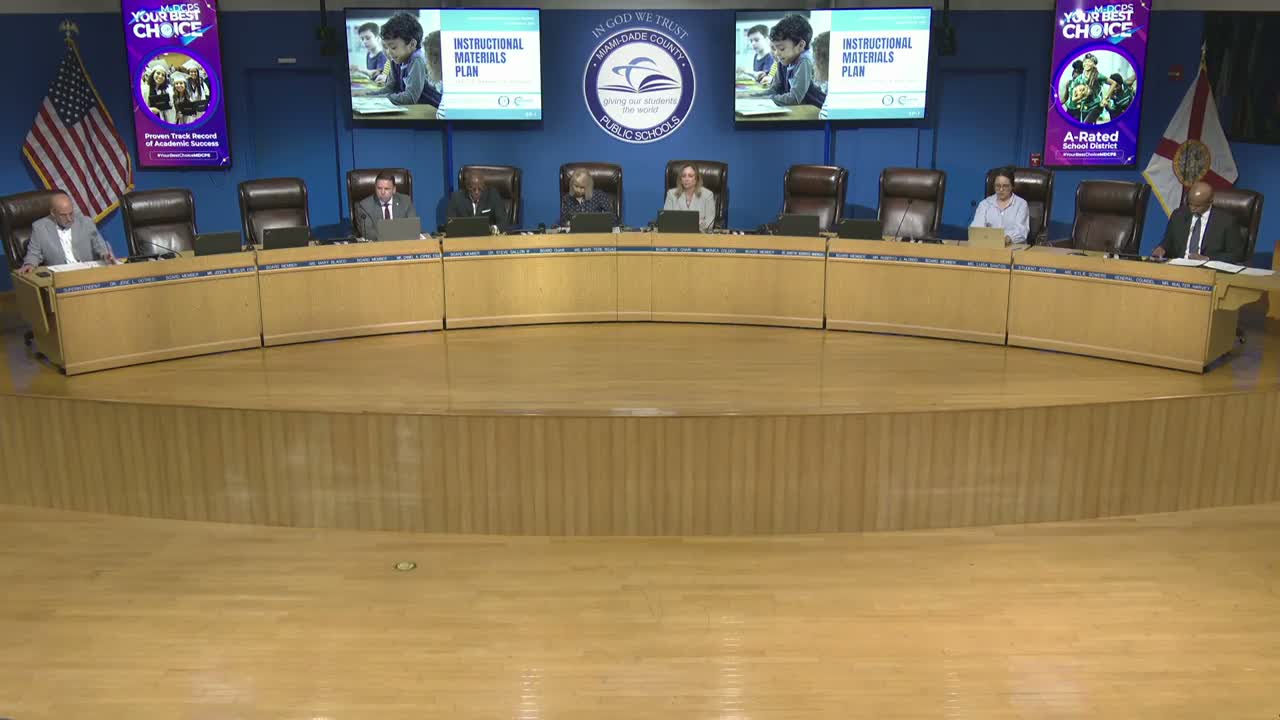
Madam Chair opened a public hearing Sept. 24 on recommended English language arts instructional materials for Miami‑Dade County Public Schools and invited public comment before the board considers final adoption at its Oct. 8 regular meeting.
Lourdes Diaz, who led the district presentation, said the district selected proposed core texts from the Florida Department of Education’s June 3, 2025 approved list after summer subcommittee review and public notice. She listed the subcommittee’s recommendations: McGraw Hill’s Florida Wonders for grades K–5, Savvas My Perspectives for grades 6–12, Bedford, Freeman and Worth titles for Advanced Placement English courses, and National Geographic Cengage Impact and Lift series for ESOL classes. Diaz said the materials have been available for public review on the district instructional materials website since Aug. 6, 2025, and reiterated that purchases are made through the Florida School Book Depository as required by statute.
Superintendent Deltress framed the discussion by urging reporters and the public to consider multiple performance categories, saying the district is “really in the 60. 60% on grade level or above,” and stressing that the review process included parents, teachers and staff volunteers.
During public comment Anna Lopez thanked the district for public access to materials and urged more variety in reading selections and a formal parental authorization process for class content. Lopez said a recent language class assignment required students to watch “a terrorism movie” and asked to work with curriculum staff to create a sequenced Spanish curriculum that begins with language origins and progresses by level.
Board members asked for clarifications during the discussion. Board member Espino noted an August attorney general lawsuit against two publishers alleging price‑related concerns and asked how the district verifies textbook pricing; Diaz responded that district purchases come directly from the Florida School Book Depository at published set prices. Vice Chair Colucci asked whether class novels are read in their entirety; Diaz said the current adoption covers core texts (often excerpts) while novels continue to be selected under district guidelines for age appropriateness and alignment with standards, and she noted the district’s Accelerated Reader platform is available to promote longer texts in elementary grades.
Board members also asked about charter school requirements. Diaz said charter schools are not required to use the district’s selected materials; they may choose from the state preapproved list or run an independent adoption process, though Dr. Steve Gallon III clarified that if a charter’s contract adopts the district’s Comprehensive Research Reading Program, the charter would be expected to use the district’s CRRP materials.
The board voted to receive public comments and close the hearing; the chair reminded the public that the school board will take final adoption action at its Oct. 8, 2025 regular meeting at approximately 1 p.m. and adjourned the hearing.