Get Full Government Meeting Transcripts, Videos, & Alerts Forever!
Get email alerts on the School Facilities Funding topic
No spam. Unsubscribe anytime.
Hardee County school board hears outside advice on hiring lobbyist to pursue state facility funds
Summary
At a Aug. 20 workshop, outside presenters Chris Doolin and Dixie County School Board member Cheryl Pridgen told the Hardee County School Board that hiring a lobbyist can increase chances of securing state special‑facilities funding, outlined timing and procurement options, and recommended careful vetting and team coordination.
Hardee County School Board members spent a workshop hearing from outside advisers about whether to retain a lobbyist to pursue state special‑facilities and other project funding.
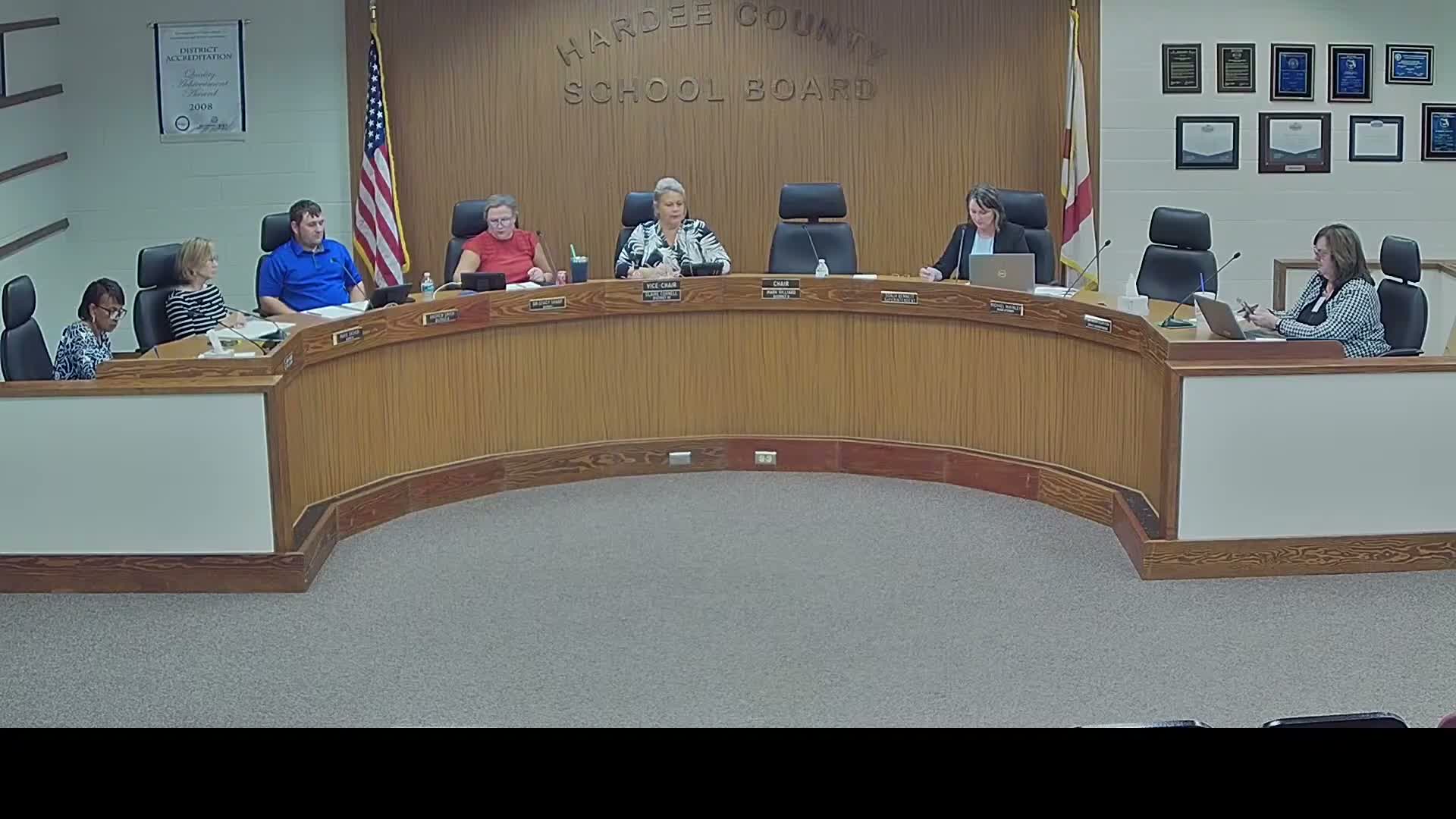
Claire Cornell opened the Aug. 20 workshop and said the board invited two presenters: Chris Doolin, who consults with small and rural districts, and Dixie County School Board member Cheryl Pridgen. Both made the case that a lobbyist can materially improve a small district’s chances of securing large, special‑project appropriations from the state.
Cheryl Pridgen described Dixie County’s experience hiring a lobbying firm when the district pursued a new high school. Pridgen said the district negotiated down an initial fee and now pays roughly $50,000 a year; she summarized the results: "A thousand percent. It's money well spent," and added that her district secured multiple special‑project awards after retaining a lobbyist. Pridgen advised boards to check a lobbyist’s track record on similar projects and to talk with previous clients before hiring.
Chris Doolin laid out the legislative and program timeline and the practical work a lobbyist does: tracking appropriations, arranging meetings with the governor’s office and appropriation staff, coordinating with the district’s delegation, and monitoring the bill process. He told the board the State Board of Education had requested about $342,900,000 for the special‑facilities program and that Hardee County was recommended for roughly $45,800,000 in the State Board’s recommendations to the governor. Doolin said districts should "own the project," bring a compact, consistent team to Tallahassee meetings and be prepared for competitive pressure: he estimated there are hundreds of lobbyists representing thousands of interests and said about 60 districts already retain lobbyists.
Doolin also described the phased funding schedule the board should expect if the recommendation holds: first funding in July 2026, a second tranche in July 2027, and later funding years for remaining amounts, with project completion and student occupancy likely targeted for August–September 2029. He warned boards to plan contracts and construction timing accordingly and noted that cost increases and multi‑year funding can create risk if districts sign long construction contracts before later funding arrives.
On procurement and fees, Pridgen and Doolin recommended vetting and negotiating, and suggested procurement approaches such as an intent‑to‑negotiate or RFQ to avoid inadvertently selecting a lowest bid that does not demonstrate the necessary experience. Doolin named firms and individuals commonly used by small districts (examples mentioned: Southern Strategies, the Ballard group, Kim McDougall, Patrick Bell) and advised the board to confirm any candidate’s experience with the special‑facilities program and with members of the district’s legislative delegation.
Board member Stacy Sharp asked whether neighboring districts can use the same lobbyist; Pridgen said it is common and not necessarily problematic, and that the key is how closely the lobbyist tracks and prioritizes each district’s project. The board also asked whether paying a lobbyist is prudent while the district faces budget cuts; Pridgen repeated her assessment that the investment had produced projects the district could not have funded from its general fund.
On legal and policy matters the presenters recommended checking the district’s procurement policy (one speaker called out "policy 6320") and consulting purchasing staff about whether to use a piggyback contract, RFQ, or an intent‑to‑negotiate process. The presenters warned against single‑sourcing without clear authority and urged the board to rank proposals itself rather than delegating that step.
With no motions or votes taken, the board agreed to accept contact details from the presenters for follow‑up and adjourned the workshop. The presenters offered to help vet lobbyists and to coordinate with any firm the district ultimately retains.
Next steps noted by presenters and the board included circulating the presenters’ contact information to the absent member, inviting proposals from interested firms, and reviewing procurement policy and purchasing options before selecting finalists.