Get Full Government Meeting Transcripts, Videos, & Alerts Forever!
Get email alerts on the HCR 18 Honduras Veterans topic
No spam. Unsubscribe anytime.
Committee hears calls to reclassify Honduras service so veterans can receive expeditionary medals
Summary
Witnesses told the House Veterans and Military Development Committee that U.S. service in Honduras (1981–1992) involved hostile actions and urged Congress to authorize federal expeditionary medals and related recognitions; committee members asked about federal record corrections, benefits, and the possibility of a state-level medal.
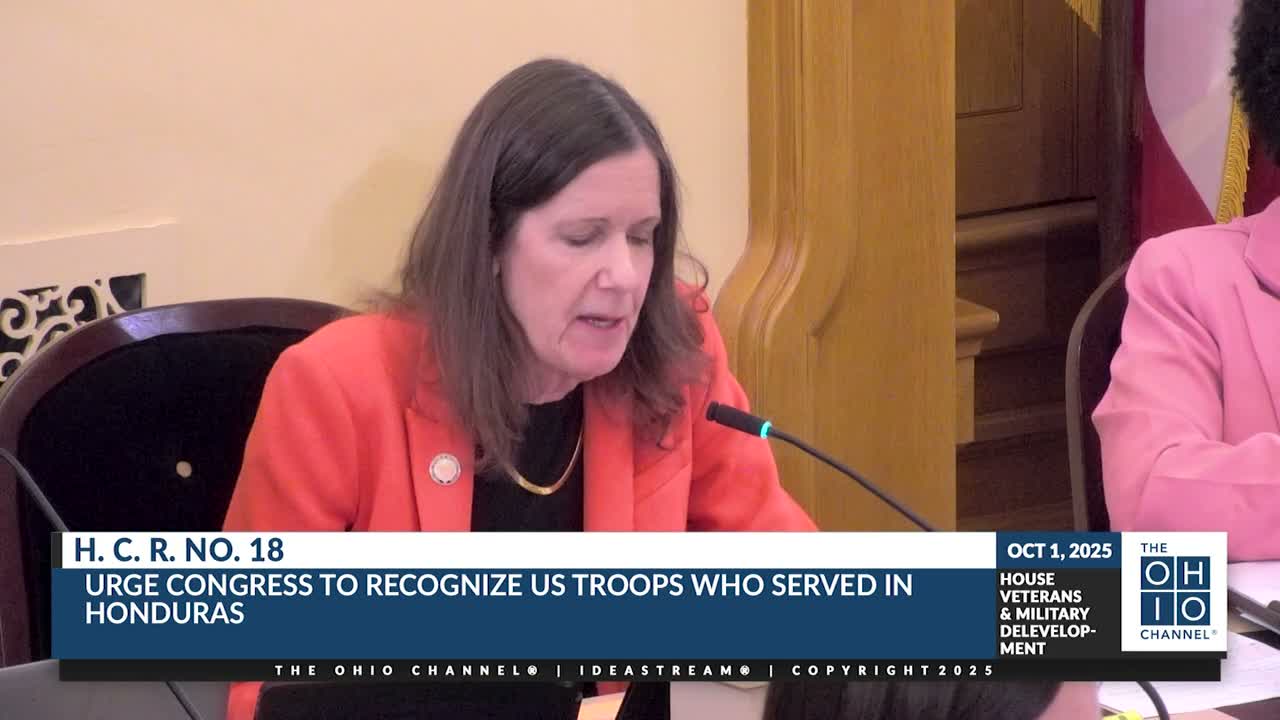
The House Veterans and Military Development Committee on Oct. 13 heard extended testimony supporting House Concurrent Resolution 18, which urges federal recognition for service in Honduras during the 1980s and early 1990s.
Michael Young, testifying in support of HCR 18, said his organization has been researching military deployments to Honduras and argued the Honduras portion of the Central American conflict has not been recognized by the U.S. government as a combat zone. "The Honduras portion of the civil Central American War remains the only conflict that's not recognized by the U.S. government as a combat zone," Young said, and he urged the committee to help secure federal expeditionary medals and other recognition for affected veterans.
Young said research shows thousands served and cited specific Ohio casualties he said occurred during deployments. He told members the campaign produced hostile engagements and that some veterans who sought awards such as Purple Hearts have been denied; Young said the work aims to reopen those determinations and to identify additional veterans who may be eligible for recognition.
Committee members pressed for clarity about what federal recognition would change for veterans. Representative Gambari observed that federal designation is needed to trigger federal benefits that could accompany a medal, and asked whether the federal government would address back pay and benefits. Committee members noted the practical hurdles: Representative Paul (an Army JAG) described the Board for Correction of Military Records and DA Form 638 procedures as lengthy and bureaucratic, and Representative McNally asked whether the committee was seeking retroactive record corrections or waivers.
Members discussed state-level options. Representative Gambari asked whether the Ohio National Guard might issue a state medal to recognize service even if the federal government does not change designations; members suggested a state-level recognition would be symbolic and would not trigger federal benefits. Young acknowledged those complexities and said his organization would work with the adjutant general if given authorization to pursue records research and benefit claims.
No vote was taken on HCR 18 during this session; the committee concluded the second hearing and members signaled an intent to obtain additional witnesses and documents to clarify potential benefits, eligibility, and the federal process for correcting or reclassifying records.
What’s next: Committee staff and members indicated they would gather further evidence, including more witnesses and documentation, before taking formal action on HCR 18.