Lifetime Citizen Portal Access — AI Briefings, Alerts & Unlimited Follows
CCUSA warns of wastewater bottlenecks, lays out master-plan path and possible rate increases
Loading...
Summary
At a joint meeting, CCUSA leaders told Campbell County supervisors the water system is nearing the 10,000-customer threshold and wastewater interceptors along US-29 need near-term upgrades. Staff outlined options (buy interceptor capacity, upsizes, or build a new plant), large capital estimates and illustrative rate increases to pay debt service.
Campbell County officials and leaders of the Campbell County Service Authority (CCUSA) met in joint session to review the authority's water and wastewater systems, long-range master planning and financing options. Jeff Wells, CCUSA executive director, and CCUSA wastewater lead Tim outlined capacity constraints, multi-decade planning needs and preliminary cost estimates for major upgrades.
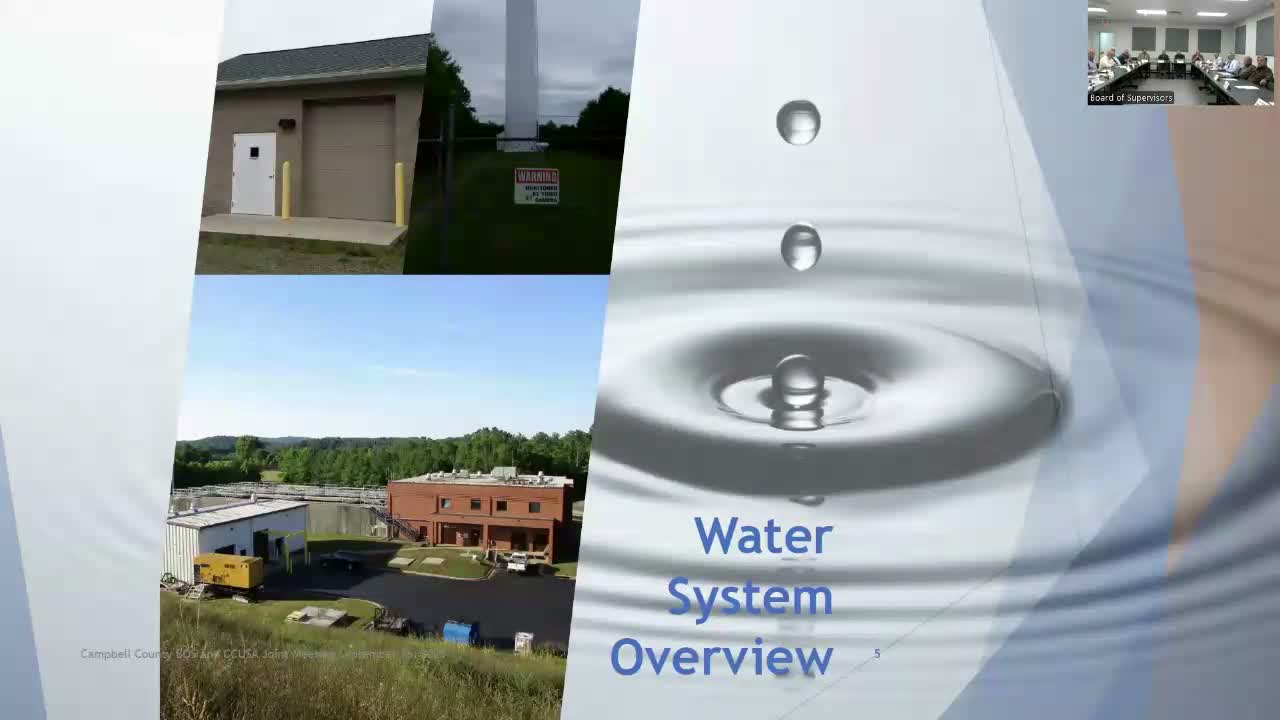
Wells said CCUSA operates the Big Otter River water treatment plant and several groundwater systems and currently records about 9,313 water service connections, approaching the Environmental Protection Agency's 10,000-customer threshold that triggers higher reporting and resiliency requirements. "We currently produced last month, about 2.858" (reported on CCUSA slides), Wells said, noting the plant's upgraded rating is "a little over 4.1 million gallons per day." He said the authority has a water-purchase contract with the City of Lynchburg that comes up for renewal in 2027 and that Lynchburg indicated it will renew but seeks to renegotiate terms.
On the wastewater side, Tim described a system that depends heavily on regional capacity at the Lynchburg Regional Water Resource Recovery Facility, where CCUSA currently owns 1,000,000 gallons-per-day of committed capacity. Tim warned of immediate bottlenecks on interceptors serving the US-29 corridor: the Dreaming Creek interceptor now peaks around 770,000 gpd but would need to reach roughly 2,620,000 gpd to handle planned development and new pump-station flows. He summarized the city's recent estimate: about $4.3 million to upsize the city interceptor, another $865,000 for downstream capacity and roughly $600,000 for CCUSA's local portion of in-system work, a combined figure the presentation placed close to $5 million to secure that capacity.
Tim said staff are studying two broad options to address larger, systemwide wastewater needs: (1) purchase and upsize conveyance capacity from the City of Lynchburg and install strategic local improvements (presented as an option costing roughly $36.5 million when cumulative purchases and upgrades are included), or (2) build a CCUSA-owned wastewater treatment plant (presented as an approximately $45.6 million option that would include land, plant and conveyance). "We're two months into a nine-month update of our wastewater master plan," Tim said. He said the consultant will provide recommendations by late spring or early summer and that the analysis will include life-cycle cost comparisons across a 50-year planning horizon.
Wells and Tim also identified near-term projects already underway. The Martin Drive project includes a pump station sized to about 675 gallons per minute and twin parallel gravity/force-main contracts; CCUSA reported easement progress (for one contract, 22 of 26 easements secured) but acknowledged four remaining holdouts. Tim described staff's standard approach for unresolved easements: an independent appraisal, a bona fide offer and, if necessary, condemnation, with funds for a bona fide offer parked in escrow while litigation is pending.
Financing and rate implications were part of the discussion. CCUSA said it maintains a reserve of roughly $3.5 million and has long-term debt of about $3.2 million with some maturities clustered in the 2027—2031 window. Using a notional $20 million water-plant bond as an example, Wells illustrated debt-service impacts using a 25-year loan at 3.75 percent: a hypothetical $4 increase in the monthly base fee (roughly 24 percent) and an $0.80 per-unit rate increase (about 16 percent) on the water side would generate roughly $928,000 annually; similar wastewater adjustments would generate roughly $320,000, the presentation estimated. Wells said CCUSA intends to phase rate changes over time rather than impose a single large increase.
Officials said other revenue sources have narrowed: federal programs such as prior ARPA-style allocations and some revolving loan funds are less certain, so project funding will likely rely on a combination of rates/fees, developer contributions and targeted grants when available.
What's next: staff said the wastewater master plan update will return recommendations to CCUSA and the board once the consultant finishes its analysis. The report will shape choices among purchasing additional capacity from Lynchburg, upsizing local conveyance, or building a CCUSA treatment plant, and will support more detailed debt versus pay-go financing decisions.