Get Full Government Meeting Transcripts, Videos, & Alerts Forever!
Get email alerts on the Property Tax Reform topic
No spam. Unsubscribe anytime.
School groups warn retroactive credit in substitute HB 186 would cut hundreds of millions from districts
Summary
School administrators and business officials told the House Ways and Means Committee that the substitute for HB 186—if applied retroactively in its current form—would reduce already-budgeted school revenue by hundreds of millions, risk layoffs and credit downgrades and could trigger contract and constitutional challenges.
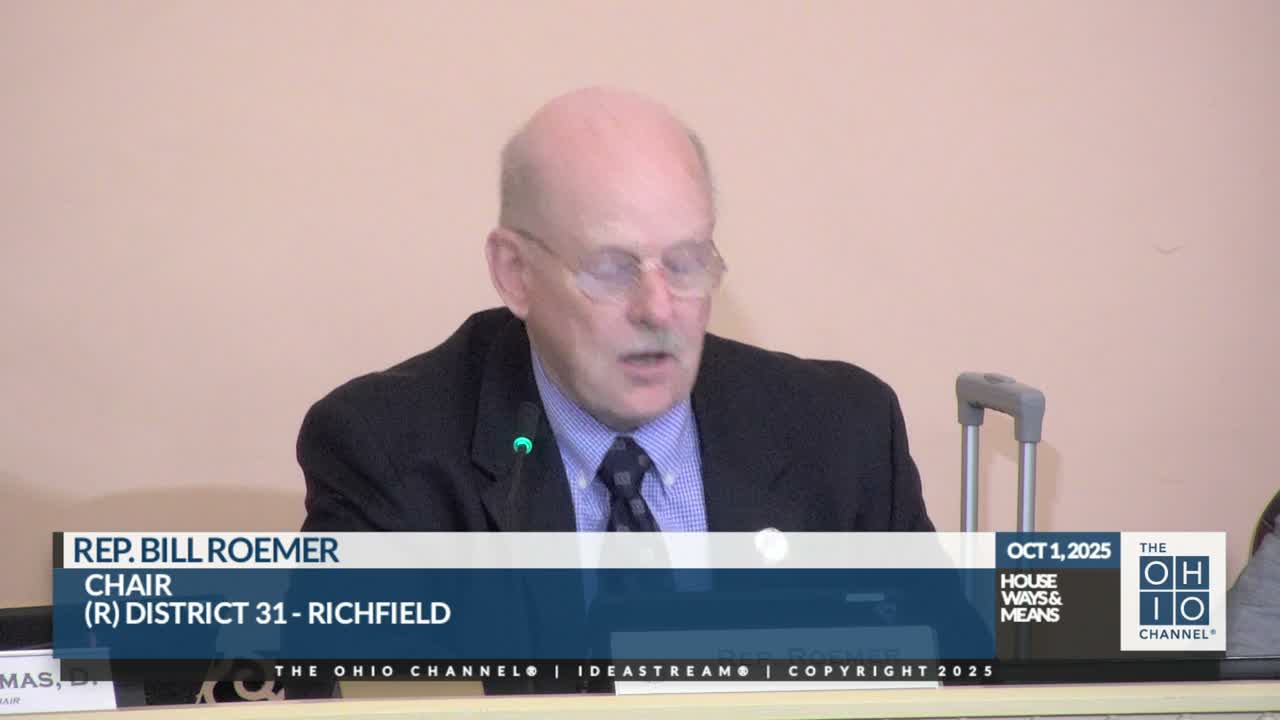
Chairman Romer and members of the House Ways and Means Committee heard sharply divergent testimony Thursday on substitute House Bill 186, a proposal to cap how much property-tax revenue school districts can collect after reappraisals.
Paul Imhoff, representing the Buckeye Association of School Administrators, told the committee the substitute bill’s retroactive language would amount to "a sudden retroactive cut of hundreds of millions of dollars in already collected and budgeted funds," citing Legislative Service Commission figures that "in the first year, more than half of Ohio school districts, 308 in total, will lose $226,400,000 compared to what they received today." Imhoff said those cuts could deplete carryover balances, harm credit ratings and force layoffs.
The testimony for the bill came from county officials and auditors. Summit County Commissioner Alan Harold, testifying for the County Commissioners Association of Ohio and the County Auditors Association of Ohio, said in straightforward terms that "House Bill 186 would cap the allowable property tax increase in 20-mill-floor school districts to the rate of inflation rather than the appraised property value increase," and urged swift enactment with Department of Taxation cooperation so county auditors could administer a 2025 bridge credit payable in 2026.
Why this matters: Committee members and witnesses framed HB 186 as an attempt to address recent sharp appraisal-driven tax spikes, but they disagreed sharply about timing and fiscal effects. Supporters argue a forward-looking inflation cap would protect homeowners from reappraisal-driven spikes; opponents say the substitute’s retroactivity provision would reduce money already committed to contracts and services, disproportionately affecting poorer and rural districts.
Key details and concerns
- Proponents’ aim: Harold and other county officials described the substitute as a mechanism to limit unvoted revenue growth in 20-mill-floor school districts to inflation rather than appraisal increases and urged the Department of Taxation to prepare county auditors so the bridge credit could appear on first-half bills in 2026.
- Administrators’ warning: School associations urged removal of the retroactive portion. Imhoff said the substitute would produce immediate and tangible cuts—"That is a true cut," he said—and listed examples from LSC data of districts with six-figure and multi-million-dollar first-year reductions, noting impacts on staff and services.
- Legal and contractual risk: Witnesses flagged constitutional and contractual issues if revenue schools relied on has already been budgeted and factored into collective-bargaining agreements; committee members raised the prospect of local litigation or districts being unable to meet certified obligations.
- Equity and coverage: Several lawmakers noted that roughly 45% of Ohioans live outside 20-mill-floor districts and would not benefit from this measure, and asked whether the state should share the cost of any credit to avoid shifting burdens entirely onto districts.
- Procedure: The committee received four written testimonies and took no vote on HB 186 Thursday, marking the substitute for further deliberation.
What supporters propose next: Harold and other local-government witnesses urged the committee to adopt the inflation-cap framework and consider the state sharing some burden to protect districts that would otherwise face sudden revenue shortfalls. Several members asked the witnesses for targeted implementation language and for updated fiscal forecasts.
The committee left the bill without a vote to allow more deliberation; members said they wanted additional data, clearer implementation mechanics from the Department of Taxation and options to mitigate contract and cash-flow risks before a final decision.