Get Full Government Meeting Transcripts, Videos, & Alerts Forever!
Get email alerts on the Information Technology topic
No spam. Unsubscribe anytime.
County IT director outlines staffing, aging fiber and AI plans
Summary
Jonathan Pengelly, Campbell County’s director of information technology, briefed supervisors on infrastructure counts, disaster‑recovery steps, a new AI committee and grant pursuits — and warned that aging fiber and cyberthreats remain top risks to 911 and public‑safety operations.
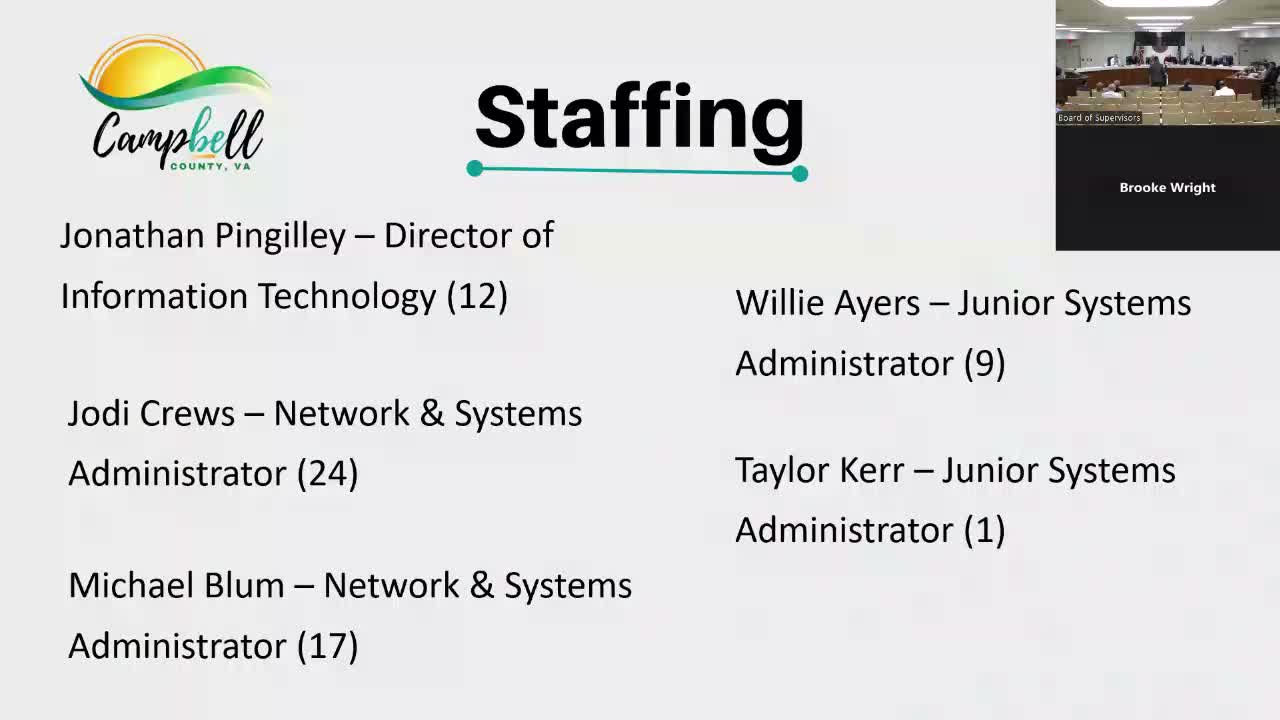
Jonathan Pengelly, Campbell County’s director of information technology, told the Board of Supervisors that his five‑person team keeps networks, servers and public‑safety systems running around the clock and that aging fiber and cyber threats are his chief operational concerns.
Pengelly, who said he has worked for the county for 12 years, introduced staff and listed the department’s responsibilities. "My name is Jonathan Pengelly. I'm the director of information technology," he said. He described the department’s work as covering "network and server infrastructure, both physical and virtual," cybersecurity, help desk support, application and hardware procurement, data and records management, and planning and policy.
Why it matters: IT supports 24/7 public‑safety operations and court and social‑services infrastructure; failures can interrupt critical functions. Pengelly described concrete capacity and replacement planning — information supervisors said helps them weigh budget and staffing choices.
Key details: Pengelly provided inventory and usage figures: the county operates 47 switches, seven routers, roughly 49 wireless access points (with plans to add at least three), about 265 managed endpoints and 10 physical servers hosting 44 virtual servers. He said email storage totals were about 14 terabytes and that the team supports roughly 385 email users.
On resilience, Pengelly recounted an election‑day outage caused by a rodent: "It was a literal rat, that it chewed through this fiber cable, and this is our connection to our library system," he said, noting libraries went offline and that the county lacks redundant fiber paths in some places.
Cybersecurity and continuity: Pengelly described layered defenses and an active backup regime. He said the county backs up on‑site and offloads copies elsewhere and that the department has built a "GoKit" with encrypted drives and keys to restore operations during outages. He also described impersonation protections added to reduce spoofed email reaching elected officials and staff.
AI, training and grants: Pengelly said the county has formed an internal AI committee about seven people strong to help drive policy and cautioned that public employees should not enter personal data into external AI tools. He said training for staff on available tools is in development. He also said the department has applied for state and local cybersecurity grant funding and hopes to learn award results in the coming weeks.
Next steps: Pengelly asked supervisors to consider ongoing investment in fiber redundancy and server refreshes (a five‑year replacement cadence) and signaled continued outreach on grant opportunities. Several supervisors thanked the team for its work and asked staff to return with additional details on phone‑system evaluations, cost savings, and grant award amounts if funds are received.