Get Full Government Meeting Transcripts, Videos, & Alerts Forever!
Get email alerts on the Higher Education Reform topic
No spam. Unsubscribe anytime.
Sponsor defends SB 1 as ‘‘more speech, not less’’ as committee presses on scholarships, governance and labor limits
Summary
Sen. Jerry Serino told the House Workforce and Higher Education Committee that Senate Bill 1, the Advance Ohio Higher Education Act, would empower presidents and trustees, promote "diversity of thought," and curb some DEI-linked practices. Committee members pressed the sponsor on data, scholarship restrictions, collective bargaining and potential budget and legal effects.
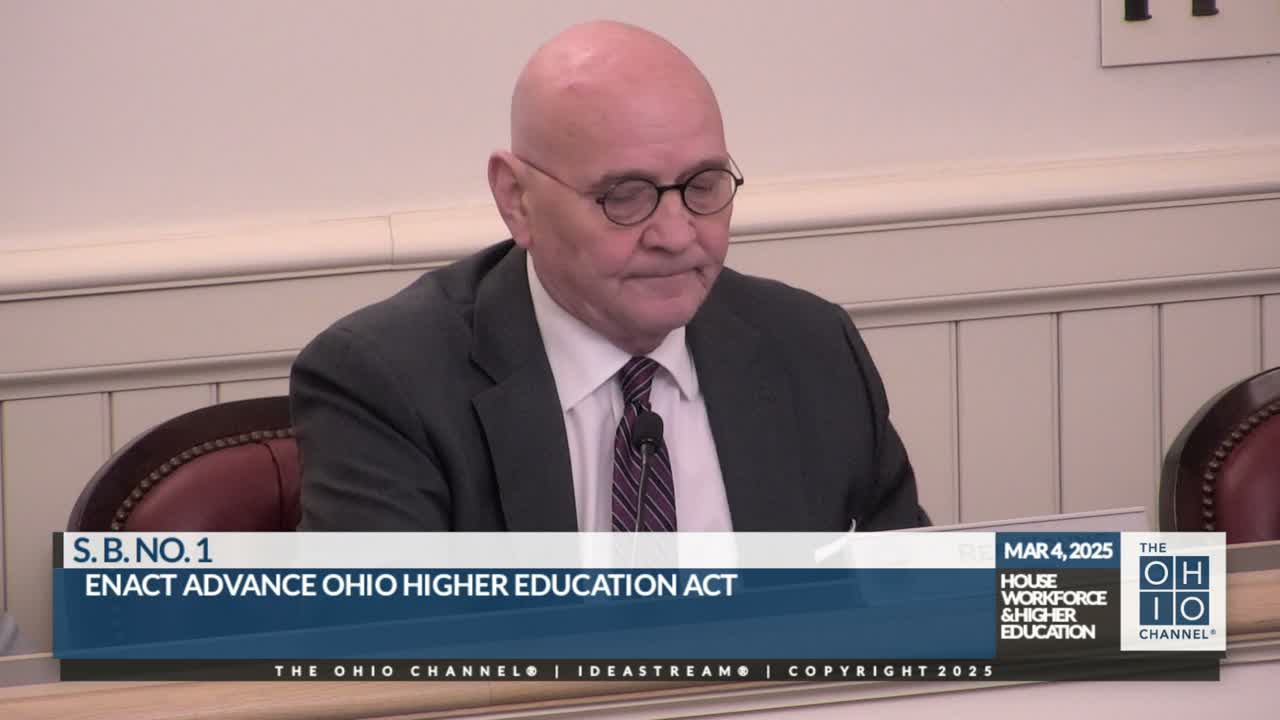
Senator Jerry Serino, sponsor of Senate Bill 1 — the Advance Ohio Higher Education Act — told the House Workforce and Higher Education Committee the legislation is meant "to put our very best foot forward" for Ohio’s public universities and community colleges and "is about more speech, not less." The sponsor framed the package as a response to demographic changes, rising institutional costs and workforce-alignment needs, and said it would give presidents and boards greater authority to make program and staffing decisions.
The bill would, among other changes, restrict some university practices tied to diversity, equity and inclusion (DEI); require demographic and outcome reporting; create a three-credit civics requirement for most bachelor’s degrees (with waivers for equivalent coursework); add higher education faculty to a limited list of workers not allowed to strike; and tighten governance around program and tenure reviews so presidents and boards can act more quickly, Serino said. He described the measure as restoring "academic freedom" and ensuring institutional neutrality while encouraging "diversity of thought." "Students absolutely come first," Serino said.
Committee members repeatedly pressed the sponsor for concrete data to justify the bill’s measures. Representative Abdullahi noted that prior hearings drew about 1,000 opponent testimonies and roughly two dozen proponents and asked what new evidence the sponsor was relying on. Serino pointed to campus visits, conversations with students, faculty and presidents, and published commentary, saying those interactions informed his view that intellectual diversity is lacking at some institutions. Several representatives said that testimony and anecdotes do not substitute for the systematic data they expect before enshrining policy changes into law.
Lawmakers delved into specific provisions. Ranking Member Pickla Antonio and others raised concerns that the bill’s retrenchment language could override locally negotiated collective bargaining processes for layoffs and retrenchments; Serino said the intent is to "empower" presidents and boards, while adding protections for faculty near retirement. Committee members also warned about potential downstream effects on state aid: members explained that if institutional scholarships with donor conditions are disallowed, students could be left eligible for more state grant dollars (OCOG), increasing state costs. Serino acknowledged that could be a mathematical consequence and said some issues may play out in court under federal anti‑discrimination law.
On scholarship language, Serino cited guidance from the Ohio attorney general and the Supreme Court’s recent admissions decision as influencing how race‑based or race‑considered scholarship awards may be treated; he said private donors could still offer targeted scholarships outside university administration. Representative Timbs and others pressed whether donor‑administered scholarships routed through a university would be affected and warned of a "slippery slope" for donor restrictions.
Other points of contention included student trustee voting, tenure and post‑tenure review, and grant administration. Serino said Ohio State’s student trustees are uniquely able to vote and that SB 1 would standardize governance across the public system; he described measures to preserve tenure’s core protections while enabling regular performance reviews and appeals. On research funding, Serino said the bill aims to prevent grants or contracts from carrying unrelated DEI mandates and to ensure federal and national security requirements are met; he also said the bill would limit donations from entities closely associated with the Chinese Communist Party in order to protect intellectual property.
Opponents’ rhetoric and courtroom risk drew sharp exchanges. A representative observed on the record that "the bill is very racist" during questioning; Serino rejected accusations that SB 1 chills academic freedom and said restoring academic freedom is a primary objective. Other members asked for clearer statutory definitions and warned the bill’s ambiguities could invite litigation—an outcome Serino acknowledged courts would resolve by examining legislative text and intent.
The committee did not take a vote at the hearing. Serino closed by saying he would provide line citations and additional clarifications on definitions and that the chancellor’s office would play a role in implementing course and grant review elements. The committee adjourned at the end of the session.