Get Full Government Meeting Transcripts, Videos, & Alerts Forever!
Get email alerts on the Unemployment Trust Fund topic
No spam. Unsubscribe anytime.
ODJFS warns trust fund could go negative by 2032 absent policy changes, outlines options to shore up solvency
Summary
Ohio Department of Job and Family Services Director Matt Damschroder told the Public Insurance and Pensions Committee the unemployment trust fund holds about $1.7 billion and, assuming no recession, could become insolvent by 2032; he outlined policy levers (reducing maximum weeks, raising taxable wage base, adjusting experience rates, or one‑time infusions) and described plans to modernize IT and strengthen fraud controls.
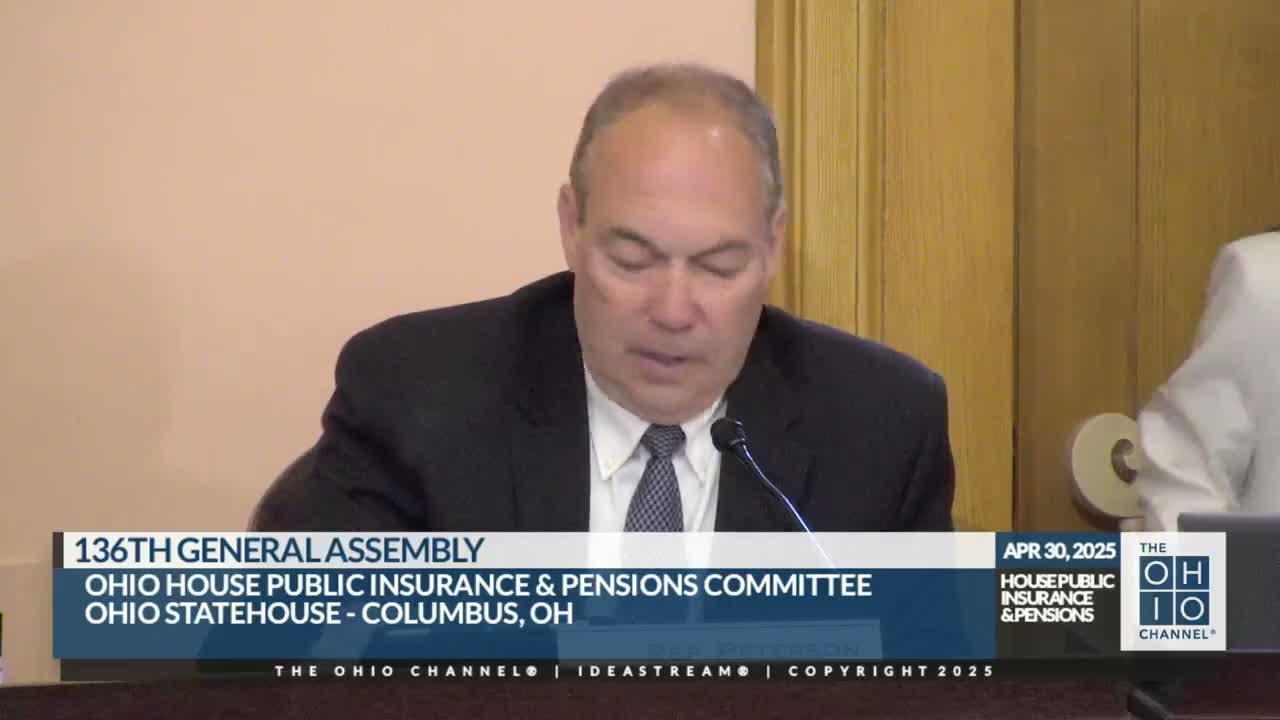
Matt Damschroder, director of the Ohio Department of Job and Family Services, told the Public Insurance and Pensions Committee that Ohio’s unemployment trust fund balance is about $1.7 billion and — on current policy settings and absent a recession — is projected to become insolvent around 2032.
Damschroder explained how the system is funded (federal FUTA taxes and state SUTA taxes), noted that employers are split between contributory and reimbursing types, and said Ohio supplements federal administrative funding with about $20 million from the General Revenue Fund. He described the taxable wage base ($9,000), the dependent add‑on (costing roughly $27.8 million in 2024), and benefit usage (average duration about 13.7 weeks; roughly 23.3% of claimants exhaust 26 weeks).
The director summarized solvency measures and targets: Ohio’s state minimum safe level (MSL) target for 2025 is about $4.4 billion — more than double the current balance — and Ohio does not meet the federal average high cost multiple benchmark. He recounted prior borrowing during 2008 and 2020 and said the 2020 federal loan was repaid in 2021 with ARPA funds to avoid interest charges and higher employer FUTA assessments.
On policy levers, Damschroder gave examples and rough fiscal impacts: reducing the maximum weeks of benefits from 26 to 25 would add about $6.1 million annually; lowering to 20 weeks could add roughly $155 million annually. Increasing the taxable wage base by $1,000 could bring in an estimated $45–50 million a year. He estimated that solving the long‑term shortfall in one step would require adding about $500 million per year across levers, but that the exact path depends on targets chosen by lawmakers.
Damschroder also described administrative responses to pandemic‑era fraud: many fraudulent overpayments have been adjudicated and recovered through coordination with the attorney general and the Department of Taxation, and the agency has implemented stronger identity‑verification measures. He said ODJFS is replacing an aging mainframe with a commercial off‑the‑shelf system under contract; the new system is in implementation and expected to go live in the fall of next year, with a proposed temporary fee in the House budget (2.15% of the taxable wage base) estimated to raise about $74 million per year to fund the replacement.
Committee members pressed for scenario projections, historical taxable wage base changes, comparisons with other states, and details about experience rating. Damschroder agreed to provide year‑by‑year comparisons and additional modeling for recession and non‑recession scenarios. The committee adjourned after requesting those follow‑ups.