Get Full Government Meeting Transcripts, Videos, & Alerts Forever!
Get email alerts on the Safety Grants Bwc topic
No spam. Unsubscribe anytime.
Ohio Chamber asks committee to add $7 million to BWC safety grants in House Bill 81
Summary
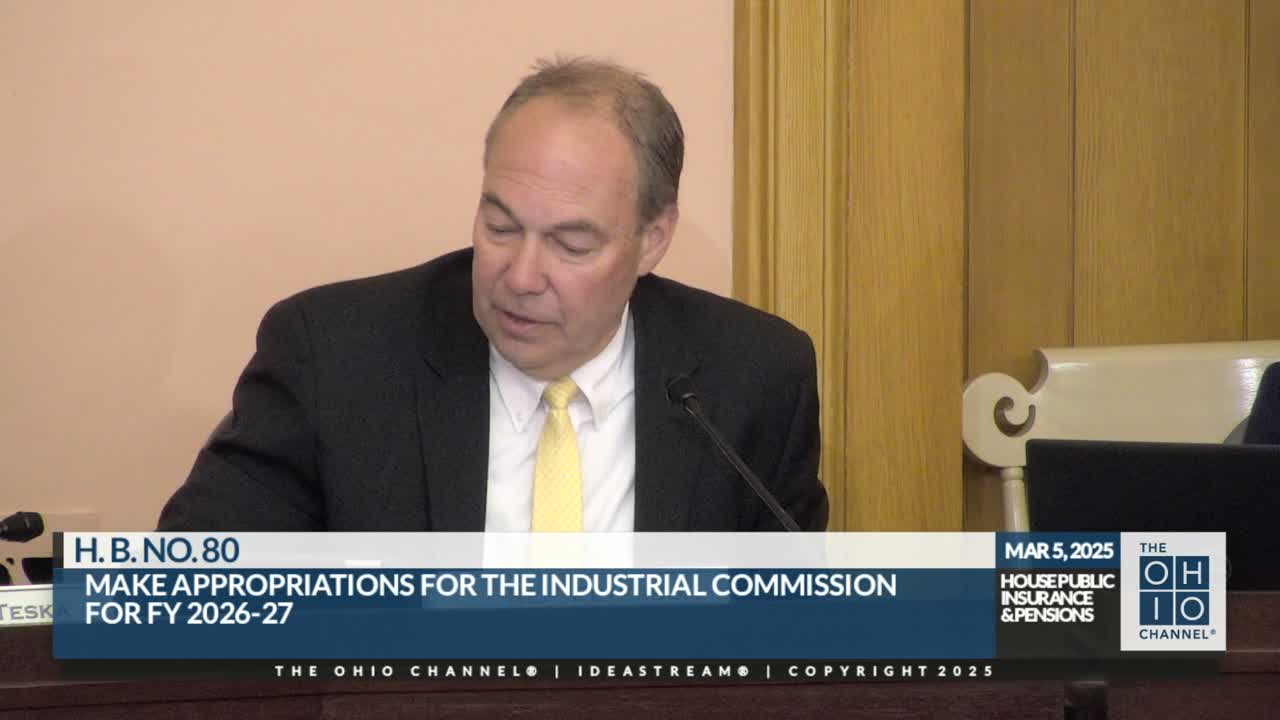
At a House Public Insurance and Pensions Committee hearing, Kevin Schimpf of the Ohio Chamber of Commerce urged an amendment to House Bill 81 to add $7 million from the state insurance fund to BWC safety grants, citing employer demand and past pauses in applications; the committee heard questions but took no vote.
The House Public Insurance and Pensions Committee heard proponent testimony on House Bill 81 as Kevin Schimpf, an associate attorney at Dickinson Wright testifying for the Ohio Chamber of Commerce, asked lawmakers to amend the bill to add $7,000,000 in additional safety grant funding from the state insurance fund.
"We are proud to say Ohio has the fifth lowest workers' compensation premiums in the country," Schimpf told the committee, noting the BWC board recently approved a 6% reduction in private-employer premiums that he said will save employers about $60,000,000 next fiscal year. Schimpf said the Chamber seeks the extra $7 million so the Bureau of Workers' Compensation can meet employer demand for safety grants without pausing applications or seeking a controlling-board appropriation later.
The requested funds would be added as new, non-GRF money from the state insurance fund, Schimpf confirmed when Representative Romer asked whether the $7 million would be non-GRF. Schimpf described the safety intervention grant as a 3-to-1 matching program (BWC provides $3 for every $1 an employer contributes), with awards available up to $40,000 and used for items ranging from law-enforcement body armor to firefighter exposure grants and K–12 school safety and security work.
Committee members questioned how grant impacts are tracked and whether the grants have driven the long-term decline in claims. Schimpf said employers who receive safety grants must submit a report a year after award and that those reports are used to assess outcomes; he also said he had not reviewed empirical studies tying the grants directly to the decline in claims, and suggested industry shifts toward lower-risk employers were a major factor in falling claim counts.
Representative Bridal raised a broader proposal—presented as a hypothetical—that past BWC surpluses could be used to create an endowment intended to generate recurring returns to support employers. Bridal cited historical surplus-return numbers to illustrate the idea. Schimpf cautioned that creating a system that effectively made workers' compensation "free" could remove incentives for employers to invest in workplace safety and said such a change would require broad stakeholder engagement.
Vice Chair Teska and other members also pressed Schimpf on why average payouts have risen even as claim counts fell; Schimpf pointed to increases in medical costs and in the statewide average weekly wage, which raises temporary-total disability payments as the primary drivers.
No amendments or votes were taken during the hearing. Chairman Peterson closed the session after the question-and-answer period and the committee adjourned.