Get Full Government Meeting Transcripts, Videos, & Alerts Forever!
Get email alerts on the Pensions OPF topic
No spam. Unsubscribe anytime.
Police and Fire fund says 70% funded; health HRA and legacy liabilities remain challenges
Summary
An OP&F representative told the committee the Ohio Police & Fire Pension Fund is about 70% funded, cited long‑running legacy liabilities from the 1965 rollup of municipal plans, and described a consumer‑driven HRA that stabilized health‑care spending but does not roll over for beneficiaries.
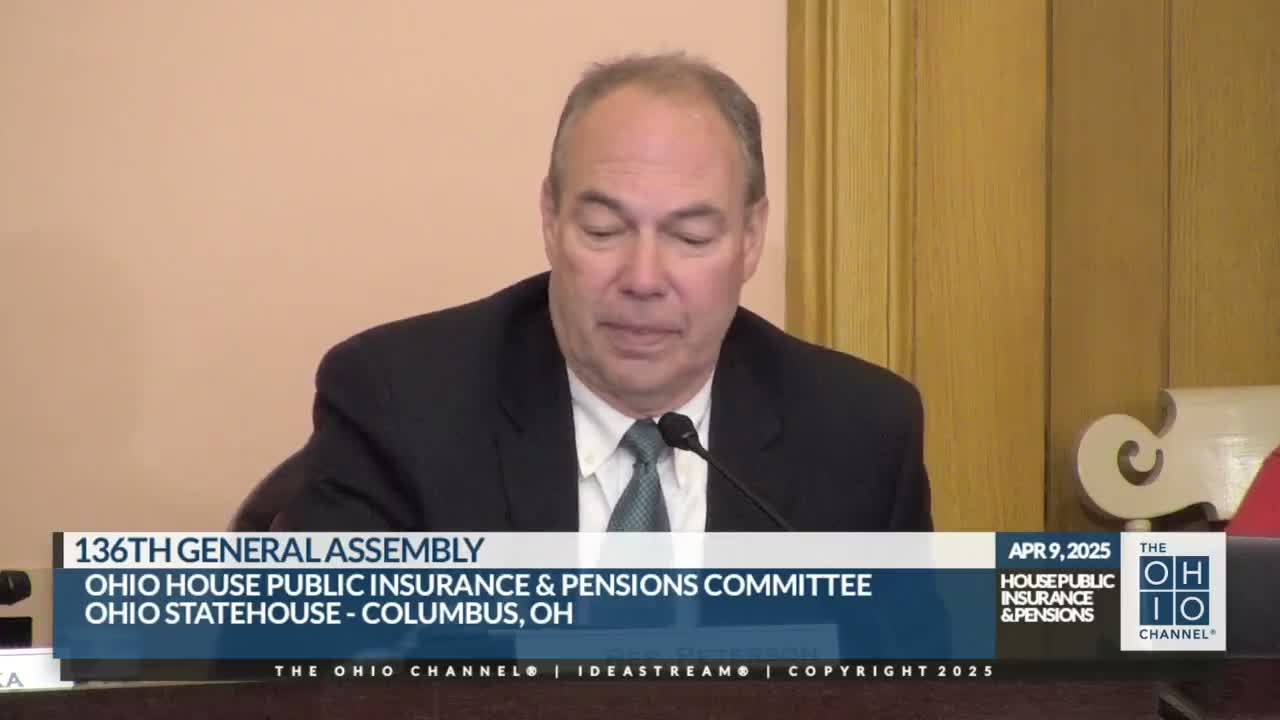
An Ohio Police & Fire Pension Fund representative addressed the House Public Insurance and Pensions Committee and described OP&F’s long history, legacy liabilities and recent reforms. The presenter — addressed in the hearing as "Mary Beth" — told lawmakers that OP&F began accepting liabilities after a 1965 consolidation and that the fund is now about 70% funded.
"OP and F is about 70% funded," the speaker said, summarizing the fund’s current status and pointing to a one‑page summary in the committee binder. The presenter explained that the fund has had to absorb significant historical liability and that employer contribution rates, which have not changed materially in decades, remain a core challenge; she cited employer contribution rates (police employers 19.5% and firefighter employers 24%) as factors that do not currently sustain the fund.
On COLA, the OP&F representative said members typically do not receive a COLA until age 55 and that COLAs are capped at 3% of CPI; she also described the fund’s move to a consumer‑driven health plan and a health stabilization fund. The OP&F HRA model differs from some other systems: the OP&F representative said OP&F does not allow HRA balances to roll over and that the transition reduced health‑care volatility dramatically (the presenter reported a marked decline in annual health spending volatility since the change).
Committee members asked about active‑to‑retiree ratios, average retiree age and the effect of service‑credit transfers among systems. The OP&F representative reported roughly 31,000 active employees and about 23,000 retirees at one point in the hearing when comparing other systems, and described the statutory limits on transfer of service credit and how members must pay contribution differences to bring service across systems.
The presenter emphasized OP&F’s recent clean audits and said OP&F had the highest returning investment portfolio year in 2024, while acknowledging the plan remains under the 30‑year statutory requirement and still faces a need to address legacy funding shortfalls.