Get Full Government Meeting Transcripts, Videos, & Alerts Forever!
Get email alerts on the Pensions OPERS topic
No spam. Unsubscribe anytime.
OPERS tells committee pension fund is 83% funded; health fund tops $13 billion
Summary
Karen Caraher, executive director of the Ohio Public Employees Retirement System, told the House Public Insurance and Pensions Committee OPERS’ pension fund is 83% funded with a 16‑year amortization period and said the system’s health‑care trust balances about $13 billion, while emphasizing health benefits remain discretionary.
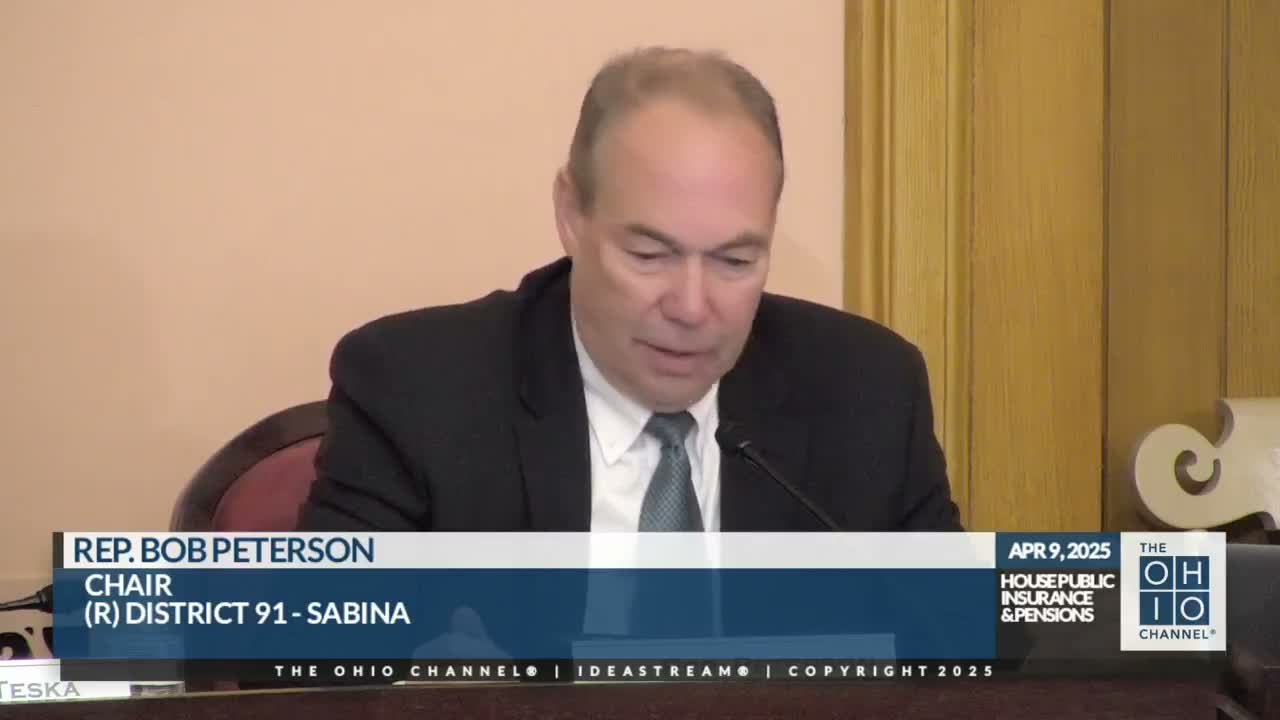
Karen Caraher, executive director of the Ohio Public Employees Retirement System, told the House Public Insurance and Pensions Committee that OPERS’ pension fund is 83% funded and has a 16‑year amortization period, under the 30‑year statutory threshold. "We're 83% funded," Caraher said as she summarized OPERS’ funding position and how the pension and health‑care trusts are managed.
Caraher explained OPERS operates two separate trusts: a pension trust (where member money is fully refundable and funds retirement benefits) and a health‑care trust that she described as "one of the largest in the United States. It sits at $13,000,000,000." She told lawmakers the basic funding equation is contributions plus investment earnings equals benefits plus expenses, and that contributions are fixed by statute while investment returns vary by market performance.
The executive director said OPERS has intentionally reduced investment risk and now uses a 6.9% assumed rate of return. She walked members through historical return patterns and stressed that negative return years have a multiplicative effect on liabilities. For 2024 OPERS reported an actuarial accrued liability and market value of assets that resulted in an unfunded liability OPERS is working to amortize over 16 years.
On cost‑of‑living adjustments (COLA), Caraher said pension reform replaced prior fixed, non‑compounded 3% COLAs with CPI‑based COLAs capped at 3% for groups retiring after Jan. 7, 2013; retirees who retired before that date keep a fixed 3% COLA. When Representative Romer asked whether COLAs are guaranteed, Caraher said the current retirees’ COLAs are guaranteed under existing rules and that OPERS has twice sought legislation (around 2017–2018) to give the board more discretion on COLAs but those bills failed.
Caraher also emphasized OPERS’ funding policy limits the use of contributions: health‑care allocations require an amortization period at or below 10 years before the board may make discretionary allocations, and any benefit increases would be one‑time payments and would require long‑term excess funding (she said the board would consider increases only if the system were 120% funded for five years).
Committee members asked follow‑up questions about member reliance on OPERS in lieu of Social Security and about member education on supplemental savings; Caraher confirmed OPERS members are outside Social Security and that OPERS encourages but does not provide supplemental savings products.
The hearing was informational; the committee approved the prior meeting’s minutes without objection and adjourned after the presentations.