Get Full Government Meeting Transcripts, Videos, & Alerts Forever!
Get email alerts on the House Bill 20 topic
No spam. Unsubscribe anytime.
ACLU of Ohio urges rejection of amended HB 20, warns 14-foot buffer could chill speech
Summary
At a House Public Safety Committee hearing, the ACLU of Ohio opposed amended House Bill 20, arguing its 14-foot buffer and vague terms like 'disrupt' could be abused to penalize lawful speech and newsgathering; members pressed witnesses on whether existing obstructing-official-business statutes suffice.
Gary Daniels of the ACLU of Ohio told the House Public Safety Committee that the amended House Bill 20 — which would create a 14-foot buffer zone around first responders performing duties — casts too wide a net and risks infringing First Amendment rights.
"For these reasons and more, the ACLU of Ohio urges your rejection of amended House Bill 20," Daniels said, adding that the bill is unclear about how severe or sustained an interruption must be to trigger penalties.
Daniels acknowledged the bill's sponsors cite life-or-death scenarios in which buffer zones protect responders, but he emphasized that Ohio already has an obstructing-official-business statute that addresses many interference situations. He said the bill's undefined terms — including "interfere," "impede," and "disrupt" — create uncertainty about whether brief or momentary conduct, or constitutionally protected speech such as shouting, could be criminalized.
Members of the committee pressed Daniels on application and scope. Ranking Member Thomas asked whether existing statutes are adequate; Daniels replied HB 20 had been pared back from a new offense to an amendment within the existing obstructing provision but said more granular clarification might be preferable to creating a new, broad standard.
Representative Gambari raised concerns about the impact on media newsgathering. Daniels noted media organizations have led litigation in other states over similar laws, pointing to an Arizona statute restricting recording within eight feet that was struck down and to 25-foot buffer statutes in other states that courts enjoined.
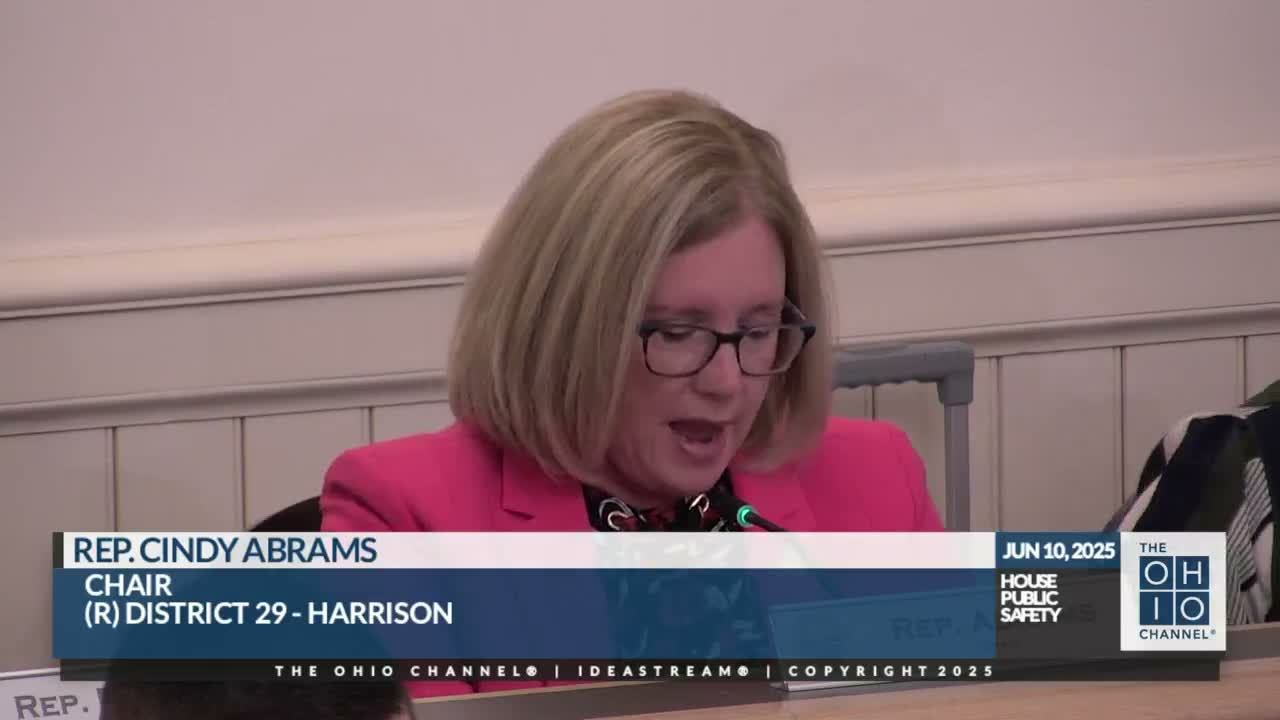
Chair Abrams read an amendment that defines "warning" as a verbal command from an emergency responder communicated so that a reasonable person would believe they must comply. Daniels said that clarification is an improvement but reiterated that other terms remain vague and could permit overbroad enforcement depending on how officers and prosecutors apply the law.
Representative Brewer recounted a personal incident in which officers told him to move while he was trying to assist someone, and said he believes HB 20 could have subjected him to a minor misdemeanor. Daniels agreed those kinds of fact-dependent circumstances are concerning and said the bill may be used, intentionally or not, to chill bystanders and newsgathering.
Chair Abrams noted proponents’ written testimony from the Ohio Police Chiefs Association and the Ohio Prosecuting Attorneys Association was available to members and closed the committee’s third hearing on HB 20. No committee vote was taken at the hearing.