Get Full Government Meeting Transcripts, Videos, & Alerts Forever!
Get email alerts on the Missing Persons Database topic
No spam. Unsubscribe anytime.
Sponsors tell Public Safety Committee the FIND Act would mandate NamUs entries within 30 days
Summary
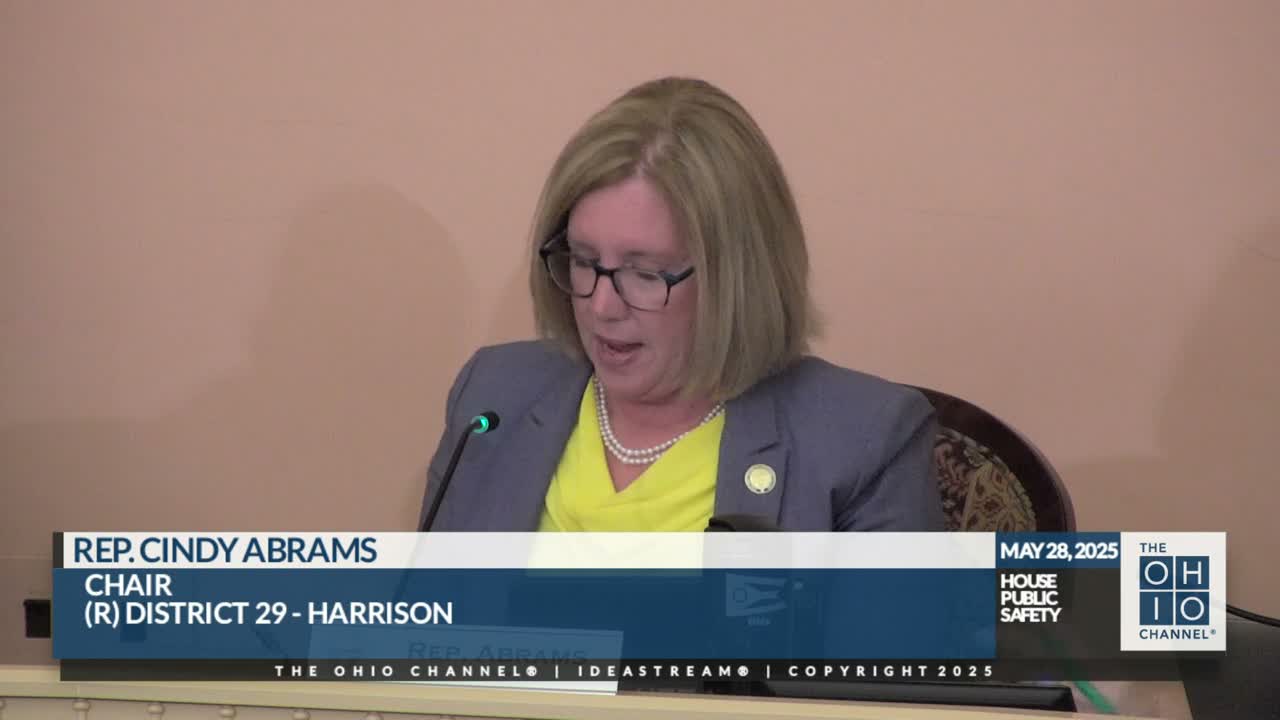
Sponsors of House Bill 217, the FIND Act, told the Public Safety Committee that the bill would require Ohio law enforcement to enter missing‑person records into the national NamUs database within 30 days to improve cross‑state searches and family support; committee members pressed sponsors on definitions, integration with NCIC and enforcement.
Representative Coughley and Representative Kevin Ritter presented sponsor testimony for House Bill 217, known as the FIND Act, at a Public Safety Committee hearing. The sponsors said the bill would require law enforcement agencies in Ohio to enter missing‑person information into the National Missing and Unidentified Persons System (NamUs) within 30 days of a report being filed.
Coughley described a personal connection to the legislation, citing a missing person billboard for Andrew Chapman and saying, “These are not just numbers. They are someone's neighbors, friends, and loved ones, and they deserve every possible resource to be brought home.” Ritter emphasized the bill’s practical aims, saying the FIND Act would “further integrate the existing law enforcement missing persons reporting system with the only national repository for missing, unidentified, and unclaimed persons cases.” The sponsors noted NamUs was created in 2003 by the National Institute of Justice and said participation is required in 16 other states.
Committee members asked detailed implementation questions. Representative Gambarri asked whether a state must be a member to access NamUs; sponsors replied that every state has access but not all states are required to use the program, and mandatory participation would increase the chance that neighboring jurisdictions locate missing persons or remains. When asked whether the bill changes the legal definition of a missing person, sponsors said the bill does not alter definitions, and that eligibility criteria for entries can vary by state.
Representative Plummer raised administrative concerns about duplication of entries given existing NCIC reporting. Sponsors said NamUs is a government database operated with a federal contractor and that they are exploring technical integration to avoid imposing additional burdens on records units. Vice Chair Miller asked what types of information NamUs holds; sponsors described profile types (forensic/detective versus public/family) and said entries may include last‑seen information, clothing, contact details, identification status and DNA availability.
Representatives also asked about stakeholder outreach and compliance. Sponsors said they had spoken with local sheriffs and the Fraternal Order of Police and had not encountered opposition to date, but acknowledged the bill currently does not prescribe enforcement steps if an agency fails to meet the 30‑day entry window and said they will seek stakeholder feedback on motivating compliance.
The chair closed the first hearing on House Bill 217 with no vote taken. Sponsors said they were available for follow‑up and thanked the committee.
The committee did not take formal action on House Bill 217 during this session; the hearing record contains sponsor statements, member questions about definition, integration and enforcement, and sponsors’ answers as described above.