Get Full Government Meeting Transcripts, Videos, & Alerts Forever!
Get email alerts on the Policing Quotas topic
No spam. Unsubscribe anytime.
Ohio Public Safety Committee hears testimony on banning ticket and arrest quotas
Summary
Lawmakers and law-enforcement witnesses told the House Public Safety Committee that proposed legislation (SB114/HB131) would ban ticket and arrest quotas in personnel evaluations, create an Attorney General reporting path, and is backed by police chiefs and unions; witnesses recounted career damage tied to quota systems.
The House Public Safety Committee heard sponsor and proponent testimony on legislation to prohibit law-enforcement agencies from using ticket or arrest quotas as the basis for evaluation, compensation, or discipline.
Senator Tom Patton, sponsor of Senate Bill 114 (the Senate companion to House Bill 131), told the committee the bill passed the Senate unanimously and would "prohibit law enforcement agencies from using tickets or arrest quotas as the basis for evaluation, compensation, or discipline" and establish a reporting system to the Attorney General to investigate allegations of unlawful quota use. Patton said the bill grew out of concerns raised by the Ohio Patrolmen's Benevolent Association and the Fraternal Order of Police and has support from the Ohio Police Chiefs Association.
Law-enforcement witnesses and advocates offered testimony supporting the change. Chief Robert Butler, president of the Ohio Association of Chiefs of Police, told legislators quotas "undermine the very foundation of our profession" and that evaluations should assess the quality and impact of officers' interactions rather than raw counts. Officer Leonard Mazzola gave a personal account of his department implementing a performance standard he called a quota; he said the policy led to disciplinary proceedings, public scrutiny and a federal lawsuit (Mazzola v. Tagliati) that settled in 2022, and described the quota as ending his career.
Research and community voices were cited in support. Alan Smith of the R Street Institute summarized academic literature he said shows states that bar quotas tend to see better-quality traffic stops and, in some analyses, improved clearance rates for violent crimes. Emily Cole of Ohio Families Unite for Political Action and Change said community members also back the measure as a way to reduce unnecessary officer–community interactions and restore public trust.
Committee members used the hearing to press sponsors on scope and enforcement. Ranking Member Thomas described personnel-evaluation practices in large departments that compare citation averages and can penalize officers who fall below the local average; Senator Patton and proponents said the bill explicitly bars using tickets or arrests as the basis for evaluation, compensation, or discipline and names the Attorney General as the enforcement agent.
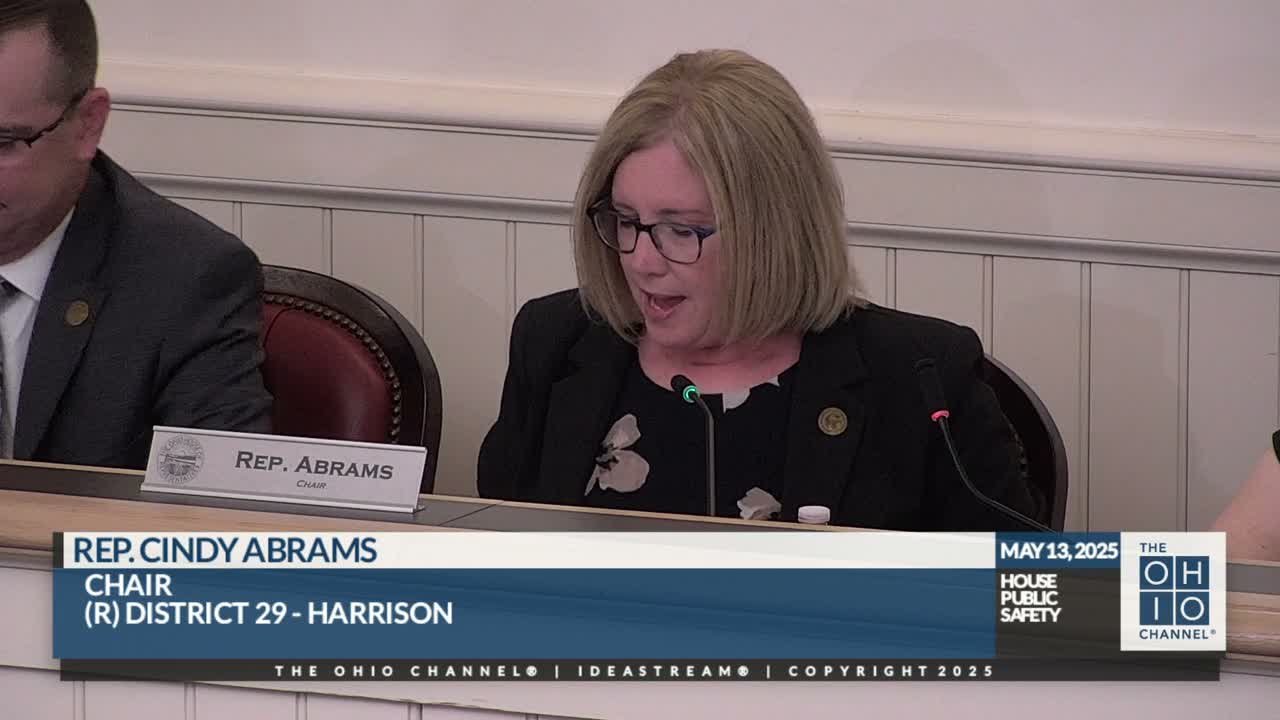
No final action on the quota ban was recorded in the hearing. Chair Abrams closed the SB114 hearing after testimony and questions; sponsors indicated they expect to continue work in committee.