Get Full Government Meeting Transcripts, Videos, & Alerts Forever!
Get email alerts on the Public Safety Buffer topic
No spam. Unsubscribe anytime.
Ohio committee hears bill to create 14-foot ‘halo’ around emergency scenes
Summary
Sponsors told the House Public Safety Committee HB20 would establish a 14-foot buffer around emergency and crime scenes to keep bystanders from impeding first responders; members raised questions about definitions, criminal penalties, and how the law would interact with existing obstruction statutes.
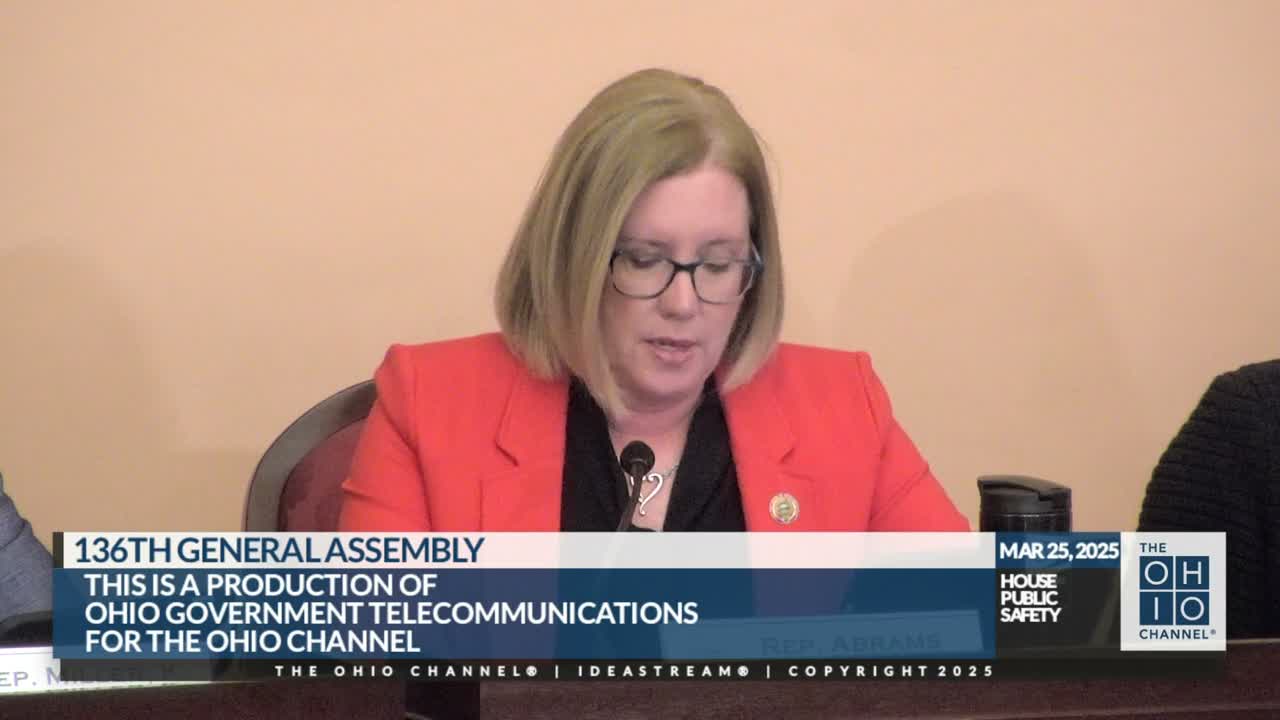
Chair Abrams convened the House Public Safety Committee on March 5 for the first hearing on House Bill 20, a measure sponsors said would create a defined 14-foot buffer around emergency scenes so police, fire and EMS personnel can work without interference. "Just give us 14 feet to do our jobs," Representative Palmer said during sponsor testimony, summarizing the proposal’s practical aim.
Sponsors framed the bill as primarily protective and educational. Representative Thomas Hall said the measure is not intended to stop helpful bystanders or people who record an incident, but to ensure first responders have space to treat victims and extricate the injured. Representative Palmer told the committee officers and EMTs would give warnings before any enforcement action.
The bill would create a misdemeanor offense tied to proximity and noncompliance within the buffer; sponsors said they drafted it as an M1 misdemeanor but signaled openness to lowering the penalty. Committee members asked how "14 feet" and "reasonable fear" would be defined in the field and whether the proposal would duplicate existing obstruction-of-official-business laws.
Ranking Member Thomas said officers already can charge obstruction when someone intentionally impedes official duties, and asked whether a separate statute is necessary. Sponsors responded that the bill’s purpose is to set a clear and consistent public expectation—a specific ‘‘halo’’—so bystanders know how far to stay back. Representative Palmer pointed to other states, noting some use wider buffers (sponsors referenced a 25-foot standard in Florida) and said local protocols vary.
Members also raised equity and safety tradeoffs. Representative Brewer warned the bill could catch people trying to help victims and asked about disproportionate enforcement; sponsors said discretion at the scene and prosecutorial review would limit that risk and that they were open to language changes to protect well‑intentioned interveners.
The committee did not vote on HB20. Chair Abrams closed the first hearing and said the committee will work with the sponsors on possible amendments, including clarifying how the buffer is measured, whether a verbal warning is required, and what penalty level is appropriate.