Get Full Government Meeting Transcripts, Videos, & Alerts Forever!
Get email alerts on the Foreign Adversary Property topic
No spam. Unsubscribe anytime.
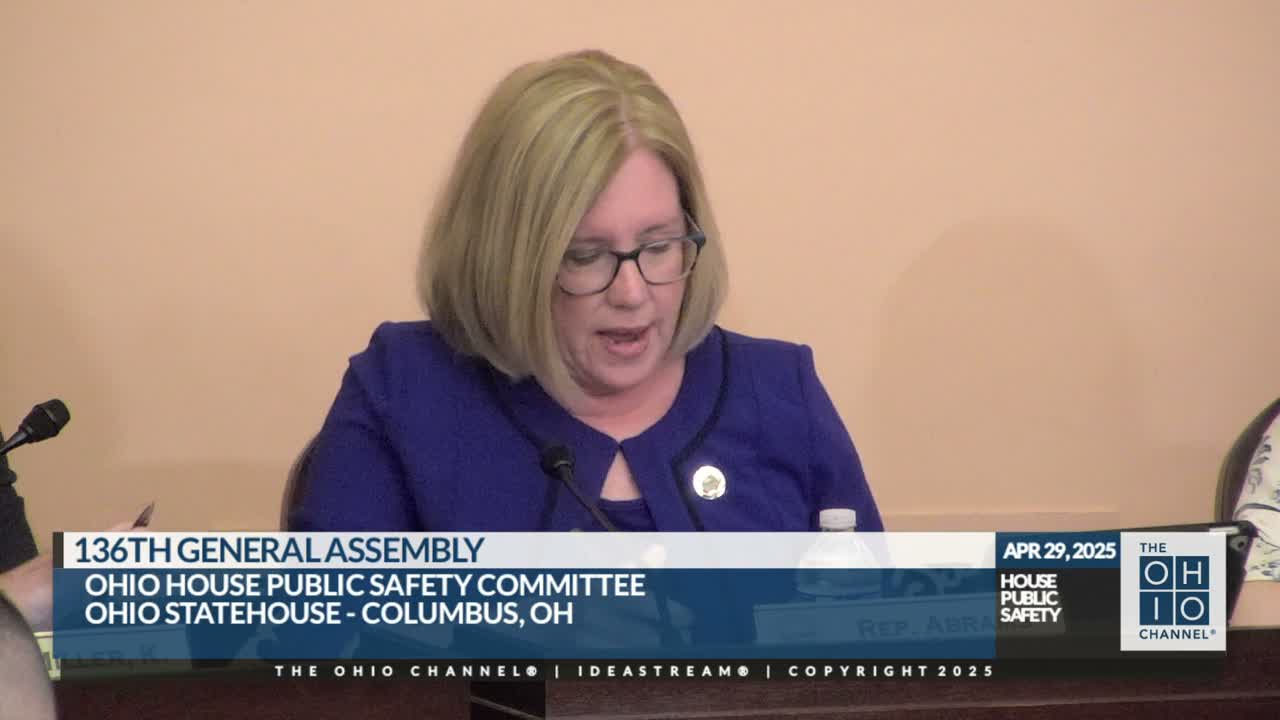
Committee hears extensive proponent testimony on bill to restrict foreign adversary land purchases near critical sites
Summary
Lawmakers and witnesses debated House Bill 1, which would bar specified foreign adversaries and listed terrorist organizations from acquiring protected property—land near military bases and critical infrastructure—and create local enforcement mechanisms; two sponsor amendments were adopted during the hearing.
The House Public Safety Committee spent nearly two hours on House Bill 1, a proposal the sponsors are calling the Ohio Property Protection Act, hearing proponent testimony and extended member questioning about how the measure would define "foreign adversaries," treat military service members and lawful permanent residents, and be enforced.
Representative Bernie Willis, the bill's sponsor, framed HB1 as a national-security safeguard to protect military installations and other critical infrastructure from foreign influence. "We want to deter and prevent any new potential attacks," Willis told the committee, citing prior cases in other states where land purchases near bases raised security concerns. Willis said the bill would build on restrictions the legislature adopted previously and rely on federal-designation lists when identifying prohibited purchasers.
Multiple witnesses emphasized China as the principal near‑term concern while acknowledging the bill is written to apply to any entity the federal government designates an adversary. Beau Houghton of State Armour testified the goal is to "reduce the surface area of risk" and cited examples including land acquired near Laughlin and Grand Forks Air Force Bases. Carla Jones of the American Legislative Exchange Council said many states have adopted similar safeguards and urged a structured process for identifying nations of concern.
Committee members asked detailed operational questions. Representative Gambari and others raised the potential effect on lawful permanent residents serving in the U.S. military; witnesses agreed exemptions could be considered. Several lawmakers asked whether the State Department or another federal list would determine which nations are treated as adversaries and how counties and sheriffs would be equipped to investigate complex foreign‑actor ties. The sponsors said the secretary of state would compile a registry informed by federal lists and that, under this bill, many enforcement actions would be handled at the county level with oversight available from the attorney general.
Two sponsor amendments were offered and accepted without objection. Representative Willis moved amendment 136-0430 to require the secretary of state to consult federal lists (including designated foreign terrorist organizations and cartels) when compiling the registry of prohibited persons; the committee adopted the amendment. A second amendment, 136-0037, narrowed the bill's exemption language so that property acquired before the secretary of state's effective registry date would remain exempt in specified circumstances; that amendment was also agreed to.
Members also pressed sponsors on equity and civil‑liberties concerns. Ranking Member Thomas warned against stereotyping entire communities and urged due process; other members pointed out economic ties to China among Ohio farmers and asked about potential trade or retaliatory impacts. Sponsors said they were open to crafting narrow exemptions—such as for active-duty service members vetted by the military—and to further technical drafting to limit unintended consequences.
The hearing concluded with committee members requesting statutory cross‑references and sample language from the Legislative Service Commission and with sponsors saying they would provide information about how other states structure comparable laws. No formal vote on the bill occurred; the committee left the item open for further consideration.