Lifetime Citizen Portal Access — AI Briefings, Alerts & Unlimited Follows
Miami‑Dade Schools outline plan to expand early‑childhood programs, cite funding as main constraint
Loading...
Summary
District staff presented the Early Childhood Education Excellence Framework, describing program types, accountability metrics and expansion plans for VPK, Head Start and early learning labs; board members pressed for legislative funding, facility changes for infants/toddlers and protections against Title I cuts.
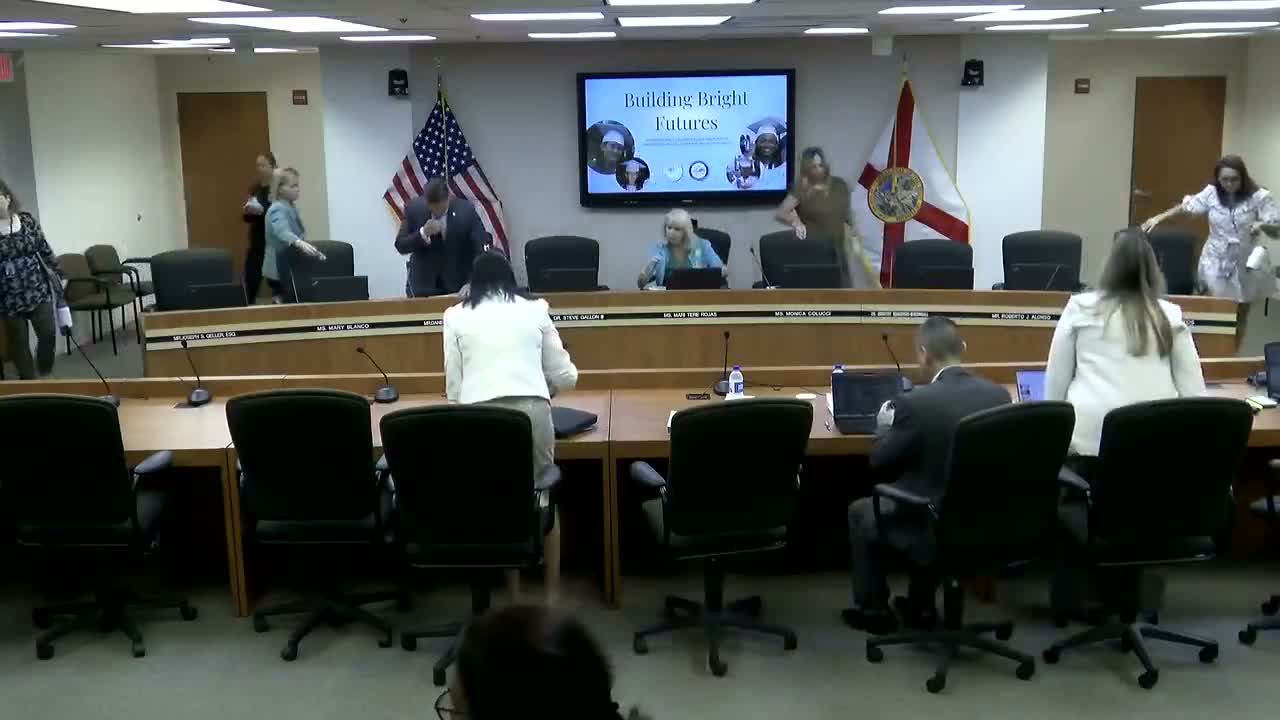
Miami‑Dade County Public Schools staff on Sept. 17 presented an overview of the district’s Early Childhood Education Excellence Framework and outlined plans to expand voluntary prekindergarten (VPK), Head Start and related early learning programs.A central aim of the framework is to increase access while maintaining program quality and accountability. Lynn Mercedes, Administrative Director for the Department of Early Childhood, said the district serves “nearly 10,000 students from birth to pre‑K” through programs that include VPK, Head Start and Early Head Start, and that the district currently operates nearly 400 VPK classrooms serving more than 6,000 VPK students.Staff described several program models and funding streams. Mercedes said some VPK classrooms are funded as Title I full‑day programs (state COE funds cover the state‑mandated hours and Title I funds support extended hours), while other VPK seats are fee‑supported. She outlined counts reported in the presentation: 211 Title I VPK classes across 147 schools; 88 fee‑supported VPK classes in 48 schools; Head Start VPK in 45 classes at 33 sites (31 schools and two homeless shelters); and a district total of 656 pre‑K classrooms across 231 schools.Metrics and accountability are central to the framework. Mercedes cited the Florida Early Learning Developmental Standards (FELDS) and a new district performance metric that combines CLASS classroom observations, FAST student assessments and learning gains. She said the CLASS observation is a two‑hour program assessment and that a classroom must score at least 4 out of 7 to retain a VPK program the following year. District CLASS averages were shown rising over recent years (reported averages of 5.11, 5.49 and 5.52).On kindergarten readiness, staff presented FAST assessment comparisons the district showed as: state 43% kindergarten readiness; all MDCPS kindergarten students 40%; students who attended any pre‑K 44%; and students who attended MDCPS VPK 49% — six percentage points above the state figure. Mercedes noted 140 schools received an “excellent” program designation this year and 45 were “above expectations.”The presentation included program innovations and partnerships. Mercedes described VPK Montessori and Reggio Emilia pilots, CTE early‑learning labs at high schools where adult and high‑school students support classrooms, a Transition to Kindergarten (TTK) program with three ambassadors serving 574 providers, and partnerships with United Way, AmeriCorps, local colleges and municipalities to expand capacity.Staff described recruitment and access strategies. Dr. Verena Cabrera, Enterprise Development Officer for Financial Services, reviewed demographic and enrollment data from Esri (sourced to Census data), the district’s strategic enrollment target of 9,020 for school year 2025–26, and a recent ITN to solicit external providers. Cabrera said the ITN and community meetings aim to bring private providers and developers into partnerships that could repurpose district spaces or add new centers.Board members used the workshop Q&A to press staff on expansion barriers and risks. Board member Espino asked whether program complexity hinders growth and what statutory fixes would help; the superintendent and staff said the primary barrier is funding. “If we were able to get full‑time VPK … that would be one mechanism,” the superintendent said, adding expansion of school‑readiness voucher eligibility as another avenue and concluding, “It’s a matter of money.”Board members also pressed on infant/toddler (0–2) expansion and facility costs. Staff said the district will initially concentrate on adding 3‑year‑old seats and pilot 0‑2 offerings in select high‑school lab sites (for example, Hialeah Gardens Senior High and Coral Gables Senior High) and that infant/toddler programs are the most expensive to operate; any broader 0–2 expansion would likely be fee‑based unless new funding became available.Questions about third‑party roles drew assurances that developers and private providers would be partners in converting spaces and operating programs. Staff said the district will weigh space availability, local provider activity, fill rates and census data when deciding where to add or scale back programs.Board members raised policy and equity concerns. Santos and Dr. Bendros Menengal urged guardrails against federal funding cuts and closer focus on districts with low median household incomes; Dr. Menengal described deep needs in District 2 and requested site walkthroughs to better align services. Staff said the demographic visuals came from Esri/Census and that a demographer has been added to improve local analyses.Staff emphasized family engagement and classroom practices. Mercedes said materials and outreach are provided in three languages, family case specialists support wraparound services in Head Start, and classroom practice balances short computer practice (about 15 minutes/day for Waterford) with developmentally appropriate play (about one hour/day).Next steps: staff will continue community meetings tied to the ITN, task‑force work across departments to implement expansion, and follow‑up with board members on site‑specific questions. No formal board votes or policy changes occurred during the workshop.