Get Full Government Meeting Transcripts, Videos, & Alerts Forever!
Get email alerts on the Prosecutor Office Reform topic
No spam. Unsubscribe anytime.
St. Louis County prosecutor outlines audit response, new units and tech reforms to cut backlog and prioritize victims
Summary
Prosecuting Attorney Melissa Price Smith told the County Council's Committee of the Whole on Aug. 25 that her office tightened purchasing and timesheet controls, created specialized violent-crime and homicide teams, launched online warrant and search-warrant portals and cleared a backlog of roughly 6,000 review packets.
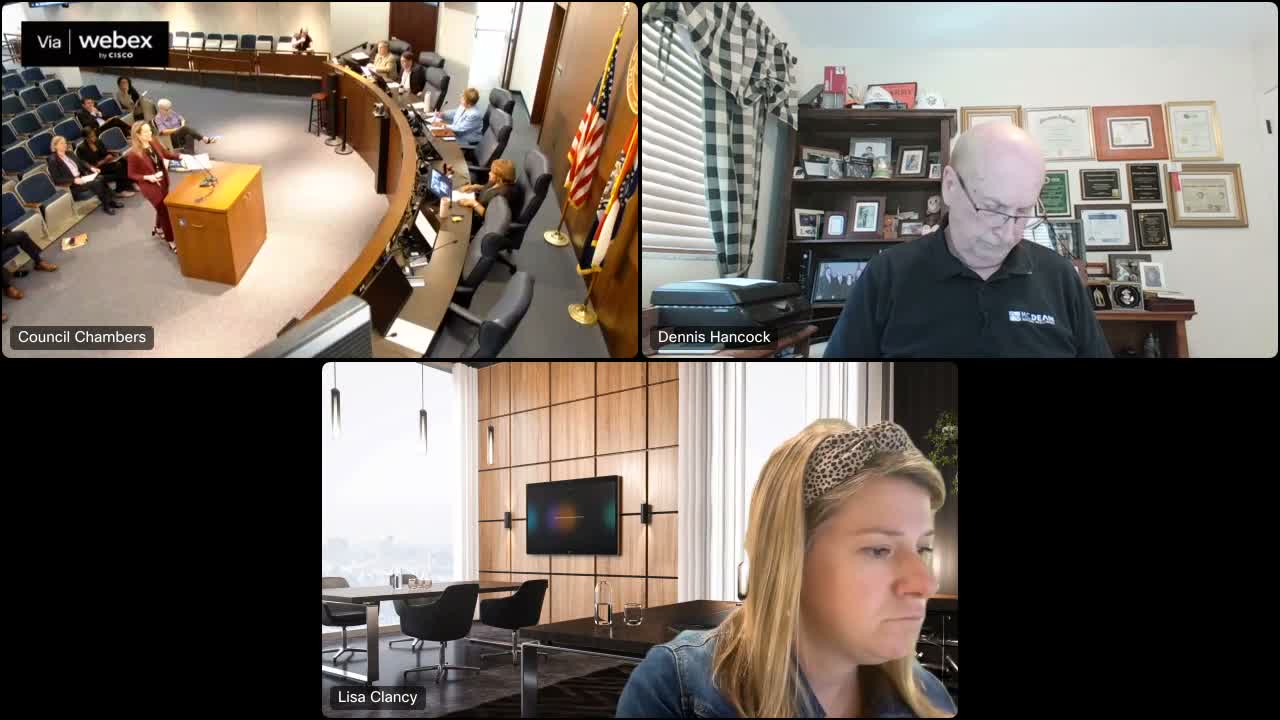
Prosecuting Attorney Melissa Price Smith told the St. Louis County Council Committee of the Whole on Aug. 25 that her office enacted a series of administrative and operational changes after she took office in January, emphasizing a shift to a "victim-centered" approach and moves intended to speed case review.
Smith said the office immediately enforced existing food and travel rules, that attorneys do not carry office credit cards and that most intern and grand-jury meals are paid from discretionary funds. She said the office implemented a mandatory supervisor signature on all time sheets effective Jan. 10, 2025, and required staff to use paid time off for outside employment during work hours.
Smith outlined several prosecution units she reconstituted or created after being sworn in Jan. 3, 2025: a reinstated violent-crime unit, a dedicated homicide unit led in part by Mike Riley (recruited from the U.S. Attorney's Office), a special victims unit (renamed SVU to include elder-abuse cases), a hospital-violence unit, a domestic-violence team under new leadership, and a retail-theft unit focused on organized theft rings. "We are trying to become a true victim-centered office and putting victims first as a priority," Smith said.
Smith said the office has about 260 pending homicide cases and that the homicide unit and other specialized teams now make charging decisions more quickly. To speed processing across felonies, she said the office reassigned existing attorneys so two prosecutors are now assigned to every felony courtroom.
On gun cases, Smith announced a policy shift: "No longer in our office are we offering probation on gun cases," she said, while adding that sentencing and charging still depend on an individual's prior record and case facts. She described that a first-time offender might receive a short jail term while a defendant with an extensive violent history could face decades in prison.
In response to council questions about jail overcrowding, Smith said the office is coordinating with pretrial services, the jail and the public defender's office to improve pretrial monitoring so prosecutors can safely recommend lower bonds where appropriate; she also noted the recent resignation of the jail director.
Smith and staff described two technology rollouts intended to cut delays. Tanisha Stubblefield said warrant applications for non-incustody arrests are now submitted electronically through the county PBK portal; she said departments began onboarding in March and that the crime lab now uploads analysis results into the same portal. The office also partnered with circuit courts on an "Easy Justice" component called Easy Warrant that allows officers to apply for search warrants from the field and receive near-immediate judge review and signatures.
Smith credited volunteers and weekend review teams with addressing a backlog of roughly 6,000 packets municipal departments had sent for review; she said some packets resulted in charges, others were dismissed for lack of evidence or statute-of-limitations reasons. She said the office will run two grand juries meeting Tuesdays and Thursdays beginning in about two weeks to speed case issuance.
The office also described cost-saving steps after an internal inventory found 28 active iPads and 19 cell phones that were unused; the county savings from deactivation was estimated at about $15,000 a year. Smith said continuing-legal-education sessions are now hosted in-house on Fridays to reduce training costs.
On enforcement programs, Smith said non-support (child support) cases have increased 79% since Jan. 1, 2025, and the office partners with the Urban League and other reentry programs to connect defendants with jobs. She said the office is developing a post-charge diversion track for lower-risk defendants that would give prosecutors time to monitor compliance before dismissing cases.
Council members asked detailed questions about timesheet spot checks, device inventory, the pace of clearing the backlog, staffing levels and the role of HR in hiring. Smith said the office currently employs about 75 attorneys and roughly 130 total staff including investigators and support staff; she said vacancy levels are small and the budget alignment is being managed with Don Geild and Ben Klus on the budget team.
The Committee made no formal policy vote at the meeting. A motion to adjourn carried unanimously and the meeting ended after the presentation and Q&A.