Get Full Government Meeting Transcripts, Videos, & Alerts Forever!
Get email alerts on the Carbon Capture Regulation topic
No spam. Unsubscribe anytime.
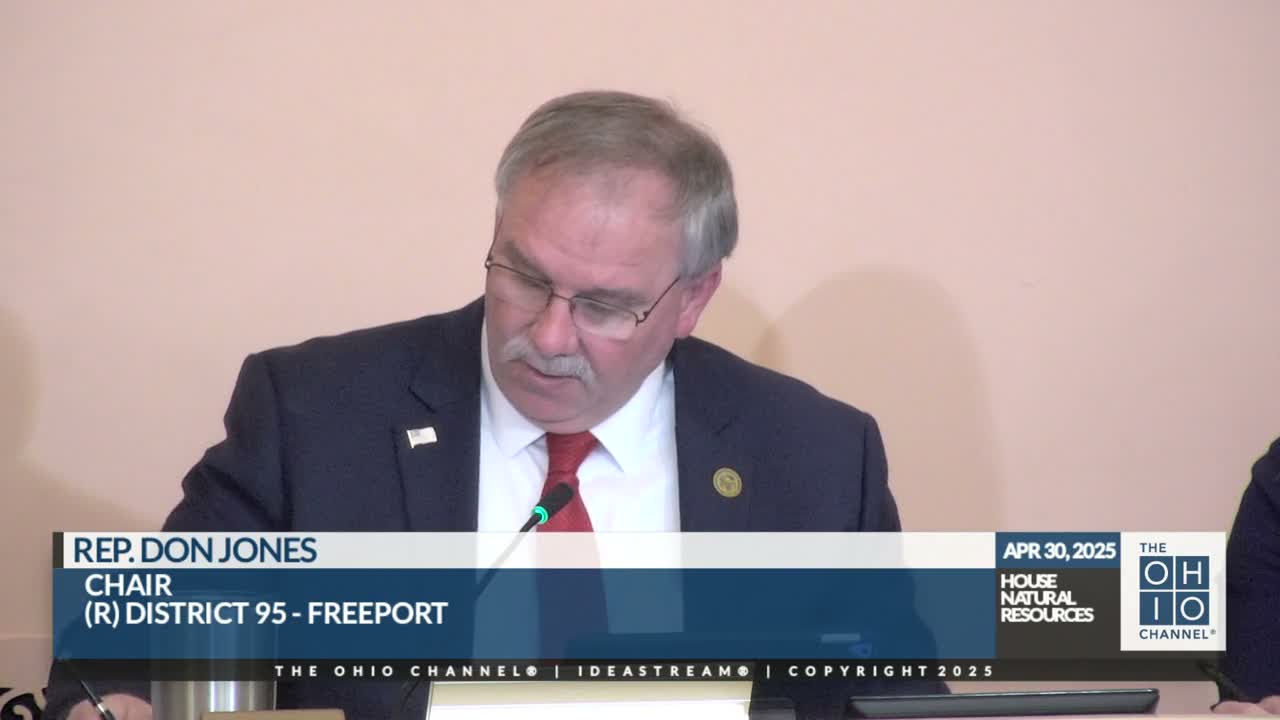
Committee hears industry and technical support for state regulation of carbon-capture wells (HB 170)
Summary
At a second hearing on HB 170, industry groups and technical experts told the House Natural Resources Committee that statutory changes are needed for Ohio to seek Class 6 primacy for carbon capture and sequestration; witnesses discussed pore-space leases, a 70% consolidation threshold, 50-year post-closure monitoring, financial assurance funds, and potential regional economic benefits. Committee members pressed on safety, acreage, and local approval.
The House Natural Resources Committee held a second hearing on House Bill 170, which would add statutory and regulatory language to the Ohio Revised Code to enable the state to seek primacy over U.S. EPA Class 6 underground injection control wells for carbon capture and sequestration (CCS).
Christina Polowalski of API Ohio told the committee HB 170 would create predictable state rules to streamline project development, mitigate environmental risks and build public confidence in CCS. "House Bill 170 would create some of the regulatory building blocks needed in the Ohio Revised Code to obtain primacy," she said, and identified provisions on surface-owner pore-space rights, notification to mineral owners, consolidation across property boundaries and operator funding of long-term monitoring.
Stephanie Cromer of the Ohio Oil and Gas Association described technical standards the bill would establish (pore space, notice, liability) and noted that while the U.S. EPA currently regulates CCS in the absence of state primacy, Ohio would gain a competitive advantage for projects if it met federal minimum standards and obtained primacy.
Technical witnesses expanded on permitting, capacity and monitoring. Andrew Duguid (Advanced Resources International) cited an eastern Ohio study estimating storage on the order of 3.4 gigatons in that study area and said major storage projects can involve "tens of thousands of acres." He and other witnesses described operational monitoring during injection and a U.S. EPA default of 50 years of post-injection monitoring before liability transfers to the state, subject to technical review.
Tenaska's testimony described the Tri-State/Buckeye hub spanning Ohio, Pennsylvania and West Virginia and presented economic-impact estimates for the Buckeye portion, including construction spending and county-level projections for Carroll, Harrison and Jefferson counties. Dallas Gerber (Growth Energy) and representatives of smaller Ohio operators described how state primacy and a clear statutory framework would help bioethanol and other industries access CCS and related markets.
Committee members repeatedly pressed witnesses on safety and public protections: where wells could be sited, whether they can be drilled under aquifers or water bodies, seismicity monitoring, how much acreage a unit would include, lease and royalty terms for pore-space agreements, and how long or by what mechanism liability and monitoring would be funded. Witnesses said operators would provide financial assurance (insurance, bonds or funded mechanisms) before construction; the bill would create fees to support program administration and a legacy fund to cover post-closure liabilities if needed.
The hearing concluded with no committee vote. Committee members requested additional technical details about unit sizes, lease terms, oversight capacity at ODNR and the interaction of state and federal permitting as the legislature continues to consider statutory language.