Get Full Government Meeting Transcripts, Videos, & Alerts Forever!
Get email alerts on the Carbon Capture topic
No spam. Unsubscribe anytime.
Ohio sponsors seek state control of carbon‑capture permits to speed projects
Summary
Sponsors of House Bill 170 told the House Natural Resources Committee the bill would give Ohio 'regulatory primacy' over UIC Class VI injection wells for carbon capture and storage (CCS), arguing federal permitting is slow and that state control will protect Ohioans and attract investment. No vote was taken.
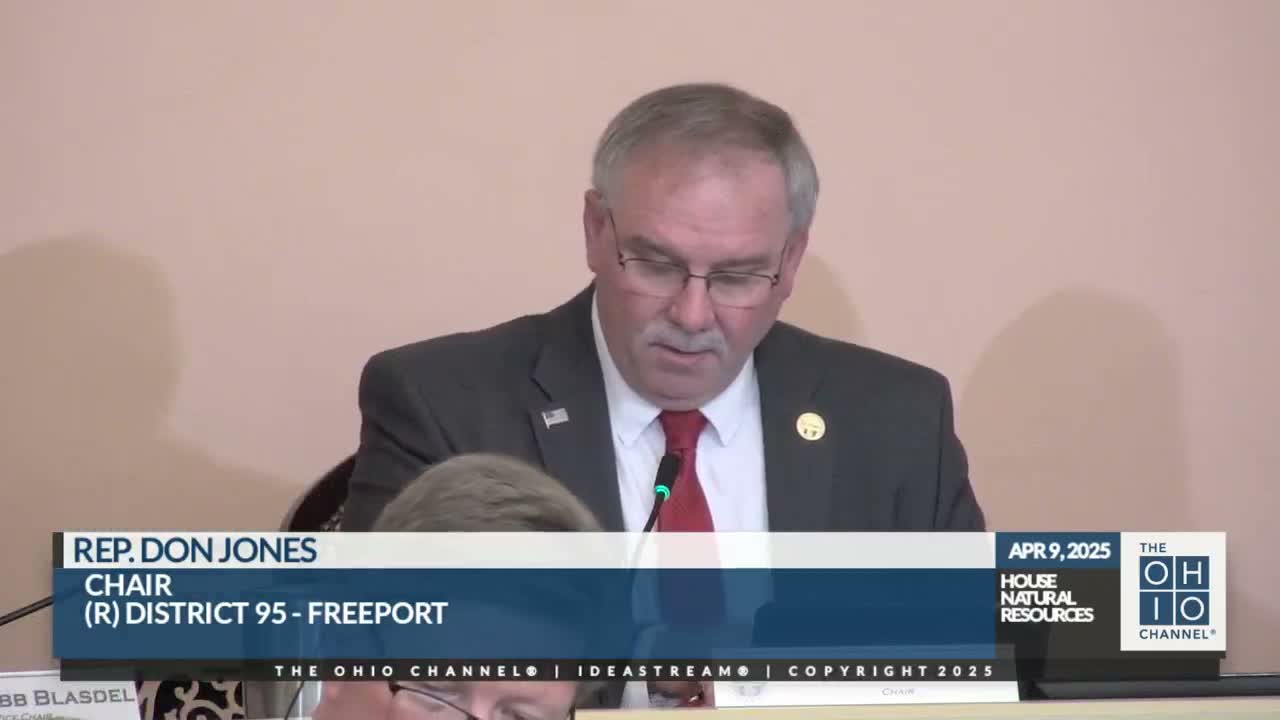
Representative Blaisdell and Representative Peterson urged the House Natural Resources Committee to advance House Bill 170, which would create a state regulatory framework to assume permitting and oversight of carbon capture and storage (CCS) injection wells currently regulated by the U.S. Environmental Protection Agency. The sponsors framed the change as a bid to speed permitting and keep economic benefits in Ohio.
"This bill will help Ohio to gain regulatory primacy of UIC Class 6 injection wells," Representative Peterson told the committee, saying that allowing the state to regulate CCS projects would ensure "the process from start to finish is done by Ohioans for Ohioans." Representative Blaisdell added that federal permitting has produced "years long delays" that can deter investment.
The sponsors said the bill is modeled on legislation adopted by other states, naming North Dakota, Wyoming, Louisiana and West Virginia as examples that have pursued primacy to attract industry investment. Representative Peterson said Ohio's geology — including porous shale formations in the tri‑state area — makes parts of the state suitable for storage and that ODNR would be asked to develop rules and staffing to carry out state oversight.
Committee members questioned specifics the bill would set in statute and what state primacy would mean in practice. Representative Rayner asked about a 50‑year liability cap in the bill, asking how lawmakers determined that timeframe and whether it was adequate to cover long‑term risks. Representative Peterson said the language is "modeled after what other states have done" and that the bill addresses liability, landowner rights and regulatory requirements.
Members also pressed whether the Ohio Department of Natural Resources (ODNR) could "ramp up" to assume federal duties and whether state and federal oversight could operate in tandem. Representative Peterson said ODNR "deals with these sorts of wells all the time" and suggested rulemaking and intergovernmental coordination would be part of implementation but deferred technical staffing questions to ODNR.
Representative Johnson asked whether the bill would mean more government grants or rely on private industry. Representative Peterson responded, "We just wanna be in the primacy state," and said private investment would remain private, with the state providing regulation rather than funding the projects.
Representative Workman asked about required seismic monitoring and local property risks; sponsors said monitoring is a typical safety measure modeled on current practice. Representative Fisher and others asked whether the bill would accelerate decarbonization by enabling industries such as power, cement and ethanol to deploy CCS; sponsors answered in the affirmative.
The hearing concluded with sponsors saying experts will be invited to a later hearing to address technical questions. No formal action or vote on the bill was recorded at this hearing.
What's next: Committee members requested additional technical testimony and written materials; sponsors signaled intent to bring expert witnesses back at a subsequent hearing.