Get Full Government Meeting Transcripts, Videos, & Alerts Forever!
Get email alerts on the Voting Methods topic
No spam. Unsubscribe anytime.
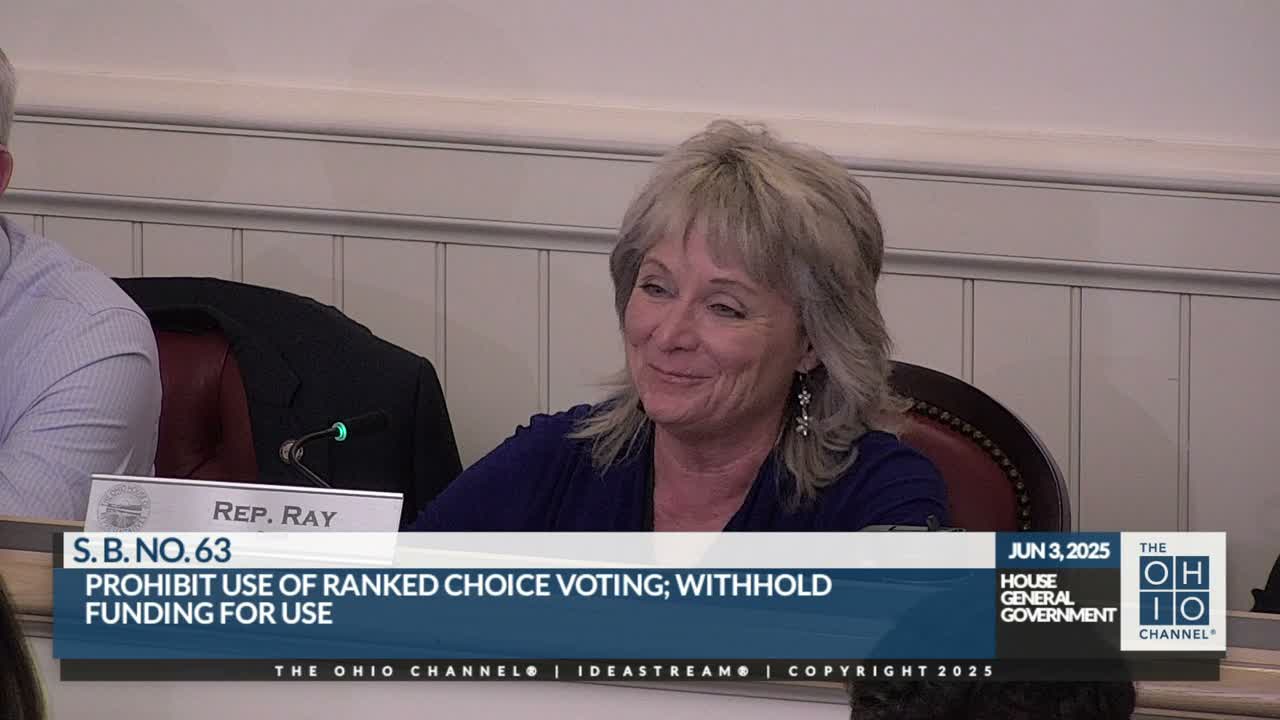
Sponsor of SB63 tells committee ranked‑choice voting would 'undermine' Ohio election transparency
Summary
Sponsor testimony at the House General Government Committee called for a statewide ban on ranked‑choice voting, arguing it delays results, confuses voters and reduces turnout; members raised historical and equity concerns and asked for citations and counterevidence.
Senate Bill 63, presented in a first hearing, would prohibit the use of ranked‑choice voting statewide except as limited by Ohio Supreme Court precedent for municipalities or chartered counties. The sponsor argued RCV — also called instant runoff voting — can delay results, complicate tabulation, confuse voters and in some cases reduce turnout.
"Ranked choice voting flies in the face of that common sense work by causing greater uncertainty, delayed election results that can take days or even weeks to settle," the sponsor testified, citing examples from other jurisdictions and noting that measures to adopt RCV were rejected in five states in 2024. The sponsor also described historical and recent local examples where RCV produced tabulation complaints.
Members asked about the bill's opponents and motives. Representative Friend raised historical context about repeal efforts in the early 20th century and said the history included backlash driven by party bosses; Representative Manning asked about the identity and arguments of organized opponents. Several members also asked whether the proposal would entrench the two‑party system; the sponsor said current primaries and general elections already provide choices and argued the bill preserves existing processes and transparency.
No committee vote was taken at the hearing; the committee closed the session after questioning. Sponsors said they would provide citations and documentation supporting claims about turnout and tabulation errors in RCV jurisdictions in follow-up.