Get Full Government Meeting Transcripts, Videos, & Alerts Forever!
Get email alerts on the Budget Lsc topic
No spam. Unsubscribe anytime.
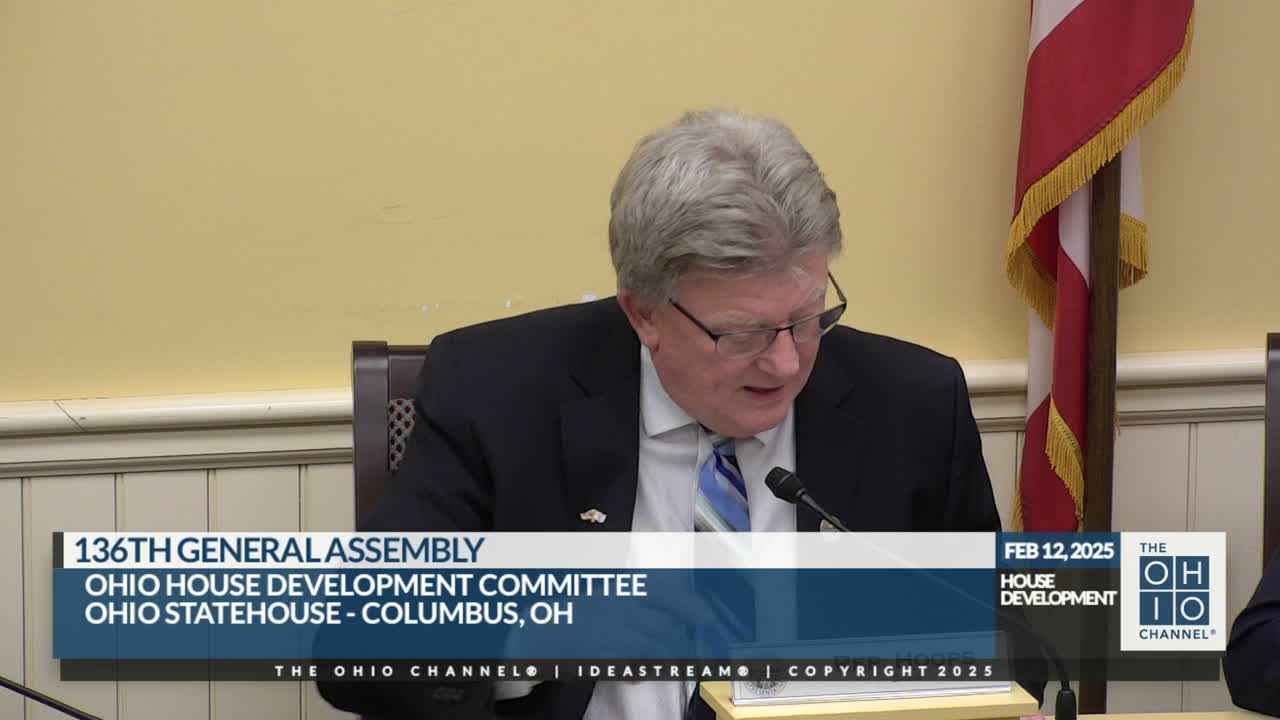
Legislative Service Commission presents biennial budget, cites staffing and one‑time costs
Summary
The Legislative Service Commission told a House Development Committee it requests largely flat funding for the next biennium, highlighted staff workload and one‑time equipment and carryover items affecting FY25–26 estimates, and urged members to consult House Bill 96 and the committee 'red books'.
The Legislative Service Commission urged the House Development Committee to maintain near‑level funding for its agencies while highlighting personnel costs and one‑time items that affect budget-year estimates.
Wendy Zhang, director of the Legislative Service Commission, told the committee the LSC budget package covers three related agencies — LSC, Legislative Information Systems (LIS) and the Correctional Institution Inspection Committee (CIIC) — and that the proposed funding levels are ‘‘largely held at the respective current fiscal year's funding level.’’ She said the LSC currently has about 145 staff and that ‘‘almost 96% of the LSC budget went to employee personnel costs last fiscal year.’’
Zhang walked members through recent workload figures intended to illustrate demand on staff: for the last budget cycle LSC drafted 8,770 amendments for House Bill 33, responded to more than 21,000 bill- and amendment-related requests, and produced roughly 40,000 letters of commendation and honorary resolutions. She also noted some increases shown in FY25 estimates reflect one‑time equipment purchases and unspent amounts that can carry forward into FY26.
Representative Glassburn raised members’ concerns about the timing of the committee’s "red books," saying members received some packets about an hour before the hearing. Zhang explained that the first batch of red books is posted only after the governor’s budget bill is officially introduced — in this case shortly after House Bill 96 was filed — and that staff try to post materials as early as possible.
On a question about a $100,000 line item for the redistricting task force, Zhang said the administration put $100,000 into the FY26 estimate and that language in the bill allows any unspent FY25 balance to carry over; she estimated, without providing a precise figure in the hearing, that the carryover could be ‘‘about over, like, a $4,000,000.’’
Zhang and committee members also discussed LIS’s role in technology and whether artificial intelligence could be used to improve services; Zhang said LSC and LIS are ‘‘looking into it’’ and evaluating where technology can increase proficiency.
The committee recorded no formal vote on the budget request at the hearing; the chair closed by thanking Zhang and moving on to the next witness. The committee also approved last week’s minutes by unanimous assent at the start of the meeting.