Get Full Government Meeting Transcripts, Videos, & Alerts Forever!
Get email alerts on the Licensure Oversight topic
No spam. Unsubscribe anytime.
State Medical Board of Ohio tells committee telehealth prescribing trends worry regulators; board outlines compacts and operational changes
Summary
State Medical Board Executive Director Stephanie Luca told the House General Government Committee the board is tracking rising telehealth prescribing trends, implementing an emerging-practice committee, and exploring use of automation and AI for complaint triage while noting confidentiality and out-of-state subpoena challenges.
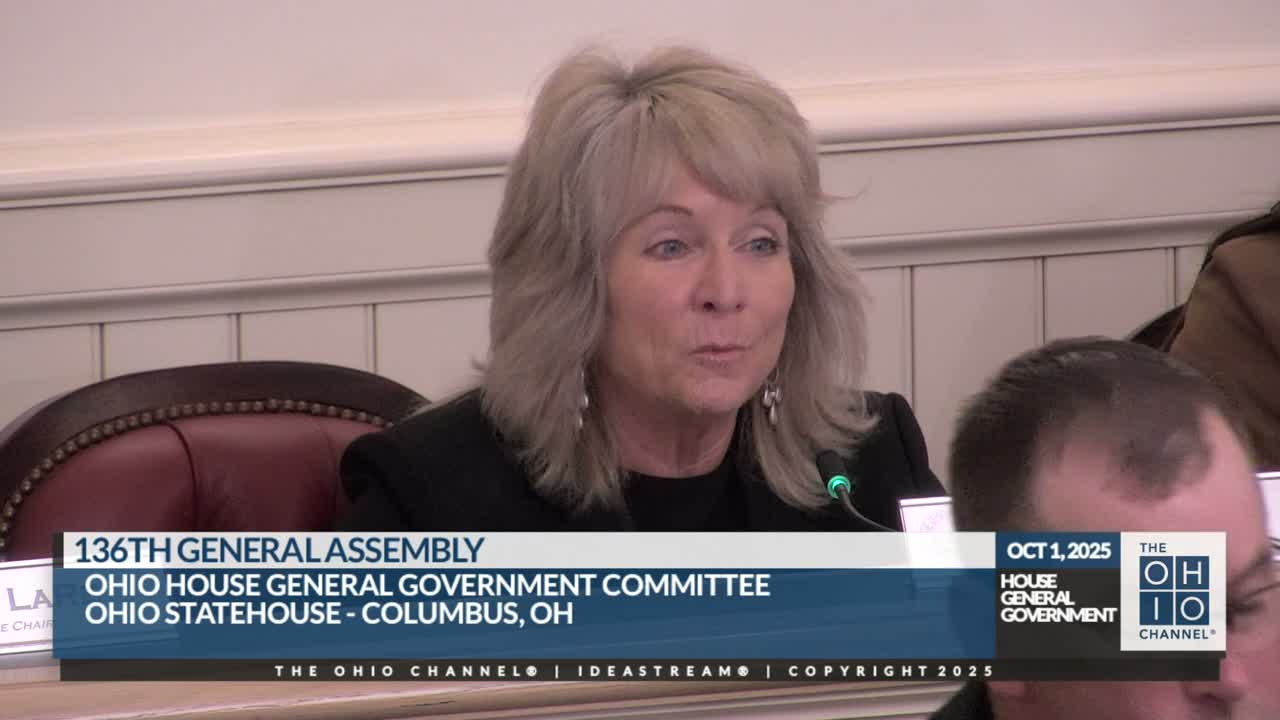
Stephanie Luca, executive director of the State Medical Board of Ohio, provided the committee with an operational overview of the board and described new and growing regulatory challenges tied to telehealth and interstate licensure compacts.
Luca said the board licenses and regulates more than 103,000 health-care professionals, has roughly 83 staff across six departments, and has seen a 13% increase in licensees since 2019. She told the committee the board created an "emerging practice trends" committee in September 2024 to study rapidly changing care models — including ketamine clinics, telehealth prescribing, weight-loss medication practices, hyperbaric oxygen therapy and retail IV therapy — and that joint guidance with the Boards of Nursing and Pharmacy has followed for retail IV clinics.
On compacts, Luca said physicians who enroll in the Interstate Medical Licensure Compact pay $700 to the compact itself; Ohio does not receive that $700. When Ohio is the state of principal licensure it receives a separate processing fee (Luca said about $250) to perform background checks and related work. She said compact participation has grown license volume and introduced operational complexity because compacts require unique disciplinary and operational processes across states.
Committee members pressed on telehealth standards and supervisory arrangements for advanced practice providers working across state lines. Luca said the board believes telehealth should meet the same standard of care as in-person visits but that, in practice, the board is seeing concerning prescribing trends — for example, marked increases in some age groups for stimulant prescribing tied to telehealth — and that investigations often require working across state lines where subpoena authority and access to records can be limited. She encouraged practitioners and constituents to file complaints so the board can investigate.
Luca also described recent performance improvements: the board reduced average review times for standard-of-care complaints (from about 300 days to roughly 150 days, she said) and completed over 1,800 investigations in fiscal year 2025. She explained the board is not yet using AI to process complaints but is participating in national work groups to design safe uses of machine learning for initial complaint analysis and investigator prioritization, emphasizing the confidentiality and health-records protections required.
Luca closed by noting the board's confidential monitoring program (Ohio Professionals Health Program) monitors approximately 300 licensees under the new program and that recent statutory changes (mentioned in the transcript as Senate Bill 109 and House Bill 33) expanded reporting requirements, shortened reporting timelines and added automatic suspension authority for certain felony charges.
Next steps: Luca said the board will continue to study telehealth trends and potential legislative or rule changes and will return to the legislature with recommended guardrails if needed.