Get Full Government Meeting Transcripts, Videos, & Alerts Forever!
Get email alerts on the Respiratory Care License topic
No spam. Unsubscribe anytime.
Sponsors argue new APRT license would expand cardiopulmonary workforce; reimbursement and rural deployment questions remain
Summary
Representatives John and Young introduced a bill to create an advanced practice respiratory therapist (APRT) license intended to boost cardiopulmonary care access; sponsors cited accreditation and workforce shortages, while members asked about reimbursement, rural incentives and overlapping career pathways.
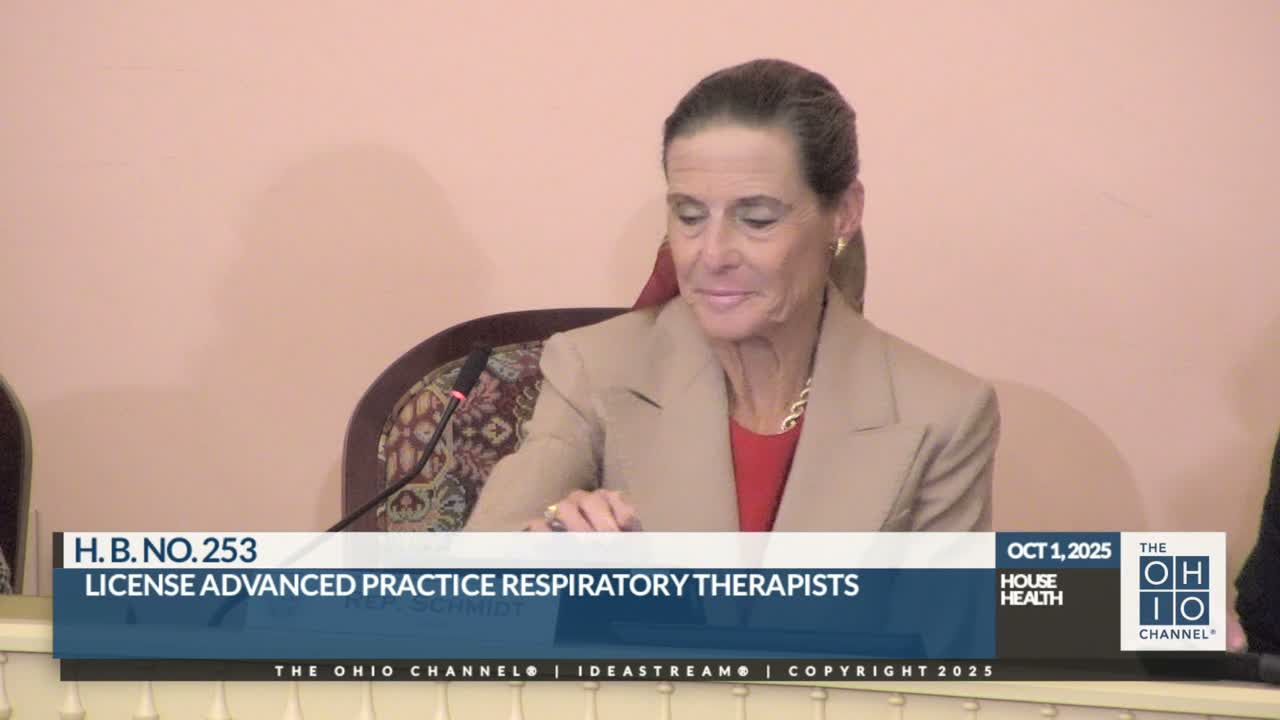
Representatives John and Young testified in support of House Bill 253 before the Health Committee, describing a new advanced-practice credential — the advanced practice respiratory therapist (APRT) — to increase access to cardiopulmonary care and provide a career ladder for respiratory therapists.
Representative John said APRTs would be master’s-level clinicians who practice under the supervision of physicians specializing in cardiopulmonary disease and would not be authorized to prescribe certain home-going controlled substances. She noted the Ohio State University launched a relevant graduate program that received APRT accreditation from the Commission for Accreditation of Respiratory Care in 2019 and that the bill was crafted with the Ohio Society for Respiratory Care using national curriculum standards and referencing the Ohio Respiratory Care Law, ORC 47 61.
Representative Young said sponsors had met stakeholders over multiple years, reached common ground, and believed the licensure path would strengthen the pipeline and service availability. He cited concerns surfaced during the COVID-19 pandemic that highlighted the need for expanded respiratory care roles.
Committee members pressed sponsors on specifics: Representative Baker asked how the new licensure would fill gaps compared with bolstering existing credentials and questioned whether incentives could steer APRTs to underserved rural areas. Vice Chair Dieter asked whether reimbursement for APRT services would be available; sponsors deferred reimbursement and detailed payment questions to forthcoming expert testimony. Representative Gross asked whether APRTs would duplicate other pathways (PA, APRN, physician) and whether the proposal risked turf conflicts. Sponsors framed the proposal as adding an additional option and career advancement rather than supplanting existing routes.
The first hearing closed after testimony and member questioning; no committee vote occurred on HB 253 at this meeting.