Get Full Government Meeting Transcripts, Videos, & Alerts Forever!
Get email alerts on the Crna Scope Modernization topic
No spam. Unsubscribe anytime.
Substitute HB52 would clarify CRNA practice, preserve physician-led care and tie ordering authority to collaboration
Summary
Substitute House Bill 52 would consolidate and modernize Ohio's CRNA statute: define collaboration, require facility privileging, move ordering of anesthesia-related drugs into scope tied to a physician's request, and explicitly preserve physician-led oversight; witnesses cited workforce pressures and high CRNA involvement in anesthesia care.
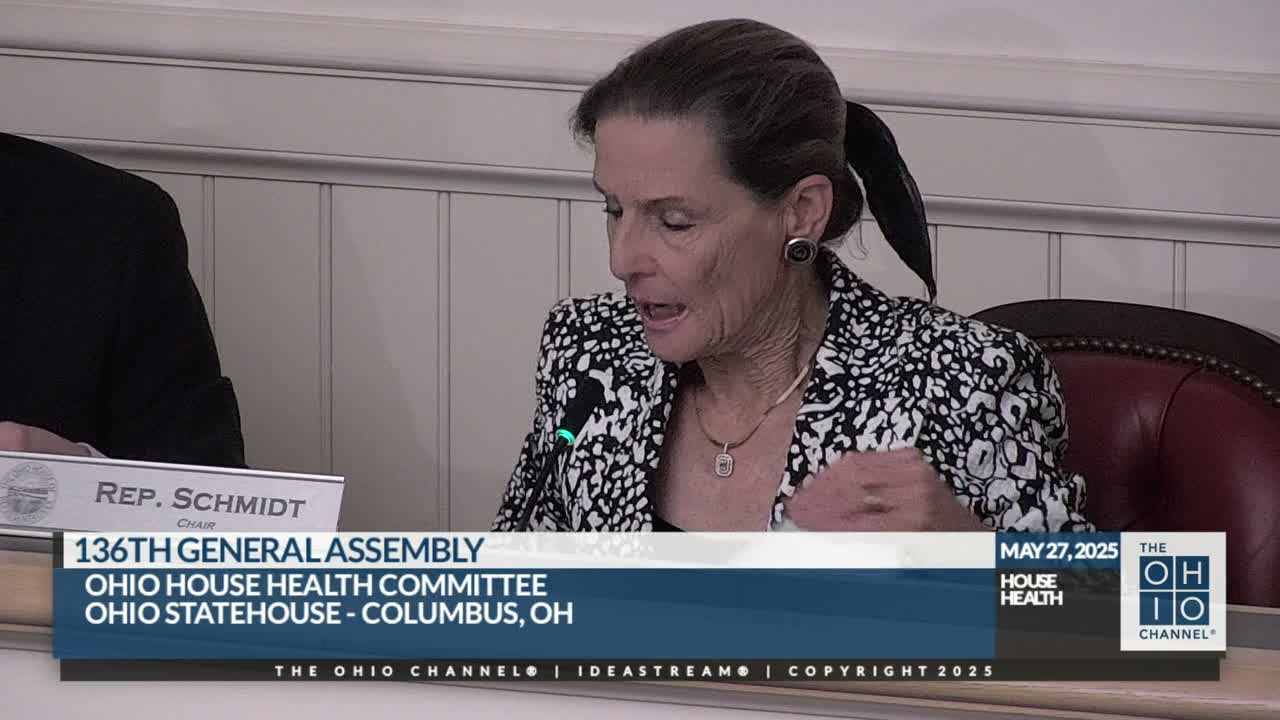
Supporters told the House Health Committee that substitute House Bill 52 updates a century-old statute to better reflect how anesthesia care is delivered and regulated. Sponsors said the bill does not expand CRNA scope of practice but clarifies authority, defines "health care facility," and ties ordering authority for anesthesia-related drugs and procedures to a collaborating physician's verbal or written request.
"Substitute House Bill 52 does not expand the CRNA scope of practice, but rather it explicitly recognizes and clarifies it," the sponsor said. The bill replaces ambiguous terms such as "supervision" with "collaboration," defines what collaboration means in practice, and retains the requirement for physician physical presence during key phases of anesthesia care.
Proponent testimony from Dr. Gerald Zalgowski, chief of anesthesia at the Institute for Orthopedic Surgery, described practice at a high-volume surgical hospital and said CRNAs work in collaboration with physicians to manage the full anesthetic continuum. Dr. Zalgowski told the committee his facility performs nearly 8,500 surgeries annually and that CRNAs are credentialed to perform nerve blocks and other anesthesia tasks within facility-granted privileges.
Witnesses and sponsors offered workforce data and practice context during questioning: testimony cited roughly 3,000 CRNA licensees in Ohio; Medicaid and CMS billing data were referenced to say about 37% of anesthetics are delivered by CRNAs as sole providers and 53% in care teams, for a combined share around 90%. Sponsors also said CRNAs perform an estimated 85'90% of labor epidurals in Ohio, and members asked about pediatric privileges, liability allocation, privileging processes and training differences between CRNAs and anesthesiologists.
Committee members pressed for details about credentialing and facility-level privilege delineation; sponsors said the bill requires individual privileging at each facility and leaves credentialing and privileging to medical staff committees. On liability, sponsors explained that each licensed provider remains responsible for their own clinical decisions unless they are directed by a collaborator to perform something they deem unsafe; CRNAs are not required to comply with an instruction they judge unsafe.
The chair closed the first hearing and said further proponent and opponent testimony will follow in subsequent sessions.